
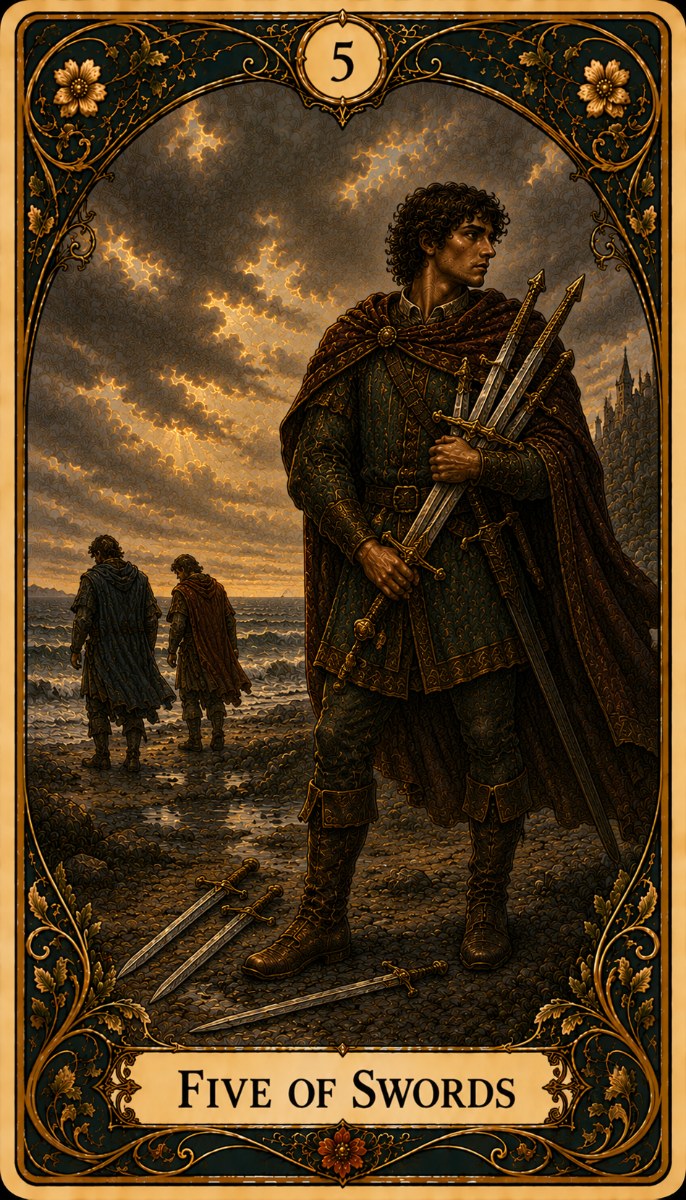
Five of Swords yes or no is a no — but it's the deck's strangest no, because this card doesn't always say you can't get what you asked for; it says that getting it, in this situation, costs more than it returns. The image explains the mechanism: a smirking figure collecting swords from a battlefield while the defeated walk away — someone technically won, and the win emptied the field of everything worth having. That hollow-victory logic plays out differently for love, reconciliation, and career questions — and reversed changes it meaningfully — so read past the headline no to the version that matches what you asked. browse yes or no tarot answers
Does Five of Swords Mean Yes or No?
For a general question, the Five of Swords is a no. In practical terms, it says the situation you asked about is contaminated by conflict — open or simmering — and that outcomes reached through this energy arrive damaged: the agreement that breeds resentment, the point proven at the price of the relationship, the thing obtained that stops being wanted the moment it's held. If you asked "will it work out," the honest answer is no — not necessarily because the thing can't happen, but because "working out" and "this situation as it currently stands" have parted ways.
The reasoning comes from the card's structure. Fives in tarot represent instability and strife — the comfortable four disrupted — and Swords rule the mind and words, so the Five of Swords is conflict fought with intellect and language: arguments won on technicalities, cutting remarks, strategy deployed against someone who was supposed to be on your side. What makes it uniquely tricky as a yes/no card is that it contains a victory. Someone in the image got what they wanted. The card's verdict on that victory is the whole answer: look at the winner's field — empty, cold, everyone else leaving. The Five of Swords doesn't say the win is impossible. It says the win is worthless, which for practical purposes is a firmer no than impossibility.
On the yes-no-maybe spectrum, this sits at the no end with one context-dependence worth naming plainly: which figure in the card is you. If you're the one holding the swords — pushing to win, strategizing, keeping score — the no is a warning: stop, because the prize is hollow. If you're one of the figures walking away — outmaneuvered, dealt with in bad faith, worn down by someone who has to win — the no is a release: the walking away is the right move, and the card is confirming that this fight was never winnable on fair terms. Same card, same no, two very different instructions.
Knight of Swords Yes or No: Fast Yes, Check the Speed, Page of Swords Yes or No: Watching, Not Moving Yet and Ten of Swords Yes or No: A Final, Finished No
Four of Swords Yes or No: Not Yet — Rest First, Three of Swords Yes or No: An Honest No, Two of Swords Yes or No: Not Until Someone Decides and Five of Swords as How Someone Sees You: Conflict
Five of Swords Reversed — Yes or No?
Reversed, the Five of Swords softens — it does not flip to a clean yes. The reversal shows the swords being laid down: the conflict is ending or can end, resentment is releasing its grip, an old grievance is finally being walked away from, or both sides are tiring of a fight that neither can win. If you asked "can this be repaired" or "is the fighting over," reversed answers maybe, leaning hopeful — a truce is genuinely available, provided someone values the peace more than the point. That's a real improvement on the upright card, and it's the closest this card gets to good news.
The shadow reading keeps it honest: reversed can also mean a grudge held past its expiry — a conflict that officially ended but lives on in one person's ledger, resurfacing as cold remarks and kept score. The tell is whether anything has actually been released or merely gone quiet. Practical translation for a yes/no question: reversed upgrades the answer from "no, this is a battlefield" to "maybe, if the disarmament is real" — and the way to test whether it's real is to stop fighting first and watch whether the other side follows or reloads.
Five of Swords Yes or No for Love and Relationships
For love, the Five of Swords is a no — and it's a no about the dynamic more than the feelings, which is exactly what makes it worth reading carefully. Drawn on a new attraction, it warns that the connection carries bad faith somewhere in it: game-playing, an agenda, interest that's really about conquest — someone collecting swords, not building anything. Drawn on an existing relationship, it describes a bond that has become a scoreboard: arguments fought to be won rather than resolved, cutting remarks deployed and remembered, two people who may still love each other but have started treating each other as opposition. If you asked "is this good for me," the card answers no — not "the love is fake," but "the way this operates will keep costing you." Love can survive many things; it does not survive being permanently at war, and this card says the war is the current operating mode.
Five of Swords Yes or No: Reconciliation / Getting Back Together
For reconciliation, the Five of Swords is a no — and it earns the no by exposing the motive underneath the question, which is uncomfortable and useful in equal measure. When this card appears on "will we get back together," it asks you to check what's actually driving the wish: getting the person back, or winning — not losing them to someone else, not being the one who was left, proving you could reverse it. Reunions pursued in Five of Swords energy are campaigns, and campaigns can succeed: you can strategize someone back into your life. The card's verdict is that this version of success is the hollow win on the battlefield — you reclaim the relationship and the conflict pattern that ended it walks back in holding its hand.
The honest edge: if the breakup itself was a Five of Swords event — fought dirty, ended with cruelty, someone humiliated — the card appearing on the reconciliation question is generally saying the walking-away figures in the image have it right. Leaving a battlefield isn't defeat; it's the only move on a battlefield that doesn't cost you more. A reconciliation worth having would require both people to arrive without swords, and this card, upright, says at least one set of swords is still being carried.
Have this exact question? Will he come back?
Five of Swords Yes or No: Marriage or Commitment
For marriage, the Five of Swords is a no — and its reasoning is specific enough to act on. Drawn on "will he propose" or "should we commit," it says the commitment question is being asked inside a power struggle: a relationship where winning arguments matters more than resolving them, where one person habitually has to be right, or where the commitment itself has become a chip in a longer negotiation — leverage, ultimatum, prize. Formalizing a bond in that condition doesn't end the struggle; it gives the struggle a legal address. The card's answer isn't "never marry this person" — it's "not on this footing," and the difference matters.
The practical translation: the pre-commitment work this card demands is disarmament — the pattern of scoring and winning has to actually end, not pause for the proposal and resume after. If you can't currently disagree with this person without it becoming a contest someone has to lose, that's the answer to the marriage question, whatever the eventual ring says. And if you're trying to see whether the conflict pattern is fixable or structural, that's more than one card can tell you — a full love tarot reading can map the dynamic itself rather than just flagging it.
Five of Swords Yes or No for Career or Big Decisions
For career questions, the Five of Swords is a no with an asterisk that makes it one of the most practically useful cards in workplace readings. Asked "will I win the dispute," "will I beat out the competition," or "will I come out on top," the card frequently answers: possibly — and don't. This is the card of the argument won in the meeting that costs you the alliance afterward, the credit claimed that poisons the team, the political victory that marks you as someone to be managed around. In office terms, the Five of Swords says you can win the fight and lose the room, and losing the room is the more expensive outcome.
For decisions, the instruction is direct: if the option you're weighing only works by beating someone — outmaneuvering a colleague, exploiting a technicality, winning at someone's visible expense — the card answers no, because the cost lands later and larger. If instead you're the one being outmaneuvered — a bad-faith boss, a colleague who fights dirty — the card's answer borrows from the walking figures: some workplaces are battlefields, and the winning move is the exit, not a better sword.
Signs to Trust This Answer
- The situation you asked about already involves visible conflict — arguments, rivalry, tactics, kept score — because this card describes an active battlefield, and if you can point to the battle, the reading is grounded in something real rather than abstract.
- You can honestly identify which figure you are — the one collecting swords or the one walking away — within a few seconds of looking at your situation; a fast, uncomfortable answer to that question is the card landing exactly where it aimed.
- Winning has started to matter more than the original goal — if you notice you're now fighting to be right, to not lose, or to prove something, rather than for the thing you first wanted, that drift is precisely what this card flags.
- If you pulled more than one card, read the neighbors for the conflict's trajectory: a truce card beside it (Temperance, Two of Cups) means repair is closer than the Five alone suggests, while a deception card (Seven of Swords, The Moon) confirms the bad faith runs deeper than the surface argument.
- Your question contained the word "win" or its cousins — beat, get back at, come out ahead — because that framing is this card's home register, and its warning is most reliable when the question itself was framed as a contest.
Five of Swords Yes or No — Card Combinations
If you drew more than one card, the card beside the Five of Swords changes the strength or direction of the answer. Here are the most common combinations and what they indicate:
| Combination | What It Means for Your Yes or No Answer |
|---|---|
| Five of Swords + Ten of Swords | Confirms and hardens the no. The conflict runs to its complete end — this pairing says the battle you asked about finishes with a full stop, not a negotiated peace, and continuing to fight only determines how much it costs on the way there. |
| Five of Swords + Temperance | Softens the answer to a genuine maybe. A middle path exists: the conflict can resolve through compromise if both sides trade winning for settling — the no holds only as long as someone insists on total victory. |
| Five of Swords + Justice | Flips the answer for the person in the right. If you've been dealt with unfairly, this pairing says the dispute resolves correctly — the bad-faith tactics fail, the truth of the situation prevails, and the outcome lands where it should rather than where it was maneuvered. |
| Five of Swords + Four of Swords | Yes to resolution, but not yet — a ceasefire has to come first. Both sides need a genuine rest from the fighting before anything can be settled; attempts to resolve it mid-battle fail, while the same conversation after the pause succeeds. |
| Five of Swords + Seven of Swords | A strong double-confirmation of the card's hardest reading: the conflict involves genuine deception, not just heat. Someone in the situation is operating covertly as well as combatively — and the no this pairing produces is one to act on quickly, not litigate. |
This Does NOT Mean
The specific over-interpretation readers make with the Five of Swords is finding the loophole: the card contains a winner, so she reads it as "difficult, but I can win this" — and converts the deck's clearest warning into a strategy memo. She asks "can I get him back," sees the figure holding the swords, and hears "yes, if you play it right." The error is understandable, because the card genuinely does depict a victory; what gets skipped is the card's entire editorial position on that victory — the empty field, the departing figures, the win that consists of holding weapons nobody is left to fear. The Five of Swords isn't telling you the prize is out of reach. It's telling you what the prize weighs once it's in your hands.
The correction is to redirect the question the card is actually answering. It was never "can you win?" — winning is frequently available, which is the trap. The real question is "what does this specific way of winning leave you holding?" — and on that question the card is unambiguous. If getting what you want requires campaigns, leverage, or someone else's defeat, this card says the getting is the loss. And if you recognized yourself in the walking figures instead: the card isn't calling you a loser. In its universe, they're the only ones leaving the field with anything intact.
FAQ
What does Five of Swords mean as a yes or no card?
The Five of Swords means no. As a yes/no card, it signals conflict, bad faith, and outcomes that cost more than they return — including the deck's strangest scenario, where you get what you asked for and it turns out hollow. Its no is less "this can't happen" than "this shouldn't happen this way," which in practice is the firmer answer of the two.
Five of Swords reversed yes or no?
Reversed, the answer softens to a maybe — the swords are being laid down. The conflict is ending or can end, resentment is releasing, and a truce is genuinely available if someone values peace over the point. The shadow reading is a grudge that went quiet rather than away; test which one you have by stopping the fight first and watching whether the other side disarms or reloads.
Five of Swords yes or no for love?
No — and it's a no about the dynamic, not necessarily the feelings. The card describes a connection operating as a contest: scored arguments, cutting remarks, someone who has to win. For a new interest, it warns of game-playing or an agenda. The love may be real underneath, but this card says the current operating mode is a battlefield, and bonds don't survive permanent war.
Five of Swords yes or no relationship / reconciliation?
No — and the card asks you to check the motive first: is this about getting the person back, or about winning? Reunions pursued as campaigns can technically succeed, and the card's verdict is that this success is the hollow victory in the image — the relationship returns with its conflict pattern intact. If the breakup itself was fought dirty, the card sides with the figures walking away.
In the Five of Swords, am I the winner or the one walking away?
Ask which behavior is yours right now: if you're strategizing, keeping score, or fighting to be right, you're holding the swords — and the card is warning you the prize is empty. If you've been outmaneuvered, dealt with in bad faith, or worn down by someone who has to win, you're a walking figure — and the card is confirming the exit, not mocking it. Most people know within seconds; the discomfort of the answer is usually its accuracy.
Related Readings
Draw your own card with the Yes or No Tarot tool, or if you're still working out what you're really asking, start wider with a Free Tarot Reading.