
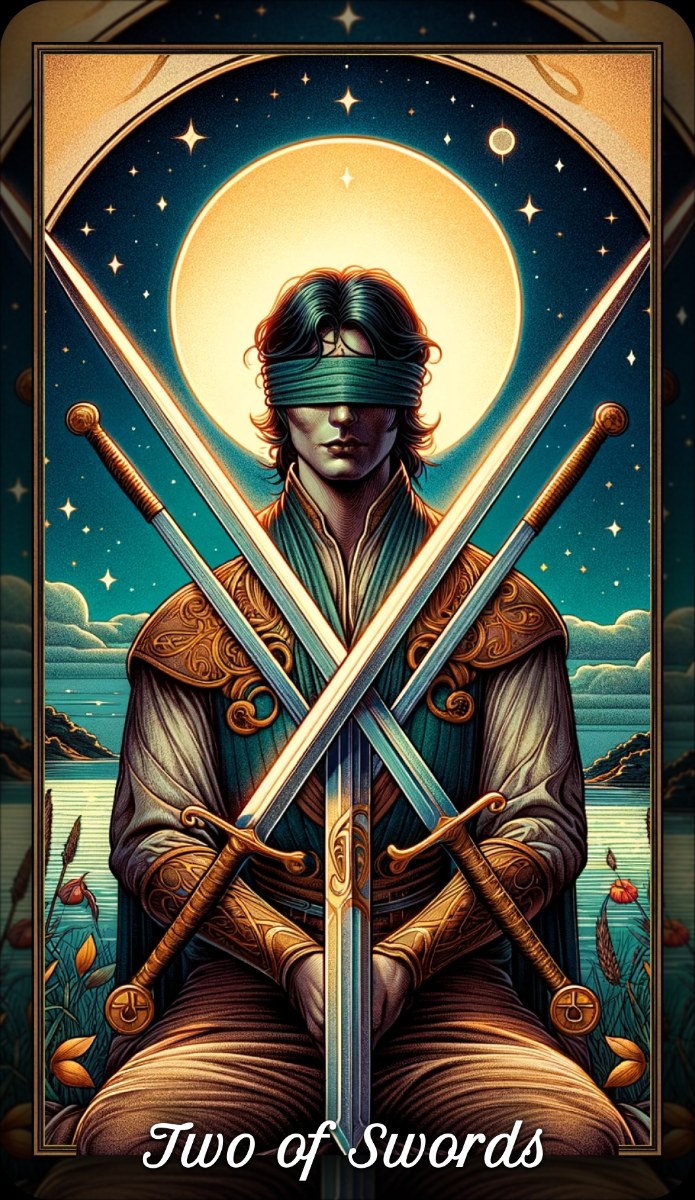
Two of Swords yes or no is a not-yet — the deck's clearest stalemate card, showing a situation frozen not by fate but by a decision someone is actively avoiding. The reason is right in the image: a blindfolded figure holding two crossed swords, deliberately not looking at the choice in front of her — the answer you're asking for exists, but it's locked behind that unmade decision. What the not-yet means, and crucially whose avoidance is causing it, shifts between love, reconciliation, and practical questions, so it's worth reading past the headline to the version that matches yours. all 78 cards yes or no guide
Does Two of Swords Mean Yes or No?
For a general question, the Two of Swords is a maybe that leans "not yet" — and it's important to hear that precisely, because this card is doing something unusual. Most cards answer your question; this one hands it back. It says the situation cannot resolve into a yes or a no right now because the resolution depends on a choice that hasn't been made — often by you, sometimes by the other person in the question, occasionally by both. If you asked "will it work out," the card's honest reply is: it hasn't been decided yet, and nothing moves until it is.
The reasoning comes straight from the imagery. Twos in tarot represent duality and choice-points, and Swords rule the mind — so the Two of Swords is the mind caught exactly between two options, blindfolded by preference. This is not confusion (that's The Moon) and not deadlock imposed from outside; it's a self-chosen pause. The blindfold in the card isn't tied on by someone else — the figure could remove it. That's the card's whole message in one detail: the information needed to decide is available, and it's being deliberately not-looked-at because both options carry a cost.
On the yes-no-maybe spectrum, this sits as one of the deck's most genuinely context-dependent cards — but don't mistake context-dependent for meaningless. The Two of Swords is highly specific about where your answer lives: behind a decision, in a conversation not being had, under a blindfold someone can take off. It refuses to predict which way the frozen situation will break, and it's honest of the card to refuse — because that genuinely depends on what the decider does next. What it does tell you, reliably, is that waiting passively for the answer to arrive on its own is the one strategy guaranteed not to work here.
Ace of Swords Yes or No: A Sharp, Clear Yes, King of Cups Yes or No: A Calm, Steady Yes, Queen of Cups Yes or No: A Yes You Can Feel and Two of Swords as How Someone Sees You: Guarded
Two of Swords Reversed — Yes or No?
Reversed, the Two of Swords breaks the stalemate — which makes this one of the rare cards whose reversal is arguably more decisive than its upright. The frozen "not yet" gives way to "now, ready or not": withheld information surfaces, mounting pressure forces the avoided decision, the fence someone has been sitting on collapses under them. If you asked "will I get an answer," reversed says yes, and soon — the limbo phase is ending because it has become unsustainable.
Be precise about what reversed doesn't promise: it doesn't tell you which way the breaking stalemate falls. The decision gets made, the truth comes out, the conversation finally happens — but the card is neutral on whether the resolution favors you. The practical instruction is to get ahead of it: if there's a decision you've been dodging or a conversation you've been postponing, make it or have it on your own terms now, because the reversed Two of Swords says it's about to happen with or without your cooperation, and forced decisions tend to be messier than chosen ones.
Two of Swords Yes or No for Love and Relationships
For love, the Two of Swords is a maybe — and here the blindfold is emotional. This card appearing on "does he have feelings" or "is this going anywhere" says the feelings question is genuinely undetermined: someone in the picture is guarding their heart, sitting on the fence, or refusing to examine what they actually feel because looking closely would demand action. That someone can be them — a person keeping you at arm's length while they avoid deciding what they want — or, more often than readers like to admit, it can be you, holding a connection at a safe distance so you never have to risk the answer. Within an existing relationship, the card points to an emotional standoff: two people being polite around an unaddressed issue, intimacy suspended behind crossed swords. The love isn't confirmed and isn't denied — it's blindfolded, and the card says it stays that way until someone looks.
Two of Swords Yes or No: Reconciliation / Getting Back Together
For reconciliation, the Two of Swords is a not-yet built out of a very recognizable standoff: both people waiting for the other to move first. This card on a "will we get back together" question rarely means the door is closed — it means the door is unlocked and nobody is touching the handle. Pride, hurt, and the fear of reaching out and being rejected have produced a perfectly balanced freeze: he won't text first, you won't text first, and the silence gets read by each side as the other's indifference when it's actually the other's identical hesitation.
Where this diverges from a plain maybe: the card locates the outcome inside the standoff itself. Reconciliation here is genuinely possible — the emotional stalemate only exists because something unresolved remains between you, and true indifference doesn't produce standoffs — but it will not happen by itself. One of you lowers a sword first or the freeze simply continues until it hardens into a real ending by default. The card won't tell you it should be you. It will tell you that "waiting to see what happens" is not a neutral option here; in Two of Swords territory, waiting is a decision too, and it decides toward no.
Have this exact question? Will he want me back?
Two of Swords Yes or No: Marriage or Commitment
For marriage, the Two of Swords is a not-yet with an uncomfortable but useful specificity: the commitment question you're asking has not been decided by the person you're asking about. If your question was "will he propose" or "is he ready to commit," this card doesn't say no — it says he is genuinely on the fence, weighing the step without resolving it, possibly avoiding the internal conversation altogether because both answers scare him. That's materially different from refusal, and it's also materially different from yes; treat it as an honest report of indecision rather than a coded version of either.
The practical edge: commitment stalemates rarely resolve through more patient waiting — they resolve through clarity, usually a direct conversation about where things are going. This card says that conversation hasn't happened, and its absence is the blockage. If the question underneath your question is really "should I keep waiting or ask him outright," the Two of Swords leans toward asking. And if the relationship itself is what you're weighing rather than one answer, a full love tarot reading will show you more of the terrain than a single stalemate card can.
Two of Swords Yes or No for Career or Big Decisions
For career questions, the Two of Swords is a "don't decide yet" — and this is the one context where its non-answer is straightforwardly good advice rather than frustrating. Drawn on "should I take job A or job B," "should I quit," or "should I accept the offer," the card says you're missing information that materially changes the choice: a detail about the role, a factor you haven't priced in, an option you haven't seen yet. Deciding now means deciding blindfolded, and the card's counsel is to take the blindfold off first — ask the awkward questions, get the terms in writing, talk to someone inside the company — before you commit.
The equally important second half: this is a pause, not a residence. The Two of Swords sanctions gathering facts; it does not sanction the indefinite deliberation that's really avoidance wearing a research costume. Set yourself a real deadline for the decision, get the missing information by then, and choose. The card's warning for careers is the same as everywhere else — stalemates left standing get resolved by other people, usually not in your favor.
Signs to Trust This Answer
- You can name the avoided decision or the unhad conversation within about ten seconds of drawing the card — if a specific "I know exactly what it's referring to" surfaced immediately, the stalemate reading is on target.
- The situation you asked about has been static for weeks — no movement in either direction, no escalation, no closure — because that suspended-animation quality is precisely what this card describes, and its presence in real life confirms the read.
- You asked a question whose honest answer depends on a choice — yours or theirs — rather than on external events; the Two of Swords is most accurate on human-decision questions and least relevant to pure-chance ones.
- If you pulled more than one card, check what surrounds it: a decisive neighbor (Ace of Swords, Judgement) means the stalemate is closer to breaking than the Two alone suggests, while a second static card (Four of Cups, The Hanged Man) confirms a deeper freeze.
- Notice your own reaction to the card's non-answer — if your impulse was to immediately draw again for a "clearer" card, that impulse is the blindfold in action, and it's the strongest confirmation this reading has.
Two of Swords Yes or No — Card Combinations
If you drew more than one card, the card beside the Two of Swords changes the strength or direction of the answer. Here are the most common combinations and what they indicate:
| Combination | What It Means for Your Yes or No Answer |
|---|---|
| Two of Swords + Ace of Swords | Sharpens the not-yet into a near-term yes to resolution. The clarity that breaks the stalemate is arriving — missing information surfaces and the frozen decision becomes suddenly makeable, usually within days. |
| Two of Swords + Four of Cups | Softens the answer toward a longer, deeper maybe. The stalemate is reinforced by apathy — someone isn't just avoiding the decision, they've stopped engaging with the question — so expect the freeze to last well beyond your patience unless something external shakes it. |
| Two of Swords + Ten of Swords | Flips the answer to a no. The avoided decision gets made by circumstances instead — the standoff ends in an ending, the classic outcome of a stalemate left standing too long. Read it as the card's warning fulfilled rather than fate. |
| Two of Swords + The Wheel of Fortune | Yes, but not yet — with the timing taken out of everyone's hands. An external event is coming that forces the frozen situation into motion; the resolution leans favorable, but it arrives on the wheel's schedule, not yours. |
| Two of Swords + The Lovers | The strongest confirmation this card can receive that the choice itself is the whole story. The stalemate is a genuine values-level crossroads, and once the choice is finally made with open eyes, this pairing says it's the right one — the yes lives directly on the other side of deciding. |
This Does NOT Mean
The specific mistake readers make with the Two of Swords is treating its "not yet" as a "no" about the other person — she asks "will he come back," draws this card, and concludes he doesn't care, when the card said nothing of the kind. The error happens because a stalemate feels like rejection from the inside: his silence looks like an answer, so a card describing suspended indecision gets read as a card describing his indifference. But the Two of Swords is structurally incapable of meaning "he's decided against you" — decided is the one thing this card never means. It means undecided, unexamined, unmoved — which is a different and far more open state than no.
The second, quieter version of the same mistake is assuming the blindfold is always on the other person. Sometimes the avoided decision is yours — whether you'd actually take him back, whether you actually want the job, whether you're asking the cards to choose so you don't have to. The correction for both versions is the same: locate the unmade decision honestly, whoever it belongs to, and understand that this card's answer upgrades to a real yes or no only after that decision gets faced. The cards can't answer a question that the people in it haven't answered yet.
FAQ
What does Two of Swords mean as a yes or no card?
The Two of Swords means not yet — a genuine maybe rather than a soft yes or a hidden no. It signals a stalemate: the answer to your question depends on a decision that's being actively avoided, by you, the other person, or both. The situation stays frozen until that decision gets faced, and the card's real message is that waiting passively won't unfreeze it.
Two of Swords reversed yes or no?
Reversed, the stalemate breaks — the "not yet" becomes "now, ready or not." Withheld information surfaces, pressure forces the avoided choice, and the limbo ends quickly. The reversal doesn't promise the resolution favors you; it promises resolution. If there's a decision or conversation you've been postponing, have it on your own terms before events have it for you.
Two of Swords yes or no for love?
Maybe — the feelings in the situation are undetermined, not absent. Someone is guarding their heart or refusing to examine what they feel, because looking closely would demand action. That someone can be them or you. The card doesn't deny the connection; it says the connection is blindfolded, and it stays that way until one of you actually looks at it.
Two of Swords yes or no relationship / reconciliation?
Not yet — the classic mutual standoff: both people waiting for the other to move first, each reading the other's silence as indifference when it's really identical hesitation. Reconciliation is genuinely possible, which is precisely why the stalemate exists, but it won't happen on its own. Someone lowers a sword first, or the freeze hardens into an ending by default.
Does the Two of Swords mean I should stop asking the cards and decide myself?
Often, yes — this is the card most likely to appear when the deck is being asked to make a decision that belongs to you. If you've drawn it repeatedly on the same question, or you notice you're re-asking until a nicer card turns up, the Two of Swords is naming that pattern directly: the answer you want isn't hidden in the deck, it's on the other side of a choice you already know you're avoiding. Make the choice; then the cards have something real to read.
Related Readings
Draw your own card with the Yes or No Tarot tool, or if you're still working out what you're actually asking, start wider with a Free Tarot Reading.