
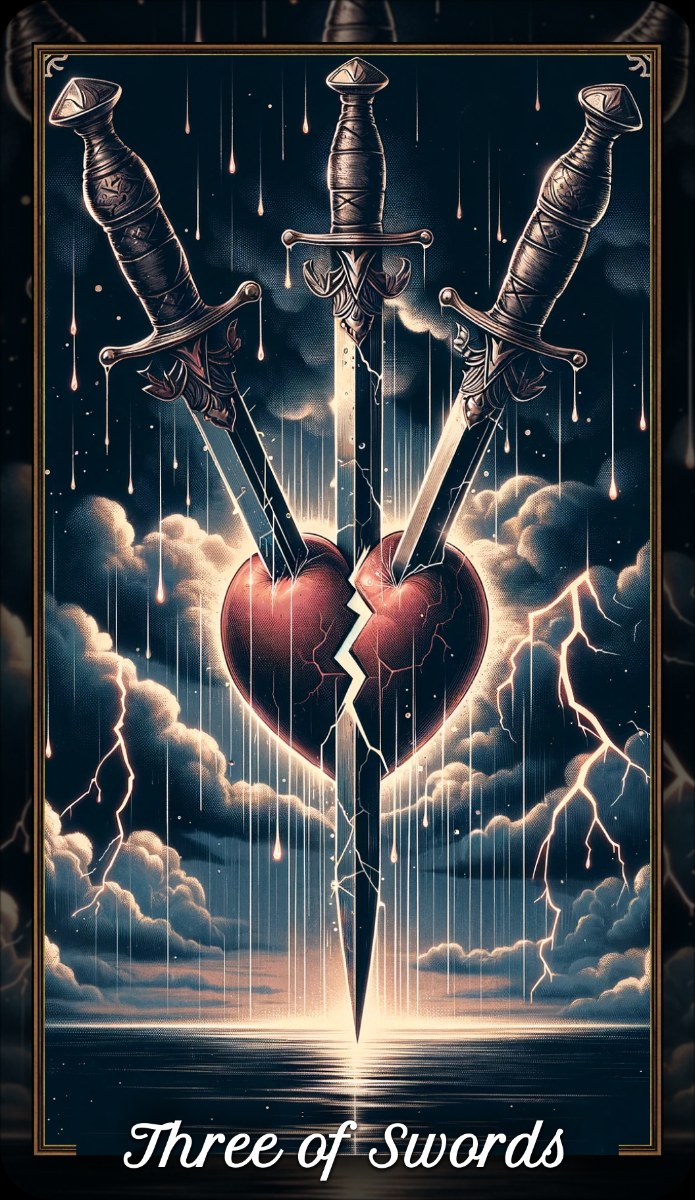
Three of Swords yes or no is a no — this is the deck's heartbreak card, and drawn on a yes/no question it signals sorrow, loss, or a painful truth sitting in the outcome you asked about. The reason is the card's entire symbolism: three swords through a heart, grief made literal, with no ambiguity built into the image the way there is in genuinely mixed cards. But there's one thing worth knowing before the no lands fully: this card confirms pain at least as often as it predicts it — and what the no means differs meaningfully between love, reconciliation, and career questions, so read on to the one that matches yours. yes or no tarot card meanings
Does Three of Swords Mean Yes or No?
For a general question, the Three of Swords is a no — one of the clearest in the deck, and not a card this site will soften for you. In practical terms it says the outcome you asked about carries hurt: the thing doesn't happen the way you hoped, or it happens and brings a painful truth with it. If you asked "will this work out," the honest answer is no, not in the form you're hoping for. There is no secret upside reading of this card that turns it into a yes, and any interpretation that offers you one is telling you what you want to hear.
The reasoning matters, because it defines what the no is made of. Threes in tarot represent the first full result of a situation — the initial outcome made visible — and Swords rule truth and the mind. So the Three of Swords is a painful truth arriving in full view: not confusion, not delay, but clarity that hurts. And here's the part the one-line answer pages skip: in real readings, this card describes an existing wound at least as often as a future one. Drawn on a question you already half-know the answer to — the relationship that's been dying, the silence that's lasted too long — it isn't predicting new disaster. It's confirming the thing you asked the cards about because some part of you already knew.
On the yes-no-maybe spectrum, this sits at the firm-no end with almost no context-dependence in its direction — only in its scope. The one honest boundary to draw around the no: it applies to the specific outcome you asked about, not to your life. The Three of Swords answers "will this particular thing go the way I want" with no; it says nothing about what comes after the no, and Swords-suit pain is the kind that clarifies rather than the kind that lingers indefinitely.
Two of Swords Yes or No: Not Until Someone Decides, Ace of Swords Yes or No: A Sharp, Clear Yes, King of Cups Yes or No: A Calm, Steady Yes and Three of Swords as How Someone Sees You: Old Pain
Three of Swords Reversed — Yes or No?
Reversed, the Three of Swords softens — it does not flip. This is the distinction to get exactly right: reversed does not turn the heartbreak card into a yes. What it signals instead is that the sharpest phase of the pain is passing: the wound is beginning to close, the worst of the grief is behind rather than ahead, and the situation is moving from raw hurt toward recovery. If you asked "will I get over this," reversed answers yes. If you asked "will the thing I want happen," the answer is still no — but a no you're already starting to survive.
One caution keeps the reversed reading honest, because it has a shadow side: the Three of Swords reversed can also mean pain suppressed rather than processed — telling yourself you're fine while the swords are still in. The tell is behavior: if you drew this reversed while actively avoiding thinking about the situation, read it as "the grief still needs to be felt before it can finish," not as "all clear." Either way, the practical answer to a yes/no question stays the same: not yet a yes, but the no is losing its grip.
Three of Swords Yes or No for Love and Relationships
For love, the Three of Swords is a no — and this is the card's native territory, so the no is at full strength here. Drawn on a new attraction, it says this connection carries hurt in it: the interest isn't what it appears, the situation has a complication you can't see yet, or pursuing it leads through disappointment. Drawn on an existing relationship, it names active pain — distance, a wounding discovery, words that cut, or grief already present between you that the question was really about. If you asked "is this person right for me" or "will this bring me happiness," this card answers no as plainly as tarot can. What it deliberately doesn't say is that you'll never be happy — it says this, here, is where the hurt is.
Three of Swords Yes or No: Reconciliation / Getting Back Together
For reconciliation, the Three of Swords is a no — and it's worth being precise about which no, because it's not always the one readers assume. Sometimes it's the direct answer: the reunion doesn't happen, or happens briefly and reopens the wound that ended things the first time. But at least as often, drawn on "will we get back together," this card is describing the state of the wound rather than the fate of the relationship: the hurt between you is still active, still sharp, still unhealed — and reconciliation attempted on top of an open wound fails not because the love is gone but because the injury hasn't been treated. Either way, the answer to "should I expect this reunion soon" is no.
The honest edge this article won't sand off: if the breakup involved betrayal, cruelty, or a discovery that broke trust, the Three of Swords appearing on the reconciliation question is generally confirming that the damage is real and disqualifying — not setting a timer on it. Grieve the relationship you're actually grieving rather than negotiating with the card for a different answer; re-asking the deck until a kinder card appears doesn't change what this one said, and part of you drew this card knowing that.
Have this exact question? Will he come back?
Three of Swords Yes or No: Marriage or Commitment
For marriage, the Three of Swords is a no. Drawn on "will he propose," "is this heading toward commitment," or "should we take this step," it says the path you asked about runs through grief rather than toward a wedding — either the commitment doesn't materialize, or there's a painful truth sitting between you and it that has to surface first. This card on a commitment question is sometimes the deck's way of flagging that something significant hasn't been said yet, and that the marriage question can't get a real answer until it is.
What the no is not: a permanent verdict on your prospects, or proof the relationship is worthless. It's a verdict on this step, now, on the current foundation. If the question behind your question is really "what's actually wrong between us" — and with this card, it often is — a single yes/no draw is the wrong instrument; a full love tarot reading can map the wound itself rather than just confirming it exists.
Three of Swords Yes or No for Career or Big Decisions
For career questions, the Three of Swords is a no — expect disappointing news. Drawn on "will I get the job," "will I get the promotion," or "will the deal go through," it points to rejection, a setback, or word that stings when it arrives. If you asked "should I make this move," the card warns the move leads through a painful outcome rather than a clean win. There's no useful way to soften that, so this article won't.
What's worth adding is the scope of the no, because Swords rejections have a specific character: they're painful and they're informative. A Three of Swords career setback tends to come with clarity attached — the rejection that tells you exactly what was missing, the bad news that ends months of limbo, the door closing that finally stops you waiting by it. The no applies to this opportunity; take the truth that arrives with it, because that truth is usually the working material for the next attempt.
Signs to Trust This Answer
- Part of you already knew — if the card's no matches a suspicion you've been carrying for weeks, that alignment is this card's signature: it confirms far more often than it surprises, and confirmation is its most reliable mode.
- There's visible evidence of the hurt in real life — distance that's grown, a conversation that wounded, a silence with weight to it — the card is naming something observable, not conjuring doom from nowhere.
- You asked a direct outcome question ("will he come back," "will I get it") rather than a vague one — this card answers sharp questions sharply, and its no is most trustworthy when the question was clean.
- If you pulled more than one card, check the neighbors before finalizing the read — a healing card beside it (Six of Swords, The Star) frames this as pain in transit rather than pain as destination, while a second hard card (Ten of Swords, The Tower) confirms the ending is the ending.
- Notice the urge to immediately redraw — if your first instinct on seeing this card was to shuffle again for a better answer, that instinct is worth more attention than a second draw would be; this card appears precisely on the questions we most want to re-ask.
Three of Swords Yes or No — Card Combinations
If you drew more than one card, the card beside the Three of Swords changes the strength or direction of the answer. Here are the most common combinations and what they indicate:
| Combination | What It Means for Your Yes or No Answer |
|---|---|
| Three of Swords + Ten of Swords | Confirms and hardens the no. The heartbreak isn't a rough patch — it's the ending, complete and final. This pairing removes whatever ambiguity remained and says stop waiting; the situation you asked about is over. |
| Three of Swords + Six of Cups | Softens the no toward a maybe — but a specific one. The pain is real, yet nostalgia and genuine old affection are still alive in the picture; a reconnection rooted in shared history remains possible, though it asks whether you'd be returning to the person or to the memory. |
| Three of Swords + The Sun | Flips the trajectory of the answer. The hurt happens or has happened — that part stands — but this pairing says it's the low point before a genuinely bright outcome; the no on the immediate question becomes a yes on where things ultimately land. |
| Three of Swords + Four of Swords | No for now, with a timing condition. The wound needs a real rest-and-recovery period before anything can be re-asked — the answer isn't frozen forever, but nothing true can be read about this situation until the healing phase has actually happened. |
| Three of Swords + Seven of Swords | A strong double-confirmation of the hardest version of this card: the pain involves deception or betrayal. If you suspected dishonesty or a third presence in the situation, this pairing is the deck confirming it — and the no it produces is one to act on, not negotiate with. |
This Does NOT Mean
The specific over-interpretation readers make with the Three of Swords runs in two opposite directions, and both need naming. The first: treating the card as automatic proof of cheating. The third-party association is real — three swords, one heart, and a long tradition of reading a triangle into it — but it is one possible meaning, not the default one. The card's core is heartbreak and painful truth in any form: distance, loss, a wounding conversation, grief. Reading every Three of Swords as "he's seeing someone else" happens because the mind under stress grabs the most vivid explanation available — and it can talk you into accusations the card never made. Unless surrounding cards point to deception specifically (Seven of Swords territory), don't supply a villain the draw didn't name.
The second over-interpretation is the mirror image: expanding the no from "this outcome" to "my future." She asks "will he come back," draws this card, and hears "you'll always be alone" — a sentence that exists nowhere in the reading. The Three of Swords is scoped to the question asked, and it's a three, not a ten: an early-stage sorrow, not a final destination. The correction for both errors is the same discipline — take the card's no at exactly its stated size. It's honest enough to hurt; don't make it bigger than it is.
FAQ
What does Three of Swords mean as a yes or no card?
The Three of Swords means no. As a yes/no card, it signals that the outcome you asked about carries heartbreak, loss, or a painful truth — one of the firmest negative answers in the deck. Its one nuance is scope: the no applies to the specific thing you asked, and this card confirms pain that already exists at least as often as it predicts new pain.
Three of Swords reversed yes or no?
Reversed, the Three of Swords softens but does not flip — it's still not a yes to the outcome you asked about. What changes is the trajectory: the sharpest pain is passing, healing has begun, and the worst is behind rather than ahead. The one caution is suppressed grief — if you've been avoiding the hurt rather than feeling it, reversed is naming that, not clearing you.
Three of Swords yes or no for love?
No — love is this card's home ground, and the no is at full strength here. For a new connection, it warns the situation carries hidden hurt; in an existing relationship, it names active pain — distance, a wounding discovery, or grief already between you. It answers "will this bring me happiness" with no. It does not answer "will I ever be happy" — that question was never asked of it.
Three of Swords yes or no relationship / reconciliation?
No — either the reunion doesn't happen, or the wound between you is still too open for it to hold. Reconciliation attempted on an unhealed injury reopens it rather than closing it, and if the breakup involved betrayal, this card is generally confirming the damage rather than setting a countdown on it. Re-asking until a kinder card appears won't change the answer this one gave.
Does the Three of Swords always mean cheating or a third person?
No — and this matters, because the assumption causes real damage. The third-party reading is one traditional meaning among several, not the default. The card's core is painful truth in any form: heartbreak, separation, harsh words, grief. It points toward deception specifically only when surrounding cards support it — the Seven of Swords beside it is a genuine flag; the Three of Swords alone is not an accusation, and shouldn't become one.
Related Readings
Draw your own card with the Yes or No Tarot tool, or if what you really need is the fuller picture of the relationship behind the question, go deeper with a Love Tarot Reading.