
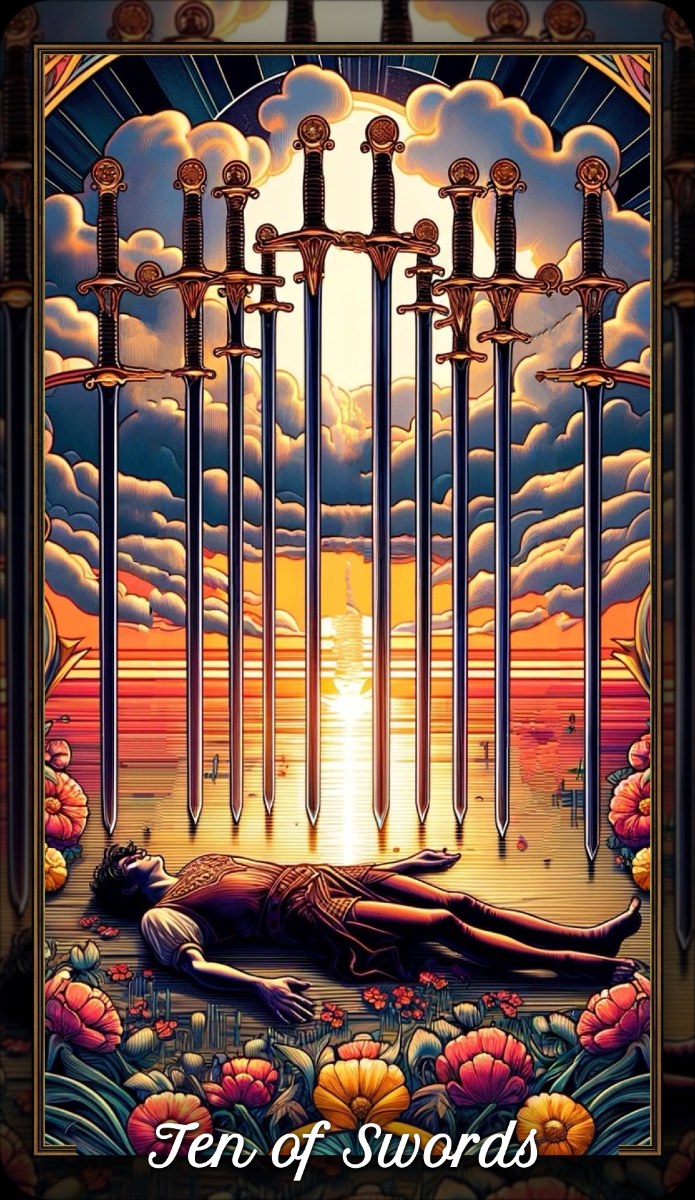
Ten of Swords yes or no is a no — the most final no in the Minor Arcana, signaling that the situation you asked about hasn't hit a rough patch or a pause: it has ended, completely. The image doesn't leave room for negotiation — a figure face-down with ten swords in his back — but it contains two details that matter as much as the verdict: the count is finished (ten swords is all of them; nothing else is coming), and behind the whole scene, the sky is turning to dawn. That's the card in full: an ending without a loophole, and a morning that's already started. What the finality means for love, reconciliation, and career — and what reversed does to it — is what the rest of this article covers. yes or no tarot card meanings
Does Ten of Swords Mean Yes or No?
For a general question, the Ten of Swords is a no — and this site won't dilute it, because the card's value to you depends entirely on it being taken at full strength. In practical terms it says: the thing you asked about is over. Not struggling, not on hold, not salvageable with effort — concluded. If you asked "will it work out," the answer is no; the working-out phase has already ended. If you asked "should I keep trying," the answer is no; the card marks the point where continued effort stops being persistence and becomes refusal to read the room. There is no secret positive interpretation of this card's verdict on the question asked, and any reading that offers one is selling comfort, not truth.
The reasoning comes from the card's arithmetic, and the arithmetic is the mercy. Tens in tarot are completion — a suit's story told to its final page — and Swords rule the mind and its trials, so the Ten of Swords is the mind's hardest story fully finished. Count the swords: ten, the whole suit's worth, every one already placed. That detail carries the card's genuinely comforting truth, which is different from a softened verdict: nothing is still incoming. The dread of the other shoe — the Nine of Swords' territory — is over, because every shoe has dropped. And the sky in the image is not decoration: the black horizon is breaking into gold, dawn arriving over the completed scene. The card's structure says both things at once, and means both: this is finished, and because it is finished, the next thing has already begun.
On the yes-no-maybe spectrum, this sits at the far no end with almost nothing context-dependent about its direction — only its placement in time, which is worth fixing precisely against its neighbors. The Nine of Swords is the fear of the ending, suffered at night before anything has actually happened. The Three of Swords is the heartbreak in progress, the wound being made. The Ten is afterward: the event has occurred, in full, and the question it answers has technically already been answered by reality — the card is often just the notification. Which means the practical function of this no isn't prediction. It's permission: to stop performing CPR on something the card has pronounced, and to turn around and face the part of the sky that's getting lighter.
Nine of Swords Yes or No: The Fear Isn't the Fact, Eight of Swords Yes or No: The Trap Isn't Locked, Seven of Swords Yes or No: No — Something's Hidden and Ten of Swords as How Someone Sees You: The End
Ten of Swords Reversed — Yes or No?
Reversed, the Ten of Swords softens — it does not flip, and the distinction is everything. No orientation of this card converts the ending into a continuation. What the reversal changes is your position relative to the ending, in one of two ways. The first and more common: the worst has passed. The swords are coming out, recovery has genuinely started, and the crushing phase of the loss is behind you — if you asked "will I get through this," reversed answers yes, you already are. The wound is real and the healing is realer; this is the card's recuperative reading, and drawn during a slow climb out of something devastating, it's the deck confirming the climb is working.
The second reading is harder and needs saying: an ending being refused. Reversed can mark a conclusion that happened months ago still being dragged forward — re-litigated, re-opened, kept technically alive by one person who won't let it finish dying. The re-reading of old messages, the anniversary vigils, the hope maintained like a machine that has to be hand-cranked daily. If that's recognizable, the reversal isn't offering a different answer to your question; it's observing that you already received the answer and have been declining delivery. The yes/no translation for both readings is the same: still no to the thing that ended — and the variable in your hands is whether the ending gets to complete, because the dawn in this card only reaches people who stop facing the swords.
Ten of Swords Yes or No for Love and Relationships
For love, the Ten of Swords is a no — the completed-ending version, which is different from heartbreak and worth distinguishing carefully. The Three of Swords describes love being wounded; the Ten describes love's story finished: the relationship that has actually concluded, the connection where what needed to die has died, the situation with nothing left in it still alive enough to fight over. Drawn on an existing relationship, it says the bond as it currently exists has run its complete course — and it frequently carries information about the manner of the ending: sudden rather than gradual, total rather than partial, and sometimes with betrayal in the mechanism, because a figure with swords in his back was not facing his attacker. Drawn on a new connection, it's a firm no with a specific warning: this situation ends badly and completely, and the card is showing you its last page in advance. If you asked "is there a future here" — the card's entire testimony is that you're looking at an ending, and endings don't have futures; they have aftermaths.
Ten of Swords Yes or No: Reconciliation / Getting Back Together
For reconciliation, the Ten of Swords is a no — the firmest one this entire 78-card series will deliver, and it would be a disservice dressed as kindness to pad it. Drawn on "will we get back together," this card says the relationship you're asking about is finished: not resting (the Four of Swords), not frozen in a standoff (the Two), not moving away with the possibility of a turned boat (the Six) — concluded, with all ten swords accounted for. The version of the relationship you're hoping to resume no longer exists to be resumed. Re-asking the deck, re-reading his old messages, re-running the last month for the moment it could have gone differently — the card has one answer to all of it, and the answer is the figure on the ground: this is what finished looks like.
Here is the card's honesty in the other direction, because the Realist owes you both halves. The Ten of Swords is a no about the relationship — it is not a no about you, and it is not a no about love. The dawn in the image is positioned with intent: it rises on the far side of the ending, reachable only by someone who lets the ending stand. Every hour spent negotiating with a completed conclusion is an hour facing away from that horizon. The card's actual gift to a reconciliation question is the thing partial answers can never give: certainty. No more decoding, no more maybe, no more life suspended on a pending verdict — the verdict is in, the waiting is legitimately over, and what the card asks of you now is the turn toward the light it already painted into the frame.
Have this exact question? Will we end up together?
Ten of Swords Yes or No: Marriage or Commitment
For marriage, the Ten of Swords is a no without a workaround. Drawn on "will he propose," "are we heading toward commitment," or "does this relationship have a future," the card answers that the path you asked about terminates — the commitment doesn't arrive, because the relationship's arc completes before reaching it. There is no reading of this card in which it precedes a wedding; tens close stories, and this ten closes the hardest kind. If the question was asked because the relationship already feels like it's dying, the card is confirming the diagnosis rather than delivering news.
What the no makes possible is worth one honest sentence: a definitive answer to "is this going anywhere" — even the worst one — returns years that an indefinite maybe would have kept taking. If part of you has been waiting on a commitment this card says isn't coming, the card is also, in its brutal way, handing back the wait. And if what you need now is to understand the whole arc — what this relationship was, why it completed, what its ending is making room for — that's more than a yes/no draw can hold: a full love tarot reading is built for exactly that reckoning.
Ten of Swords Yes or No for Career or Big Decisions
For career questions, the Ten of Swords is a no that names an ending in the professional sphere: the job that's over whether or not the paperwork has caught up, the project being wound down, the role collapsing under a reorganization, the working relationship that has passed its point of repair. Asked "is this job still viable," "will the situation at work recover," or "should I keep fighting for this position," the card answers no — the ending is already in motion, and the visible signs you've been explaining away are the ten swords being placed. Occasionally it carries the workplace version of the card's betrayal note: a decision made about you before it was announced to you, politics concluded behind your back.
The practical instruction follows from the finality: stop spending effort on the verdict and spend it on the exit. Update the resume before the announcement, take the meetings, negotiate the terms of the ending rather than its existence — people who read this card correctly leave on their own timeline with their references intact; people who fight it leave anyway, later, with less. And the card's dawn applies at full strength here, more visibly than anywhere: career endings are the endings most reliably followed by better mornings, and this card has watched more of them than any resignation letter.
Signs to Trust This Answer
- Reality has already been saying it — if the card's no matches months of visible evidence (the silence, the distance, the writing on every wall) rather than arriving as a shock, you're in the card's true register: it confirms completed endings far more often than it predicts surprise ones.
- The situation is past tense in your own speech — listen to how you describe it to friends; if you've already slipped into "what we had" and "how it was," your language has accepted what your question is still contesting, and the card is siding with your language.
- You asked a final-status question — "is it really over," "is there any chance left" — because verdicts are this card's exact function, and its no is most trustworthy when the question was explicitly about finality.
- If you pulled more than one card, let the neighbors set what comes next rather than whether it's over: an Ace or The Fool beside it points to the new beginning already forming, The Star to the healing timeline, while a second ending card (Death, The Tower) confirms the conclusion is total and the only remaining work is acceptance.
- The certainty landed with a strange relief underneath the grief — that quiet exhale beneath the pain is the most reliable confirmation this card produces: some part of you has been waiting for permission to stop waiting, and recognizing that is the reading landing true.
Ten of Swords Yes or No — Card Combinations
If you drew more than one card, the card beside the Ten of Swords changes the strength or direction of the answer. Here are the most common combinations and what they indicate:
| Combination | What It Means for Your Yes or No Answer |
|---|---|
| Ten of Swords + The Tower | Confirms and hardens the no to its maximum. The ending is total and its arrival is sudden — this pairing removes any remaining question of degree and says the collapse completes fully; the only useful preparation is for the aftermath, not the event. |
| Ten of Swords + Six of Cups | Softens the answer to a narrow maybe — not for the relationship, but for the connection. The ending stands, yet genuine old affection survives it; some altered form of contact or peace between you may persist after the finish, without resurrecting what finished. |
| Ten of Swords + Judgement | Flips the trajectory of the answer. The ending happens in full — and then something genuinely rises from it: a rebirth, a second act on entirely new terms, the one pairing where "over" and "not the end of the story" are both true. Rare, and it requires the death to actually complete first. |
| Ten of Swords + Death | Yes to renewal, but only after the ending finishes — a timing condition. The transformation is certain and favorable, and it cannot be rushed or partially done: the old situation must conclude completely, unclung-to, before the new one is released. The schedule belongs to the completion. |
| Ten of Swords + Three of Swords | A strong double-confirmation: the heartbreak and the ending are the same event, now complete. Whatever hope was riding on "maybe it's just a rough patch" — this pairing closes it. Its mercy is the same as the Ten's own: all the swords are counted, and nothing further is coming. |
This Does NOT Mean
The specific over-interpretation readers make with the Ten of Swords is expanding a completed ending into a permanent condition: she asks "will we get back together," draws the deck's most final card, and hears not "this relationship is over" but "I am someone things end for" — the verdict on one situation quietly rewritten as a verdict on her. The error happens because finality feels totalizing from inside fresh grief; a mind absorbing one full stop starts placing them everywhere. But the card's own arithmetic argues against the expansion it triggers: ten swords is the count for one story, fully told — not a forecast, not a pattern, not a sentence passed on the reader. The figure on the ground is the situation. The dawn is the reader's, and the card painted them in the same frame on purpose.
The second misreading is the loophole hunt run on the card's mercies: the dawn, the "worst is over" — pried at until they seem to whisper "so maybe, after the dark, he comes back." No. The dawn in this card rises on the ending, not through it; what the light reveals is the next chapter, not a revival of the last one. And the mirror error of the betrayal note deserves its sentence: swords in the back suggest treachery was possible in how things ended — they do not convict a specific person of a specific act, and grief given a villain to prosecute stays in the courtroom years after the case closed. The correction for all of it is the same discipline this card teaches better than any other: let the ending be exactly the size it is — one situation, complete — grieve it at that size, and then do the only thing the figure in the image cannot and you can: get up, and face east.
FAQ
What does Ten of Swords mean as a yes or no card?
The Ten of Swords means no — the most final no in the Minor Arcana. It signals that the situation asked about has ended completely: not paused, not struggling, concluded. Its two built-in mercies are structural, not softened verdicts: all ten swords are already placed, so nothing further is coming — and the dawn in the image is real, rising on the far side of the accepted ending.
Ten of Swords reversed yes or no?
Reversed, the card softens without flipping — the ending still stands. The common reading: the worst has passed and recovery has genuinely begun; the swords are coming out. The harder reading: an ending being refused — concluded months ago but kept artificially alive by someone declining delivery of the answer. Either way, still no to what ended; the open variable is whether you let it finish.
Ten of Swords yes or no for love?
No — the completed-ending version, distinct from heartbreak in progress. The relationship's story has run its full course: what needed to die has died, often suddenly and totally, sometimes with betrayal in the mechanism. For a new connection, it's a firm no showing you the last page in advance. The card answers "is there a future here" with: endings don't have futures — they have aftermaths, and yours has already started.
Ten of Swords yes or no relationship / reconciliation?
No — the firmest anti-reconciliation card in the deck. The relationship as it existed is finished, with all ten swords accounted for; the version you'd be returning to no longer exists to receive you. What the card gives instead is the thing a maybe never could: certainty, and with it the end of the waiting. The dawn it promises is real — and it's reachable only by turning away from the swords.
Does the Ten of Swords mean I was betrayed or stabbed in the back?
It raises the possibility without convicting anyone — the swords-in-the-back image is a genuine traditional association, and the card can mark an ending arranged behind your back or a trust broken at the finish. But its core meaning is the completed ending itself, betrayal or no betrayal. Read treachery specifically only when supporting cards point there (Seven of Swords beside it is a real flag); alone, the card describes how finished things are, not who to prosecute — and grief handed a villain tends to stay in the courtroom long after the case has closed.
Related Readings
Draw your own card with the Yes or No Tarot tool, or if what you need now is to understand the whole arc of what ended and what comes after it, go deeper with a Love Tarot Reading.