
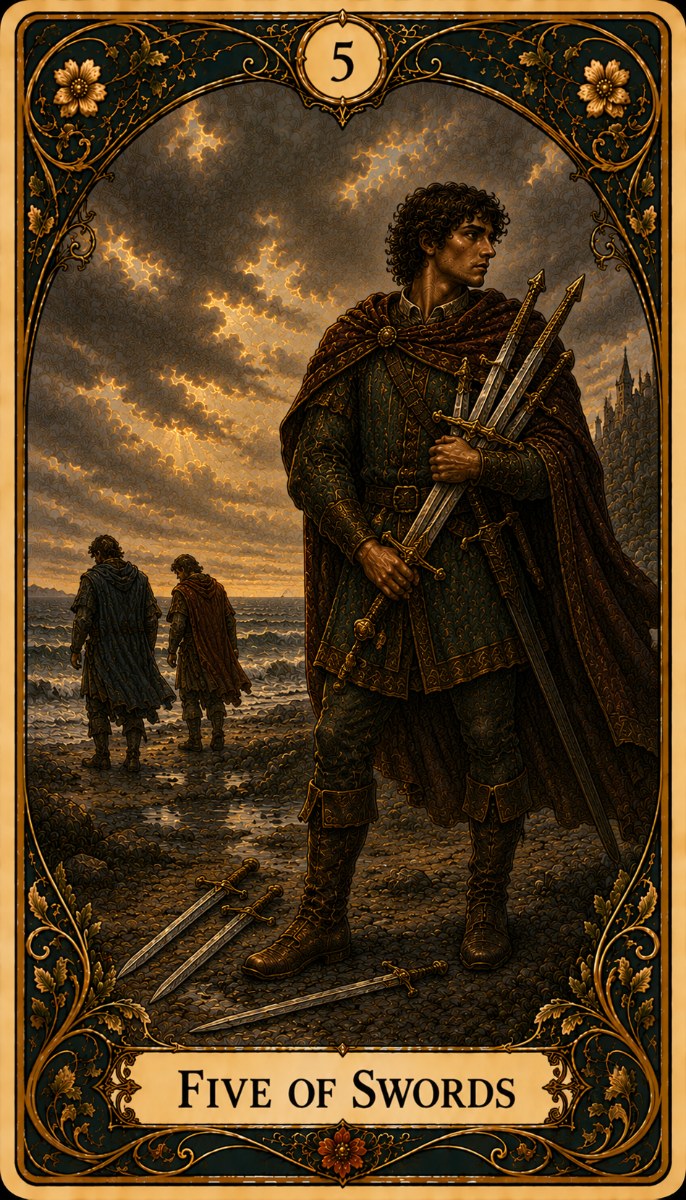
The Five of Swords as how someone sees you means he associates you with conflict — specifically, a disagreement or falling-out he hasn't fully let go of. Most generic tarot sites will hand you "betrayal, hollow victory, tension" as generic upright keywords, without ever asking the question that actually matters: whose version of the conflict is he carrying around? This card almost always describes a one-sided story, and there's a real chance the version in his head has cast you as more combative than you actually were.
What the Five of Swords Says About How He Sees You
When the Five of Swords shows up in a how-someone-sees-you reading, it points to a specific and often uncomfortable perception: he sees you through the lens of a past disagreement. He may perceive you as someone who fights to win, someone hard to back down against, or someone who left him feeling defeated or dismissed after a conflict between you. Alternatively, he may see you as the one who walked away — the person who ended a disagreement by disengaging rather than resolving it, leaving him with unfinished business he's still turning over.
This perception is often rooted in something real. There's usually an actual moment — an argument, a falling-out, a hard conversation that went badly — sitting underneath this card. But the framing of that moment is where projection tends to creep in. After a conflict, people commonly rewrite the story to protect their own ego: the other person becomes "unreasonable" or "combative" not because that's objectively true, but because it's easier to carry than admitting fault. If he's perceiving you as difficult to deal with, it's worth asking whether that's an accurate account of what happened, or his self-protective version of it.
Either way, the named quality is clear: conflict-associated. You are not, at this moment, being perceived neutrally — you're being perceived through the residue of something unresolved between you.
Five of Swords Reversed as How Someone Sees You
Reversed, this often points to lingering resentment rather than an active grievance — he's not actively replaying the conflict, but he hasn't fully released it either. Instead of seeing you as combative in the moment, he may quietly perceive you as someone he can't fully trust again after what happened, or someone he's decided isn't worth the friction of engaging with directly.
This version tends to be quieter and harder to detect than the upright meaning, because it shows up as distance rather than open tension. It usually shifts only through direct repair — a real conversation about what happened, rather than time simply passing. Resentment held in silence tends to calcify rather than fade on its own.
What This Means For Your Situation
If This Is a Crush or Early Stage
If this shows up early, there's likely been a specific disagreement or misunderstanding that's shaping how he currently sees you — possibly disproportionately to how significant it actually was. Worth considering whether a direct, low-stakes conversation could reset the narrative before it hardens into a fixed impression of you as "difficult."
If You're in a Relationship
Here, this card is a fairly direct signal that an old conflict is still doing quiet work in the background — shaping his behavior even if it's not being actively discussed. If you thought something had blown over, this suggests it may not have, at least not for him.
How This Perception Affects His Behaviour
Someone who associates you with conflict tends to become more guarded around disagreement generally — avoiding certain topics, choosing his words more carefully, or disengaging faster at the first sign of tension rather than working through it. He may also bring up the original conflict indirectly, in ways that seem unrelated but circle back to the same unresolved point.
Is This How You Want to Be Seen?
Almost certainly not, and it's worth taking seriously rather than dismissing as "just a card." Being perceived as someone associated with conflict — fairly or not — tends to create ongoing friction and distance that won't resolve itself through avoidance.
Does This Perception Lead to Action?
Generally toward distance rather than pursuit. The Five of Swords describes an unresolved conflict, and unresolved conflict tends to make people pull back, guard themselves, or disengage rather than move closer. For this to shift, someone has to actually address what happened — not necessarily to assign blame, but to close the loop that's currently left open. Without that direct repair, this card tends to describe a slow drift apart rather than any move toward connection.
Five of Swords as How Someone Sees You — Card Combinations
The card beside the Five of Swords in a how someone sees you reading shifts the perception significantly. Here are the most common combinations and what they indicate:
| Combination | What It Means in a How Someone Sees You Reading |
|---|---|
| Five of Swords + The Star | He's actively moving past the conflict and starting to see you in a more hopeful light again — a combination that often signals real repair is underway rather than lingering resentment. |
| Five of Swords + Eight of Swords | He feels stuck replaying the conflict without a way to resolve it, which tends to freeze the situation entirely rather than move it in either direction. |
| Five of Swords + Ten of Swords | He may consider the relationship or connection between you effectively over because of what happened — a more final and less recoverable version of this perception. |
| Five of Swords + Two of Cups | A conflicted perception: he wants reconciliation and genuine connection with you but is still guarded from the conflict, creating a push-pull between wanting closeness and protecting himself from another round of friction. |
| Five of Swords + The Tower | Points to a specific, significant rupture rather than ordinary disagreement — something that shook the relationship and is still actively shaping how he sees you, for better or worse depending on what's happened since. |
This Does NOT Mean
The most common mistake readers make with this card is assuming it confirms they were in the wrong, simply because he perceives them as the difficult one in the conflict. That's an easy leap to make, especially if you already feel guilty about how something went — but this card describes his perception, filtered through his own ego-protective instincts, not an objective account of what happened. Being perceived as combative doesn't mean you actually were.
The correction: separate what he currently believes from what's actually true. If there's real fault on either side, that's worth examining honestly — but don't accept his post-conflict narrative as fact just because this card is naming it as his current perception.
FAQ
Is the Five of Swords as how someone sees you a good sign?
No — this card generally points to an unfavorable or complicated perception tied to unresolved conflict. It's not a hopeless sign, but it isn't a flattering one either.
Five of Swords reversed — how does he see me?
Reversed, he's more likely holding quiet resentment than active grievance — the conflict has gone underground rather than resolved, which can be harder to detect and address than open tension.
Does the Five of Swords as how someone sees you mean he likes me?
Not typically. This card describes a perception shaped by conflict, which usually works against warmth or attraction rather than alongside it — though it doesn't rule out feelings existing underneath the tension.
Does the Five of Swords mean he respects me?
Not necessarily. If he perceives you as someone who "won" a conflict at his expense, respect and resentment can actually coexist — he may respect your strength while still feeling bruised by it.
Does the Five of Swords mean the conflict is my fault?
Not at all — this card reflects his current perception, not an objective judgment of who was right. People frequently reframe conflicts in their own favor after the fact, so his view may not reflect what actually happened.
Related Readings
If you want to go deeper on how he actually thinks and feels about you, these spreads pair well with this reading:
What Does He Think of Me spread How Does He Feel About Me spread Does He Love Me spread Is He Thinking of Me spread