
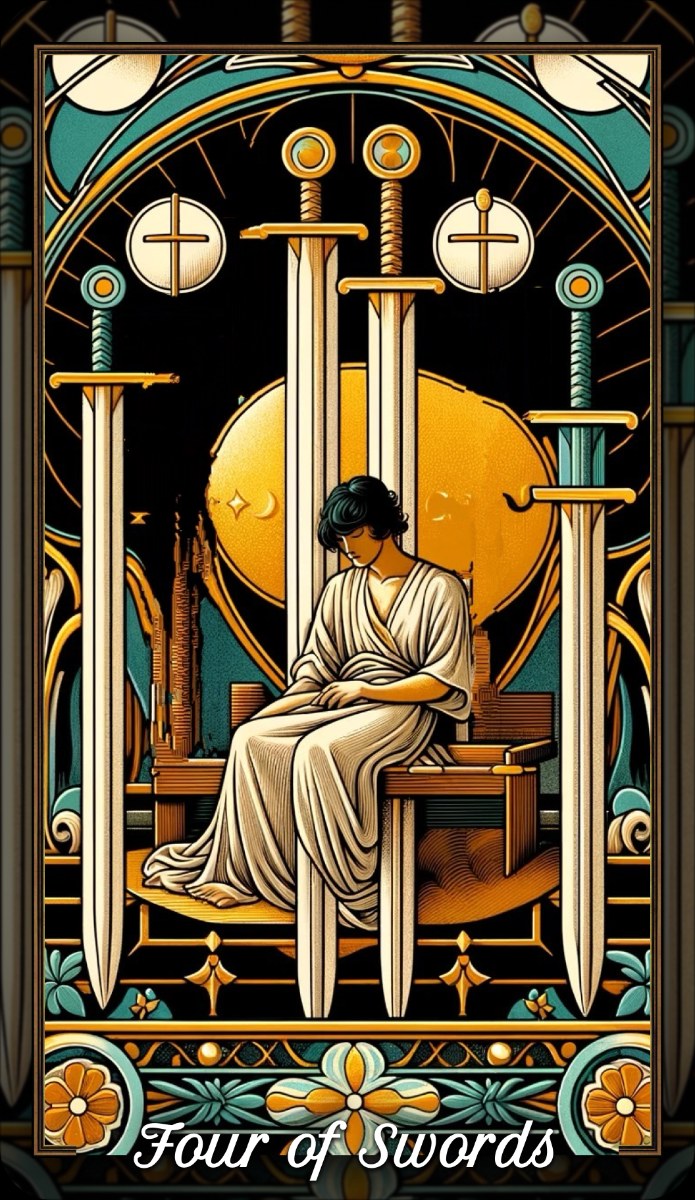
Four of Swords yes or no is a not-yet — the deck's rest card, signaling that the situation you asked about is in a genuine pause and no final answer exists while the pause holds. The reason is what the card depicts: a figure lying in stillness, swords hung on the wall rather than in use — recovery in progress, action deliberately suspended. The crucial distinction, and the one flat answer-lists always drop: deferred is not denied. What the pause means, and how long it's likely to hold, differs between love, reconciliation, and career questions — so read on to the version that matches yours. yes or no tarot card meanings
Does Four of Swords Mean Yes or No?
For a general question, the Four of Swords is a not-yet — and it's worth understanding that this card isn't dodging the question, it's answering a different part of it. Most cards tell you the outcome; this one tells you the timing, and the timing is: not now. The situation is in a recovery phase — after stress, conflict, exhaustion, or simply too much motion — and outcomes read during a recovery phase aren't final, the way a score checked at halftime isn't a result. If you asked "will it happen," the honest answer is: it hasn't been decided, and it won't be decided until the rest period ends.
The reasoning comes from the card's structure. Fours in tarot represent stability and stillness — a situation holding its shape — and Swords rule the mind. So the Four of Swords is the mind at enforced rest: thinking suspended, decisions shelved, energy rebuilding. Unlike the Two of Swords, where the pause is avoidance and the blindfold could come off at any moment, the Four's pause is legitimate and necessary — someone or something in your question genuinely needs this stillness, and the stillness is doing its job. That's why the card resists being pushed: pressure applied to a recovery doesn't speed the answer up, it damages what's recovering.
On the yes-no-maybe spectrum, this sits squarely in "not yet" territory with a mild lean toward eventual yes — mild, and worth stating carefully. Rest implies something worth resting for; situations that are truly over don't pause, they end, and the deck has other cards for endings. But the Four of Swords does not guarantee the post-rest answer goes your way — it guarantees only that the real answer arrives after the pause, and that anything you force before then gets you a worse version of it.
Knight of Swords Yes or No: Fast Yes, Check the Speed, Page of Swords Yes or No: Watching, Not Moving Yet and Ten of Swords Yes or No: A Final, Finished No
Three of Swords Yes or No: An Honest No, Two of Swords Yes or No: Not Until Someone Decides, Ace of Swords Yes or No: A Sharp, Clear Yes and Four of Swords as How Someone Sees You: Stillness
Four of Swords Reversed — Yes or No?
Reversed, the Four of Swords means the pause is ending — which shifts the answer from "not yet" toward "soon." The rest period is completing: energy returning, the silence approaching its natural break, the suspended situation preparing to move again. If you asked "will I hear something" or "will this start moving," reversed answers yes, shortly — the waiting phase you've been living in is in its final stretch, and the deferred answer is about to become an actual one.
Two cautions keep the reversed reading honest, because this reversal runs in two directions. First: it can mean rest cut short by restlessness — someone (possibly you) bolting out of the recovery before it's done, which restarts motion but on shaky legs; if you've been white-knuckling the waiting period, reversed may be naming your impatience rather than blessing it. Second, the opposite: rest refused entirely — pushing through exhaustion until burnout forces the stop the card recommended. Either way, the practical yes/no translation holds: the suspension is breaking and answers are becoming available — just make sure you're exiting the pause because it's finished, not because you couldn't stand it.
Four of Swords Yes or No for Love and Relationships
For love, the Four of Swords is a not-yet — and here the pause has a specific, recognizable shape: withdrawal. Drawn on "does he have feelings" or "is this going anywhere," this card says someone in the connection has retreated — gone quiet, pulled back, needed space — and the retreat is recuperative, not rejecting. That's the distinction the entire reading turns on, because from the outside the two look identical: the unanswered messages, the lowered energy, the distance. The Four of Swords says what you're seeing is someone recovering — from stress, from a hard season, sometimes from the intensity of the connection itself — and that the feelings question is unreadable until they surface again. Within an established relationship, it can also simply mean the relationship is in a quiet chapter: not thriving, not dying, resting — and quiet chapters are survivable if nobody panics and treats stillness as a verdict.
Four of Swords Yes or No: Reconciliation / Getting Back Together
For reconciliation, the Four of Swords is a not-yet — and it's arguably the single most precise card the deck has for the situation most people asking this question are actually in: the silence after a breakup, and the agonizing project of interpreting it. This card's answer to "does his silence mean it's over" is no — the silence is processing. He's in the recovery phase the card depicts: sorting through what happened, letting the rawness settle, resting from the conflict. The card doesn't promise he emerges wanting reunion; it promises the silence isn't itself the answer, and that whatever he decides gets decided after the rest, not during it.
The instruction embedded in the card applies to you as much as to him, and this is the part readers skip: the Four of Swords showing up on your reconciliation question is also prescribing rest for you. Reaching out during someone's recovery phase — the check-in text, the accidentally-on-purpose contact — interrupts exactly the process that could lead back to you, and reads to the resting person as pressure. The honest playbook this card supports: let the pause be a pause, on both sides, and use it for your own recovery rather than for surveillance of his. The answer arrives when the rest ends; nothing you do during the rest improves it, and several things you could do would worsen it.
Have this exact question? Will he come back?
Four of Swords Yes or No: Marriage or Commitment
For marriage, the Four of Swords is a not-yet — the commitment question is shelved, not refused. Drawn on "will he propose" or "are we moving toward commitment," it says the relationship is in a consolidation phase where big steps aren't being taken or seriously weighed: energy is going into recovery — from a stressful year, a rough patch, external pressure — rather than into escalation. That's materially different from reluctance. A person in Four of Swords mode isn't deciding against marriage; he isn't deciding anything, because deciding isn't what this phase is for.
The practical read: commitment questions asked during a rest phase get their real answer after it — and pressing for the answer mid-pause tends to produce either a stalled non-response or a stressed no that wouldn't have been the rested answer. If the relationship has just come through something hard, let it fully land before the next big question. And if what you're actually trying to gauge is whether this quiet phase is healthy consolidation or slow drift, that's a fuller question than one card can carry — a full love tarot reading can distinguish the two.
Four of Swords Yes or No for Career or Big Decisions
For career questions, the Four of Swords is a not-now with two distinct applications, depending on what you asked. If you asked about an outcome — "will I hear back," "will the promotion come through" — the answer is: not during this window; the process is genuinely paused (decision-makers stalling, budgets frozen, the quiet stretch mid-pipeline), and the silence isn't a rejection any more than it is in love. Chasing it hard right now yields nothing the waiting wouldn't.
If you asked about a move — "should I push for it," "should I take on more," "should I make the leap" — the card's answer is a flat not-yet aimed directly at you: you're closer to depletion than you're admitting, and decisions made from depletion are reliably worse than the same decisions made rested. This is the card the deck plays when the honest advice is take the break before the break takes you. The opportunity question will still be there after the recovery; your judgment won't be, if you skip it.
Signs to Trust This Answer
- The situation you asked about has recently come through something intense — a breakup, a conflict, a brutal stretch of work — because the Four of Swords describes the pause after strain, and a visible preceding strain confirms you're in the card's actual territory.
- The silence or stillness you're reading has a settled quality rather than a hostile one — no blocking, no pointed gestures, just quiet — which matches recuperative withdrawal and not the sharper signatures of rejection.
- You yourself are tired in a way you've been overriding — this card frequently mirrors the asker, and if "rest first" landed with a thud of recognition, the reading is on target.
- If you pulled more than one card, check the neighbors for direction: a movement card beside it (Knight of Cups, Ace of Swords, The Wheel) means the pause is nearer its end than the Four alone suggests, while a second static card (The Hanged Man, Two of Swords) confirms a longer suspension.
- You asked a timing-flavored question — "when," "will I hear soon," "is it happening now" — because timing is this card's native register, and its not-yet is most reliable when timing was genuinely what you asked.
Four of Swords Yes or No — Card Combinations
If you drew more than one card, the card beside the Four of Swords changes the strength or direction of the answer. Here are the most common combinations and what they indicate:
| Combination | What It Means for Your Yes or No Answer |
|---|---|
| Four of Swords + Six of Cups | Strengthens the not-yet toward an eventual yes for reconciliation questions. The rest is happening on a foundation of genuine old affection — the person retreating is processing warmth, not indifference, and this pairing leans toward contact resuming with feeling attached. |
| Four of Swords + Eight of Cups | Softens the answer toward a harder maybe. What looked like temporary rest may be the first stage of a deliberate walking-away — the withdrawal has direction to it, and this pairing says prepare for the possibility that the pause is an exit taken slowly. |
| Four of Swords + Ten of Swords | Flips the answer to a no. The stillness isn't recovery — it's the quiet after an ending. This pairing says the situation you asked about has already concluded, and what you've been reading as a pause is actually the rest that follows a finish. |
| Four of Swords + The Wheel of Fortune | Yes, but on the wheel's schedule. The pause ends through an external turn of events rather than anyone's decision — circumstances shift, the frozen situation is set back in motion, and the outcome leans favorable, but the timing belongs entirely to the turn. |
| Four of Swords + The Star | A strong double-confirmation of the card's best reading: the rest is genuinely healing, and what emerges from it is renewed and better than what went in. For any question about recovery — a person's, a relationship's, your own — this is the pairing that says the pause is working. |
This Does NOT Mean
The specific over-interpretation readers make with the Four of Swords is converting "the answer is paused" into whichever final answer their anxiety prefers — and it splits cleanly down two lines. The anxious reading hears the silence as a no: he's gone quiet, the card shows stillness, therefore it's over — when the card's entire function is to distinguish recuperative silence from terminal silence, and it appeared specifically to tell you this is the first kind. The hopeful reading makes the opposite error: "he's just resting" becomes a guarantee he returns, and the rest period becomes a countdown to a reunion the card never promised. Both errors happen for the same reason — a not-yet is the hardest answer to sit with, so the mind resolves it prematurely in whichever direction it's already leaning.
The correction is to take the card at its actual word: the outcome is genuinely undetermined, and the determining happens after the rest — which means the one move the card fully endorses is the one both misreadings skip: use the pause on yourself. Not waiting-as-vigil, where you rest your phone hand while monitoring his socials, but the real version — recovery, distraction, your own life resuming. Partly because it's what the card prescribes, and partly for the practical reason every misreader learns eventually: whichever way the answer breaks when the pause ends, you want to receive it rested.
FAQ
What does Four of Swords mean as a yes or no card?
The Four of Swords means not yet. As a yes/no card, it signals that the situation is in a genuine rest-and-recovery phase and the real answer arrives only after the pause ends — deferred, not denied. It carries a mild lean toward eventual yes, since situations that are truly over end rather than pause, but its firmest statement is about timing: nothing final can be read right now.
Four of Swords reversed yes or no?
Reversed, the pause is ending — the answer shifts from "not yet" to "soon." Energy is returning, the silence is approaching its break, and the suspended situation is about to move. The caution runs both ways: reversed can also flag rest being cut short by impatience, or rest refused until burnout forces it — so make sure you're leaving the pause because it's done, not because you couldn't bear it.
Four of Swords yes or no for love?
Not yet — someone in the connection has withdrawn to recover, and the distance you're reading is recuperation, not rejection. The feelings question is genuinely unreadable until they re-emerge from the quiet, which is different from the feelings being absent. In an established relationship, it can simply mark a resting chapter — not thriving, not dying — that survives fine as long as stillness isn't mistaken for a verdict.
Four of Swords yes or no relationship / reconciliation?
Not yet — this is the deck's most precise card for post-breakup silence, and its answer to "does the silence mean no" is: the silence is processing, not the answer. Whatever gets decided gets decided after the rest phase, and contact pushed into the middle of it reads as pressure and works against you. The card's instruction cuts both ways: let the pause hold, and spend it recovering rather than monitoring.
How long does the Four of Swords pause usually last?
Longer than you'd like and shorter than you fear is the honest frame — but the card carries a real timing signature: fours mark a complete, contained phase, and rest periods run until the recovery is actually done, typically felt in weeks rather than days or years. The more useful tell is qualitative: the pause ends when its cause resolves — the stress passes, the processing completes — so watch the strain that started it rather than the calendar. A follow-up draw once something visibly shifts will read far truer than one pulled mid-stillness.
Related Readings
Draw your own card with the Yes or No Tarot tool, or if you're still working out what you're really asking, start wider with a Free Tarot Reading.