
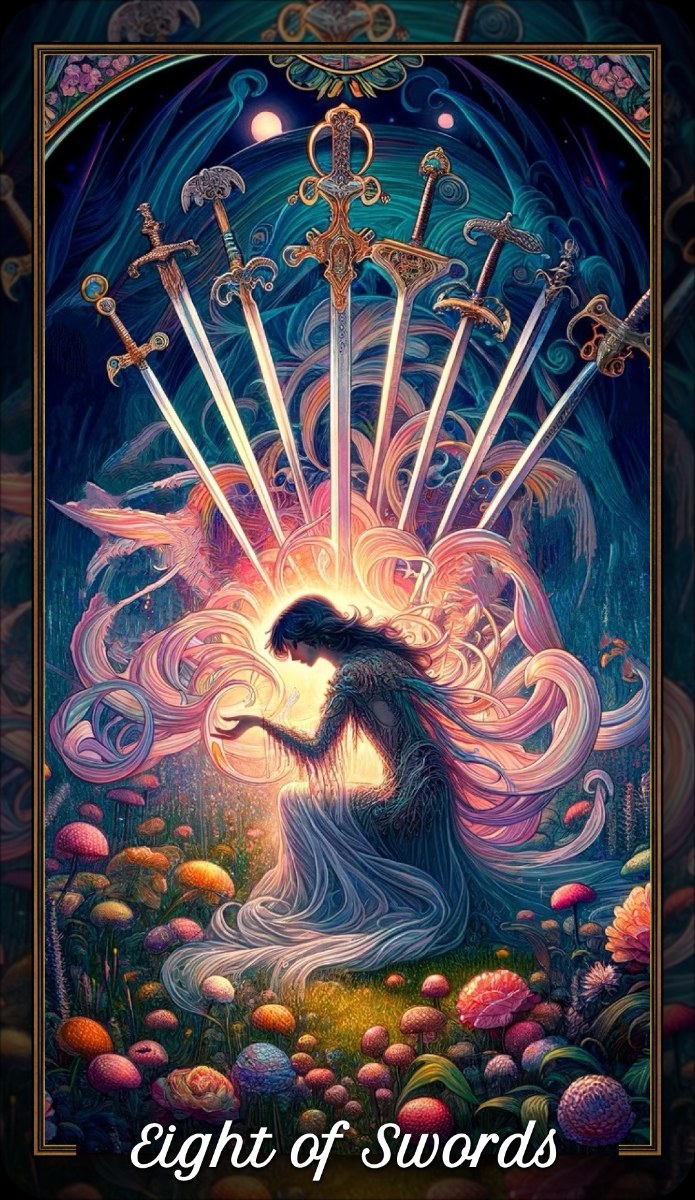
Eight of Swords yes or no is a no, for now — the card shows a situation that genuinely isn't moving, and locates the reason somewhere most cards don't: in how the situation is being seen. The image is exact about this: a bound, blindfolded figure standing among eight swords — and the bindings are loose, the swords have gaps between them, and nothing in the picture actually holds her there except the blindfold. That's the card's whole structure: the no is real, and it's conditional on a perception, which changes what the no means for love, reconciliation, and career questions in ways a one-word answer can't carry — so read on to the version that matches yours. browse yes or no tarot answers
Does Eight of Swords Mean Yes or No?
For a general question, the Eight of Swords is a no — with an unusual scope. In practical terms it says: nothing you asked about moves while the situation stays framed the way it's currently framed. The card describes a state of felt powerlessness — trapped, out of options, unable to act — and it answers from inside that state: no, it doesn't work out, no, the thing doesn't happen — not because the world has ruled it out, but because a person who believes they have no moves makes none, and situations run by someone making no moves go nowhere. If you asked "will this resolve," the honest answer is: not on its own, and not while you're waiting for it to.
The reasoning is in the card's construction, and it repays a close look. Eights in tarot are cards of momentum and consequence — the situation's logic playing out — and Swords rule the mind, so the Eight of Swords is mental momentum turned into a cage: a story of restriction repeated until it feels like fact. Every restraint in the image fails inspection: the ropes are slack, the sword-fence is open on one side, the blindfold is cloth. The card is not describing a prison; it's describing the experience of one — which is why it's worth distinguishing from its blindfolded sibling, the Two of Swords. The Two is a refusal to choose between visible options; the Eight is the belief that no options exist at all. Different problem, and importantly, a different exit: the Two needs a decision made, the Eight needs the blindfold tested.
On the yes-no-maybe spectrum, this sits at "no, for now" with the emphasis earned by both words. The no is genuine — this card never means "everything's fine, proceed" — but it's the most reversible no in the Swords suit, because its cause is the one variable fully inside the asker's reach. The card's real answer to most questions is a redirection: the situation you asked about isn't the locked thing; the frame is. Test one binding — one assumption of the form "I can't" — and the answer to your original question starts changing.
Knight of Swords Yes or No: Fast Yes, Check the Speed, Page of Swords Yes or No: Watching, Not Moving Yet and Ten of Swords Yes or No: A Final, Finished No
Seven of Swords Yes or No: No — Something's Hidden, Five of Swords Yes or No: A Win You'd Regret, Four of Swords Yes or No: Not Yet — Rest First and Eight of Swords as How Someone Sees You: Stuck
Eight of Swords Reversed — Yes or No?
Reversed, the Eight of Swords flips toward yes — and it's one of the genuinely good reversals in the deck. The bindings come off: the blindfold lifts, the story of "no options" breaks contact with reality, and the person in the card discovers what was always true — she can simply walk out. In practical terms, reversed signals self-liberation in progress: seeing the situation clearly for the first time in months, options becoming visible that were technically always there, the first real step out of a stuck place already taken or about to be. If you asked "will I get free of this," reversed answers yes — and sooner than the upright card's fog would ever have let you believe.
The one honest caution: this reversal can also catch the moment just before release, when freedom is visible and being resisted — because leaving a familiar trap means losing the story that made the stuckness bearable ("I had no choice"). If you drew this reversed while actively defending your reasons for staying put, read it as the release arriving over your objections. Either way, the yes/no translation holds: the restricted phase is ending, the answer to your underlying question becomes available as it does, and the card's only instruction is not to re-tie anything on the way out.
Eight of Swords Yes or No for Love and Relationships
For love, the Eight of Swords leans no — and it's essential to hear where the no points, because it isn't at the other person's feelings. This card drawn on a love question describes captivity, in one of two recognizable forms. The first: staying in a relationship out of the belief that leaving is impossible — no one else would want me, I've invested too much, I couldn't manage alone — which is a bond held together by perceived lack of exits rather than by love, and the card names it without cruelty: the relationship isn't the trap; the belief is. The second form: being so bound up in anxious thinking about a connection — decoding messages, rehearsing conversations, monitoring for signs — that the actual person has become unreachable behind the noise. In both cases, if you asked "is this good for me" or "will this work," the card answers: not from inside the bindings — the connection can't be truly read, let alone enjoyed, until the frame that's squeezing it loosens.
Eight of Swords Yes or No: Reconciliation / Getting Back Together
For reconciliation, the Eight of Swords is a no — and it's the rare card whose no is aimed almost entirely at the asker rather than the outcome, which makes it uncomfortable and unusually freeing in the same breath. Drawn on "will he come back," this card generally isn't reporting on him at all. It's describing your position: life on hold, options unexplored, days organized around a decision that belongs to someone else — bound and blindfolded in the exact posture of the image, waiting. The belief doing the binding is usually one specific sentence: he's my only chance at this. And the card's verdict is that reconciliation pursued from inside that sentence fails even when it technically succeeds — because a reunion accepted from powerlessness recreates the dynamic that requires you to stay powerless.
The honest translation, stated once and plainly: the card is not saying he'll never return — it genuinely doesn't address his movements. It's saying the question "will he come back" has become the blindfold, and that the answer you actually need isn't available through it. What this card supports is the untying: rebuilding the parts of your life that got suspended, testing the belief that nothing good exists outside this one door. Paradoxically — and every reader of this card eventually notices it — that's also the only posture from which a reconciliation could ever arrive as a choice rather than a rescue.
Have this exact question? Will we end up together?
Eight of Swords Yes or No: Marriage or Commitment
For marriage, the Eight of Swords is a no — scoped precisely to the reasoning behind the question. Drawn on "should we commit" or "will he propose," the card asks what the commitment would be made from: choice, or perceived lack of alternatives? If any part of the push toward formalizing is "I've invested too many years to leave," "no one better will come," or "at my age this is what's available" — the card answers no, because commitment chosen as the least-bad exit from a feeling of entrapment doesn't resolve the entrapment; it signs a lease on it. The Eight of Swords never blesses a decision made with the blindfold on.
The constructive flip side: this card is not anti-commitment — it's anti-captivity, and the two get confused. Its actual instruction on a marriage question is sequencing: get free first, decide second. Take the blindfold off — honestly inventory the fears steering the choice, verify which constraints are real — and then ask the commitment question again from open ground; a yes from freedom is a different animal from a yes from cornered. If what you're really trying to see is whether the relationship itself is the binding or the thing worth choosing, that's a fuller reading than one card can hold — a full love tarot reading can separate the two.
Eight of Swords Yes or No for Career or Big Decisions
For career questions, the Eight of Swords is a no-for-now that describes one of the most common working conditions there is: feeling trapped in a job. Asked "should I stay," "can I get out of this role," or "is there anything better for me," the card first names the state — golden handcuffs, sunk-cost years, "the market is terrible," "I'm only qualified for this" — and then delivers its finding: most of those restraints, tested, are looser than they look. The card's no applies to the current strategy of enduring and hoping; it does not certify the cage. If you asked "will things improve if I change nothing," the answer is no. If you asked "is escape possible," the card's whole image answers: the ropes are slack.
The practical instruction is to test one binding at a time rather than debate the whole prison: one application sent, one conversation with someone who left, one honest look at the finances behind "I can't afford to." Traps of this card's kind rarely survive contact with a single verified fact. The no converts the day the testing starts.
Signs to Trust This Answer
- Your description of the situation is built from "I can't" statements — count them in how you'd explain it to a friend; this card's territory is confirmed when the restraints in the story outnumber the ones anyone could point to in the world.
- The trapped feeling is old news — if the stuckness has persisted for months while the actual circumstances stayed escapable-looking to everyone around you, that gap between felt and real restriction is exactly what the card measures.
- You haven't tested the exits recently — the reading lands hardest when the honest answer to "when did I last actually try?" is a long time ago; untested bindings are this card's signature.
- If you pulled more than one card, let the neighbors locate the trap: a mind card beside it (Nine of Swords, The Moon) confirms the restriction is internal and anxiety-fed, while The Devil or a controlling court card warns that a real external dynamic is reinforcing the perceived one — a different and more serious reading.
- Relief and resistance arrived together — notice if some part of you pushed back on "the trap isn't locked"; defended bindings are the most accurate sign that the card found the right ones.
Eight of Swords Yes or No — Card Combinations
If you drew more than one card, the card beside the Eight of Swords changes the strength or direction of the answer. Here are the most common combinations and what they indicate:
| Combination | What It Means for Your Yes or No Answer |
|---|---|
| Eight of Swords + Nine of Swords | Confirms and deepens the no — the trap is being maintained by anxiety running at full volume. The restriction is real to the nervous system even if not to the facts, and nothing reads clearly until the spiral is addressed before the situation is. |
| Eight of Swords + The Star | Softens the answer to a hopeful maybe. The stuckness is real but the healing has a direction — this pairing says the way out exists and is gentler than feared, and the first loosening of the bindings is closer than the current fog suggests. |
| Eight of Swords + Ace of Swords | Flips the answer toward yes. A single cut of clarity severs the whole arrangement — one fact verified, one truth spoken, one assumption tested — and the situation that read as impossible reorganizes fast once it lands. |
| Eight of Swords + Judgement | Yes, but not yet — release comes as a wake-up call on its own schedule. Something is coming that makes the bindings impossible to un-see; the freedom is certain, the timing belongs to the call, and the card asks you to answer it when it sounds rather than negotiate with it. |
| Eight of Swords + The Devil | A strong double-confirmation of the card's most serious reading: the perceived trap is being actively reinforced by a real one — a controlling dynamic, a manipulation, a hook. The restriction isn't only in your head, and the no this pairing produces calls for outside support and a real exit plan, not just a mindset shift. |
This Does NOT Mean
The specific over-interpretation readers make with the Eight of Swords is taking it as the deck's confirmation of the trap: she asks "will I ever get out of this," draws a card showing a bound and blindfolded figure, and hears "no — see, even the cards say I'm stuck." The reading becomes evidence for the very belief it came to dismantle. The error is almost built into the image — it looks like a prison at first glance, and a person who already feels imprisoned recognizes herself instantly and stops looking. What gets missed is everything the card put in plain sight for the second look: the slack ropes, the open side of the sword-fence, the ground she could walk across. The Eight of Swords doesn't certify captivity; it diagrams one, restraint by failable restraint, precisely so the diagram can be checked against reality.
The opposite misreading deserves its sentence too: "it's all in your head" turned into a dismissal — as if perceived traps don't hurt, or as if naming the blindfold removes it. It doesn't; beliefs of the "I can't" family are genuinely binding while they're believed, and the card treats them as real forces, not foolishness. The correction holds both truths at once: the trap is doing real work, and it is made of testable parts. So test one — this week, the smallest one: the assumption easiest to check, the exit easiest to try. The card's no is not a life sentence; it's a standing offer that expires the moment you reach up and touch the blindfold.
FAQ
What does Eight of Swords mean as a yes or no card?
The Eight of Swords means no, for now. As a yes/no card, it signals a situation that isn't moving because it's being lived from a position of perceived powerlessness — and the card's central claim is that the restriction is mostly self-imposed: the bindings in the image are loose. The no is genuine but conditional on the frame, which makes it the most reversible no in the Swords suit.
Eight of Swords reversed yes or no?
Reversed, the answer flips toward yes — this is one of the deck's better reversals. The blindfold lifts, options become visible, and self-liberation is already underway: the stuck phase is ending, often faster than the upright card's fog made imaginable. The one caution is release resisted at the threshold; if you're defending your reasons for staying put, the reversal says freedom is arriving over your objections.
Eight of Swords yes or no for love?
Leans no — and the no points at the captivity, not the other person's feelings. Either a relationship is being held together by "I can't leave" rather than by love, or anxious over-thinking has wrapped the connection so tightly it can't be read at all. The card's answer to "is this good for me" is: not from inside the bindings — loosen the frame first, then look at what's actually there.
Eight of Swords yes or no relationship / reconciliation?
No — but not the no you'd expect. The card isn't reporting on whether the ex returns; it's describing your position: life suspended, options unexplored, everything waiting on someone else's decision. The belief "he's my only chance" is the binding itself. The card supports the untying — rebuilding what got put on hold — which is also, not coincidentally, the only ground from which a reunion could arrive as a choice rather than a rescue.
Does the Eight of Swords mean my situation is hopeless?
No — it means nearly the opposite, which is why the card rewards a second look. It appears for situations that feel hopeless while being built from restraints that fail inspection: loose ropes, an open side, a blindfold that lifts. Hopeless is the experience the card depicts, not the verdict it delivers. The one exception worth respecting: paired with The Devil or a controlling figure, the trap may have a real external component — in which case the answer isn't mindset work but support and an exit plan.
Related Readings
Draw your own card with the Yes or No Tarot tool, or if you're still working out what you're really asking, start wider with a Free Tarot Reading.