
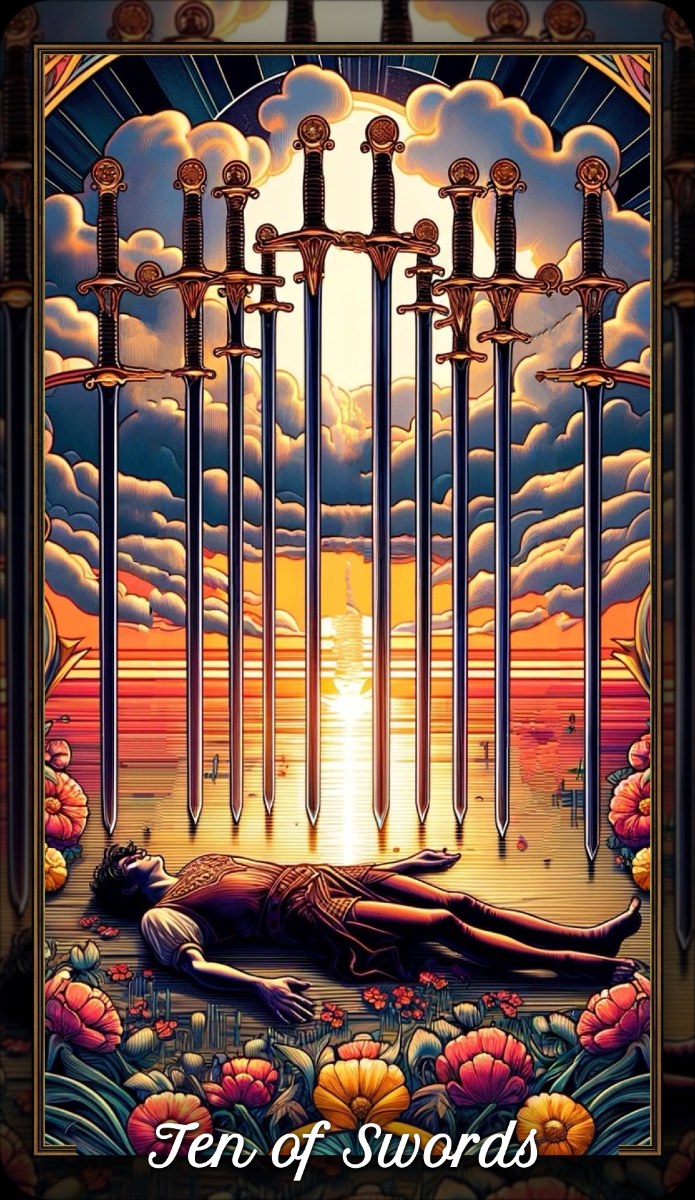
The Ten of Swords as how someone sees you means he perceives you, or the connection between you, as something that's already reached its end. Most generic tarot sites will hand you "rock bottom, painful conclusion, finality" as generic upright keywords, without ever asking the one question that actually matters: is this ending real, or is it a story he's telling himself so he can feel justified in walking away? Declaring something finished is sometimes less about facts and more about giving himself permission to disengage.
What the Ten of Swords Says About How He Sees You
When the Ten of Swords shows up in a how-someone-sees-you reading, the named quality is finality. He's not perceiving you as someone struggling through something ongoing — he's perceiving you, or your situation together, as something that has already concluded. This might mean he sees you as someone who's been through the worst of a hard period and come out the other side of it, or it might mean he considers the relationship or connection between you finished, past the point of repair.
This perception can absolutely be accurate. If there's genuinely been a definitive ending — a breakup that's truly done, a rock-bottom moment that's clearly behind you — he may simply be reading the situation correctly. But this is also one of the cards most prone to self-serving projection. People who want to leave, or who feel too tired to keep trying, often need to perceive the situation as unsalvageable before they can give themselves permission to walk away. Declaring something "over" can be more about his readiness to exit than about the actual, more ambiguous state of things.
Either way, the quality assigned to you is clear: connected to an ending. Worth being honest with yourself about whether that ending is real, or whether it's a convenient narrative that serves him more than it reflects the truth.
Ten of Swords Reversed as How Someone Sees You
Reversed, this often shifts toward a perception of resistance to accepting an ending that's actually already happened — he may sense that something between you is over but hasn't fully let himself acknowledge it, dragging out a conclusion rather than facing it directly. This can look like inconsistency: distant one moment, engaged the next, as he goes back and forth on a decision he hasn't actually made.
It can also point to a perception of recovery — he may see you as someone who hit a genuine low point and is now visibly on the way back up, rather than still there. Whether this shifts toward acceptance or toward continued avoidance usually comes down to whether he's willing to name what he actually believes rather than letting ambiguity drag on indefinitely.
What This Means For Your Situation
If This Is a Crush or Early Stage
If this shows up early, it's worth asking directly whether he perceives something between you as already concluded — perhaps a previous attempt, a stalled conversation, or an earlier version of a connection he's decided didn't work. Early "endings" declared without much basis are sometimes more about hesitation on his part than a genuine dead end.
If You're in a Relationship
Here, this card deserves direct attention rather than quiet worry. If he genuinely perceives the relationship as finished, that's a conversation worth having openly rather than avoiding. If it's a premature or self-serving narrative — a way of justifying pulling back without doing the harder work of addressing what's actually wrong — that's worth naming too, since it won't resolve on its own.
How This Perception Affects His Behaviour
Someone who perceives an ending tends to behave like someone already halfway out — less invested in resolving conflict, less inclined to make future plans, more prone to treating problems as confirmation rather than something to work through. If he's constructing this narrative to justify disengaging rather than because it's genuinely true, you may notice him avoiding direct conversation about what's actually going on, since naming it clearly would require him to defend a conclusion that doesn't fully hold up.
Is This How You Want to Be Seen?
Almost certainly not, and this is a card worth confronting directly rather than absorbing quietly. If the ending is real, clarity — even painful clarity — serves you better than uncertainty. If it isn't real, and he's using "it's over" as a shortcut to avoid effort, that's worth calling out rather than accepting as an unchangeable verdict.
Does This Perception Lead to Action?
Usually toward disengagement rather than repair. The Ten of Swords describes a perceived conclusion, and people rarely invest further in something they've already mentally filed as finished — this perception typically precedes withdrawal, not renewed effort. For this to shift, something concrete usually has to interrupt the narrative he's settled into: a direct conversation that challenges the "it's over" story, or a genuine change in circumstances that makes the ending feel less final than he's assumed. Without that interruption, this card tends to describe someone already moving toward the exit rather than someone reconsidering.
Ten of Swords as How Someone Sees You — Card Combinations
The card beside the Ten of Swords in a how someone sees you reading shifts the perception significantly. Here are the most common combinations and what they indicate:
| Combination | What It Means in a How Someone Sees You Reading |
|---|---|
| Ten of Swords + The Sun | He perceives the worst as genuinely behind you rather than an ongoing crisis, and may feel encouraged to re-engage now that he sees a hopeful chapter starting rather than continued decline. |
| Ten of Swords + Death | He perceives a genuine and necessary ending rather than a dramatic overreaction — this combination tends to confirm the conclusion is real rather than exaggerated, with little chance of reversal. |
| Ten of Swords + The Hanged Man | He hasn't fully accepted the ending he perceives, stuck in a suspended state between acknowledging it's over and holding on anyway — a shifting, unresolved read that can go either direction. |
| Ten of Swords + Two of Cups | A conflicted perception: part of him considers things over, but he still feels a genuine pull toward reconciliation, creating a push-pull between declared finality and lingering hope. |
| Ten of Swords + Four of Swords | He's disengaging quietly rather than addressing the perceived ending directly, choosing withdrawal and rest over confrontation — a pattern that tends to prolong ambiguity rather than resolve it. |
This Does NOT Mean
The most common mistake readers make with this card is accepting "he sees it as over" as an objective, unchangeable fact, without questioning whether that perception is actually true or simply convenient for him. It's an easy trap because endings feel definitive by nature — but people frequently declare things finished as a way of avoiding the harder, more honest work of naming what's actually wrong and trying to fix it.
The correction: before accepting this as a closed door, ask whether the ending he perceives is based on something real and specific, or whether it's a narrative that conveniently lets him step back without further effort. Not every declared ending is actually final.
FAQ
Is the Ten of Swords as how someone sees you a good sign?
No — this card generally reflects an unfavorable perception tied to endings or finality. It's not a card that suggests hope for continued closeness, at least not without direct intervention.
Ten of Swords reversed — how does he see me?
Reversed often points to him resisting an ending he senses is already true, or alternately, perceiving you as recovering from a genuine low point rather than still in it. The surrounding cards usually clarify which applies.
Does the Ten of Swords as how someone sees you mean he likes me?
Not typically in the sense of active interest — this card describes a perception of conclusion, which usually works against continued investment rather than for it, regardless of whatever feelings may have existed before.
Does the Ten of Swords mean he respects me?
It doesn't speak clearly to respect either way. This card is about a perceived ending, not admiration — check other cards in the spread if respect specifically is what you're trying to gauge.
Does the Ten of Swords mean it's actually over between us?
Not necessarily. This card reflects his current perception, which may be accurate or may be a convenient narrative he's using to justify pulling back. Worth having a direct conversation before accepting his read as the final word.
Related Readings
If you want to go deeper on how he actually thinks and feels about you, these spreads pair well with this reading:
What Does He Think of Me spread How Does He Feel About Me spread Does He Love Me spread Is He Thinking of Me spread