
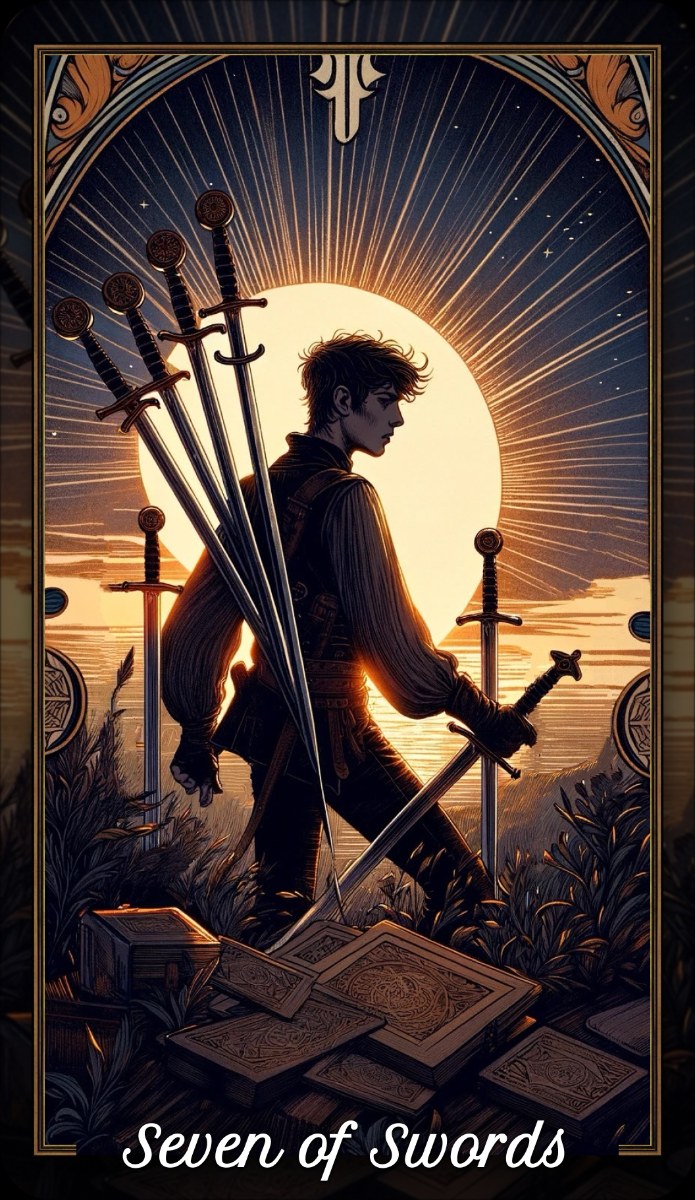
Seven of Swords yes or no is a no — this is the deck's deception card, and drawn on a yes/no question it says something in the situation is hidden, evasive, or being done behind someone's back, which poisons whatever answer sits on the surface. The image carries the whole meaning: a figure slipping away from camp with an armful of stolen swords, glancing back to check he hasn't been seen. One thing to hold onto before the no fully lands: this card flags dishonesty somewhere in the picture — it doesn't, by itself, name the person or the crime, and who's doing the sneaking changes the reading completely. That, plus how the answer shifts for love, reconciliation, career, and money, is what the rest of this article sorts out. browse yes or no tarot answers
Does Seven of Swords Mean Yes or No?
For a general question, the Seven of Swords is a no. In practical terms it says the situation you asked about is not operating in good faith: information is being withheld, someone is working an angle they haven't disclosed, or the version of events you're being shown is curated. If you asked "will this work out," the honest answer is no — not necessarily because the outcome is impossible, but because outcomes negotiated on hidden terms don't hold; whatever gets built on the concealed thing gets rebuilt or destroyed when the concealed thing surfaces, and it always surfaces.
The reasoning comes from the card's structure. Sevens in tarot are cards of strategy and testing — situations that demand cleverness — and Swords rule the mind and words, so the Seven of Swords is cleverness turned covert: the plan executed quietly, the truth managed rather than told, the shortcut taken through someone else's camp. Notice the detail that defines the card's verdict: the figure is carrying five swords and leaving two behind. The scheme is incomplete — sneaking, in this card's universe, never gets everything, and what it leaves behind is usually what undoes it. That's why the card reads no even when the covert plan is technically succeeding: it's succeeding on borrowed time.
On the yes-no-maybe spectrum, this sits firmly at no, with the important scope-note that the no is provisional in one specific way: it's a no about proceeding while the hidden thing stays hidden. The Seven of Swords doesn't say the underlying question — the relationship, the deal, the plan — is doomed forever; it says no answer given now is trustworthy, because the inputs are dishonest. The card converts into a real, final answer only after the concealed element comes into the open. Until then, treat every reassurance in the situation as unverified.
Knight of Swords Yes or No: Fast Yes, Check the Speed, Page of Swords Yes or No: Watching, Not Moving Yet and Ten of Swords Yes or No: A Final, Finished No
Five of Swords Yes or No: A Win You'd Regret, Four of Swords Yes or No: Not Yet — Rest First, Three of Swords Yes or No: An Honest No and Seven of Swords as How Someone Sees You: Withholding
Seven of Swords Reversed — Yes or No?
Reversed, the Seven of Swords shifts rather than flips — the sneaking phase is ending, because the secret is surfacing. This reversal classically means confession, exposure, or conscience catching up: the hidden thing comes to light, someone finally comes clean, the covert plan is discovered or abandoned. What that does to your yes/no depends entirely on which side of the secret you're on. If you're the one being kept in the dark, reversed is genuinely better news than upright: the fog you've been living in is about to clear, and the real answer to your question — whatever it is — becomes available once it does.
If the hidden maneuvering is yours — the monitoring, the strategic silence, the plan you haven't told anyone about — reversed says the cover is failing: come clean on your own terms before the exposure happens on someone else's. Either way, the practical yes/no translation is the same: still not a yes to the outcome you asked about, but a yes to the truth arriving — and this card reversed is one of the deck's more reliable signals that a concealed situation is in its final act. Hold your decision until the reveal; it's close enough to wait for.
Seven of Swords Yes or No for Love and Relationships
For love, the Seven of Swords is a no — and it's crucial to hear what kind: this is a trust verdict, not a feelings verdict. The card doesn't say the attraction is fake or the love absent; it says something in the connection is undisclosed, and love can't be confirmed while its actual terms are hidden. In a new connection, that reads as an agenda you haven't been shown — someone not being fully straight about their situation, their intentions, or what else is running in their life. In an established relationship, it reads as evasion: conversations deflected, a phone angled away, a gap between the story and the schedule — or, sometimes, your own concealments, the things you're managing rather than saying. If you asked "can I trust this," the card answers no, not as it currently stands — and it locates the problem precisely: not in what you feel, but in what you haven't been told.
Seven of Swords Yes or No: Reconciliation / Getting Back Together
For reconciliation, the Seven of Swords is a no — and it cuts in two directions, so check both honestly. The first: the ex is being evasive. Warm enough to keep you hoping, vague enough to commit to nothing, possibly keeping you in reserve while pursuing other options — the card says the intentions you're trying to read are being deliberately obscured, and a reunion can't be built on someone whose real position you're not allowed to see. If that description lands, the no is about him, and the instruction is to stop decoding mixed signals and require a straight answer.
The second direction is harder to hear: sometimes the figure sneaking through the camp is the asker. If your reconciliation plan involves monitoring his accounts, engineering coincidental run-ins, going through friends for intelligence, or presenting a strategically edited version of yourself to win him back — the card is describing your campaign, and its verdict applies: what's obtained by stealth is held by stealth, forever, because the reunion's foundation would be a maneuver he never saw. A reconciliation this card could ever bless starts with the swords put back — direct contact, real cards on the table — and if that feels impossible, that feeling is the actual answer to your question.
Have this exact question? Will we get back together?
Seven of Swords Yes or No: Marriage or Commitment
For marriage, the Seven of Swords is a no with a non-negotiable condition attached: not while something material is concealed. Drawn on "will he propose" or "should we commit," it says the commitment question is being asked over the top of an undisclosed thing — a debt, a doubt, a past, a parallel situation, an intention that doesn't match the words — and formalizing a bond around a hidden variable doesn't neutralize the variable; it signs you up for its eventual detonation. The card's answer isn't "this person can never be committed to" — it's "no commitment is real until the hidden thing is on the table."
The practical translation: if you have a specific suspicion, this card says the suspicion deserves a direct conversation before any next step — not surveillance, a conversation. And if the concealment is yours — something you're planning to sort out quietly after the ring — the card is addressed to you: disclosure first, commitment second, because the order doesn't reverse well. If what you're really trying to establish is whether the trust in this relationship is repairable or structural, that's beyond a single card's scope — a full love tarot reading can examine the foundation itself.
Seven of Swords Yes or No for Career or Big Decisions
For career questions, the Seven of Swords is a no that usually points at a person rather than an outcome. Asked "can I trust this workplace," "is my colleague straight with me," or "will this go smoothly," the card flags operating dishonesty in the environment: credit being quietly taken, a plan moving behind closed doors that affects you, an ally who's also reporting elsewhere, terms in the offer that aren't what they seem. If your question was about whether to rely on someone's stated position — don't, yet. Verify independently; this card's entire message is that the stated position and the actual position differ.
For decisions, the card draws one bright line: if the move you're weighing only works done covertly — the exit planned in secret while assuring everyone you're staying, the maneuver around a colleague rather than through a conversation — the card answers no, not because stealth never works short-term but because it's the two swords left behind that end careers: the detail forgotten, the person who saw. Protect yourself in writing, keep your own dealings clean, and treat anything you'd hate to have read aloud as the thing that eventually will be.
Seven of Swords Yes or No for Money
For money questions, the Seven of Swords is a flat no — and uniquely among Swords cards, its financial meaning is literal: the figure in the image is stealing. Asked "is this deal legitimate," "should I trust this investment," "will I get my money back," the card answers no: something in the arrangement is designed not to be seen — terms that shift after signing, a too-good return, a borrower who intends the loan as a gift to themselves. This is the deck's scam card, and drawn on any question involving handing money over on trust, the instruction is: don't, until every term is verified in writing by someone on your side.
Distinct from the career point, this applies to informal money too — the friend's loan, the split arrangement, the shared account: the card says the informality is where the leak is. If money is already gone and you asked about recovery, the honest lean is no through goodwill — pursue formal routes, not promises.
Signs to Trust This Answer
- Something already doesn't add up — a story that shifted between tellings, a schedule with unexplained gaps, terms that got vaguer when you asked for specifics; this card confirms discrepancies far more often than it invents them, and a nameable discrepancy grounds the reading.
- Your question was about trust — "is he honest," "is this legit," "can I rely on this" — because good-faith verification is this card's exact register, and its no is most reliable when trust was literally what you asked.
- You checked your own hands first — the card's accuracy doubles once you've honestly ruled in or out whether any of the sneaking (monitoring, strategic edits, covert plans) is yours; readers who skip this check misassign the card most often.
- If you pulled more than one card, let the neighbors set the severity: a heartbreak card beside it (Three of Swords) points toward betrayal in love specifically, a material card (any Pentacle) toward the financial reading, while a truth card (Ace of Swords, Judgement) says the concealment is near exposure.
- The reassurances you've received are verbal only — if every comfort in the situation is words while the checkable facts stay unofferable or off-limits, that asymmetry is precisely the condition this card describes.
Seven of Swords Yes or No — Card Combinations
If you drew more than one card, the card beside the Seven of Swords changes the strength or direction of the answer. Here are the most common combinations and what they indicate:
| Combination | What It Means for Your Yes or No Answer |
|---|---|
| Seven of Swords + The Moon | Confirms and deepens the no. The deception runs further than what you've noticed — what's visible is the edge of it, not the extent — and this pairing says trust nothing in the situation until far more surfaces than has so far. |
| Seven of Swords + Two of Cups | Softens the answer to a maybe, with a specific shape: genuine mutual feeling exists underneath the concealment. The sneaking may be avoidance or fear rather than betrayal — still a real problem, but one an honest conversation could survive, which pure bad faith could not. |
| Seven of Swords + Ace of Swords | Flips the trajectory of the answer. The hidden thing gets cut open — fast. Truth arrives, the covert operation fails in daylight, and the situation finally becomes answerable; a no about the current fog becomes a yes to clarity, usually within days. |
| Seven of Swords + The Hanged Man | The truth comes out, but not yet. The concealment holds through a suspended stretch where nothing you do accelerates the reveal — the answer to your question exists and is coming, on a timeline you can't force; don't act until it lands. |
| Seven of Swords + The Devil | A strong double-confirmation of the card's hardest reading: the dishonesty isn't an incident, it's a structure — manipulation, a hook, a dynamic built to keep someone from leaving or seeing clearly. The no this pairing produces is one to act on promptly, not investigate indefinitely. |
This Does NOT Mean
The specific over-interpretation readers make with the Seven of Swords is converting a flag into a verdict: she asks "is he faithful," draws the deck's deception card, and arrives at his door with a conviction the card never issued. The error is understandable — this card really is the deck's primary dishonesty signal, and on a trust question it really is saying something is hidden — but "something is hidden" has a range: an affair, yes, possibly; also an undisclosed debt, a doubt he hasn't voiced, a job situation he's ashamed of, a conversation he's avoiding. The card identifies concealment; it does not identify contents. Acting as though it named the crime — the accusation, the phone search, the ambush — replaces his possible deception with your certain surveillance, and hands the moral ground to exactly the wrong side of the reading.
The correction is to use the card as it's built: as grounds for a direct question, not grounds for a sentence. "Something isn't adding up for me and I need us to talk about it honestly" is the Seven of Swords deployed correctly — it names the concealment without inventing its contents, and it forces the one thing this card says the situation lacks: daylight. The mirror-image error deserves its line too: readers who draw this card and quietly recognize their own maneuvering sometimes dismiss the reading as being "about him." The card doesn't take sides; it takes inventory. Whoever's carrying the swords, the instruction is identical — put them back, say the true thing, and then ask your question again in the open, where answers actually mean something.
FAQ
What does Seven of Swords mean as a yes or no card?
The Seven of Swords means no. As a yes/no card, it signals that the situation isn't operating in good faith — information is withheld, someone is working an undisclosed angle, and answers given on hidden terms can't be trusted. Its no is provisional in one way: it applies while the concealment holds, and converts into a real answer once the hidden thing surfaces.
Seven of Swords reversed yes or no?
Reversed, the secret surfaces — confession, exposure, or conscience catching up. It's still not a yes to the outcome you asked about, but it's a yes to the truth arriving soon, which is better news than upright if you're the one being kept in the dark. If the hidden maneuvering is yours, reversed says the cover is failing: come clean on your own terms before the reveal happens on someone else's.
Seven of Swords yes or no for love?
No — as a trust verdict, not a feelings verdict. The card doesn't declare the love absent; it says something in the connection is undisclosed — an agenda, an evasion, a gap between the story and the facts — and love can't be confirmed while its real terms are hidden. The instruction is a direct conversation about the discrepancy, not surveillance and not pretending you haven't noticed.
Seven of Swords yes or no relationship / reconciliation?
No — in one of two directions. Either the ex is being deliberately vague — warm enough to keep you hoping, evasive enough to commit to nothing — or the reconciliation is being pursued through stealth: monitoring, engineered run-ins, strategic edits. The card's verdict covers both: nothing real gets built on concealed intentions, and a reunion worth having starts with the swords put back and a straight conversation.
Does the Seven of Swords mean he's cheating?
It means something is hidden — which can include cheating and often doesn't. This card is a genuine flag for concealed behavior, and it is not, alone, proof of an affair: the hidden thing can equally be a debt, a doubt, an avoided conversation, or a situation he's ashamed of. Look for supporting cards before reading betrayal specifically — Three of Swords or The Devil beside it sharpens the concern; alone, the card justifies one thing only: asking him directly, in the open, and weighing how he handles the question.
Related Readings
Draw your own card with the Yes or No Tarot tool, or if what you're really weighing is the trust in a whole relationship, go deeper with a Love Tarot Reading.