
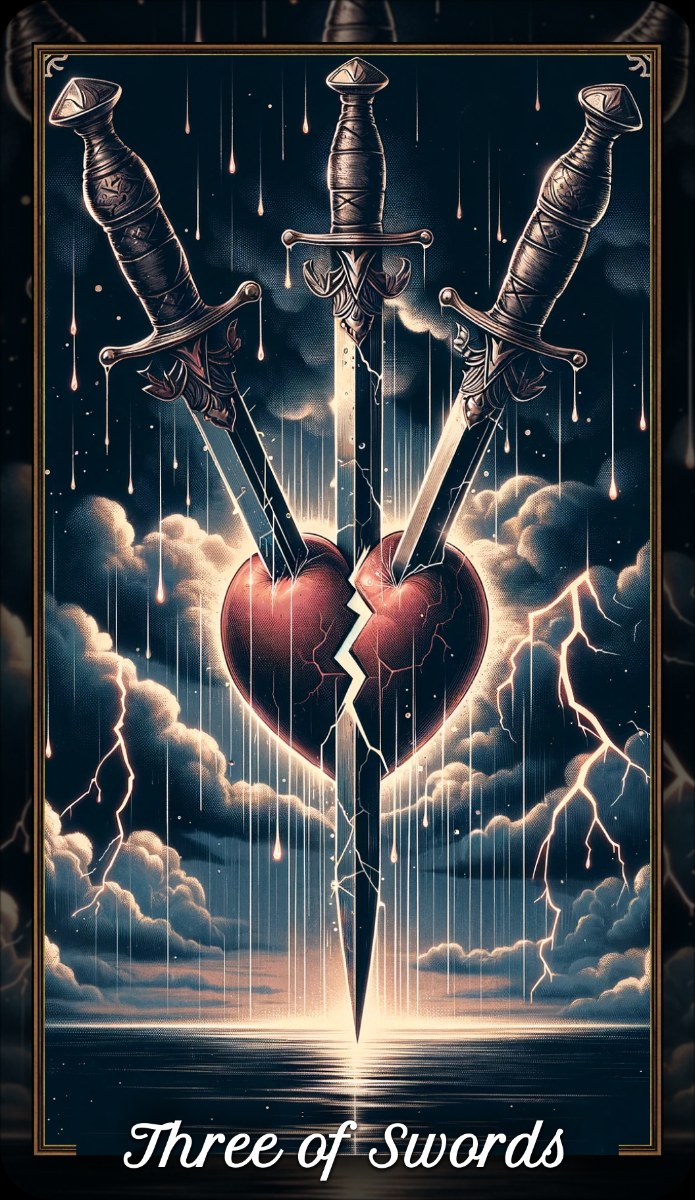
The Three of Swords as how someone sees you means he associates you with hurt — but whose hurt matters more than most tarot sites bother to ask. Most generic readings will hand you "heartbreak, betrayal, grief" as if that's the full picture, without ever splitting the two very different things this card can mean: he may see you as connected to pain he's already carrying, or he may perceive you as someone currently wounded and be treating you with a caution built around that. Those lead to very different situations, and this card alone won't tell you which one you're in.
What the Three of Swords Says About How He Sees You
When the Three of Swords shows up in a how-someone-sees-you reading, it names a perception rooted in pain — but the pain doesn't necessarily originate with you. One version: you remind him of a past betrayal or heartbreak, sometimes because of something you actually did, sometimes simply because you carry a quality — a look, a pattern of behavior, a way of pulling back — that echoes someone who hurt him before. In this version, his caution around you isn't really about you at all. It's transference, and you're catching the emotional weather from a storm that happened somewhere else.
The other version: he perceives you as someone who is currently hurting, grieving, or recovering from something painful, and he's responding to that perception by softening his approach — being gentler, more careful, less direct than he might otherwise be. This can be a genuinely accurate read if you have in fact been going through something visible. It becomes projection only if he's assuming pain you're not actually carrying, perhaps because something about your energy reminds him of someone who was.
Either way, the named quality is the same: you are perceived through the lens of pain, not through a clean, neutral read of who you are right now. That's worth sitting with, because it means his behavior toward you may be responding to a story in his head as much as to you directly.
Three of Swords Reversed as How Someone Sees You
Reversed, this often shifts toward him seeing you specifically as the source of a wound rather than someone associated with one more generally. Instead of "she reminds me of pain," it becomes "she is the person who caused it" — a harder, more personal version of this perception, and one that usually means there's a specific incident or moment he's still holding against you, whether or not he's said so directly.
This version tends to be stickier than the upright meaning because it's rooted in something concrete rather than an old association. It can shift, but usually only if the actual incident gets addressed — an apology, an explanation, a real conversation about what happened — rather than fading on its own through time or distance.
What This Means For Your Situation
If This Is a Crush or Early Stage
If this is showing up early, it's worth considering that his hesitancy might have nothing to do with how he feels about you and everything to do with a past relationship he hasn't fully processed. This doesn't mean you should wait around to be his healing project, but it does mean any distance you're sensing may be self-protection on his end, not a verdict on you.
If You're in a Relationship
Here, this card often points to an old wound — his or possibly one you actually caused — that's still quietly shaping how he engages with you. If it's his, this may be a sign the relationship would benefit from him doing some work on his own history. If it's something you did, this is usually a signal that the incident hasn't actually been resolved between you, whatever surface-level peace exists.
How This Perception Affects His Behaviour
Someone who associates you with pain — theirs or yours — tends to move more carefully around you than he might otherwise. He may hold back from full vulnerability, test the waters before committing to anything, or seem inconsistent between warmth and withdrawal as old patterns surface and recede. If he perceives you as currently hurting, this caution can look like tenderness; if he perceives you as the source of his own hurt, it can look more like guardedness or quiet resentment.
Is This How You Want to Be Seen?
Worth being honest with yourself here. Being perceived as someone worth protecting because you're hurting is different from being perceived as someone who caused hurt — one invites care, the other invites distance. If you're not sure which version is active, it's worth considering what's actually happened between you rather than assuming the more flattering read.
Does This Perception Lead to Action?
Rarely on its own, and often in the wrong direction. When someone associates you with pain — whether it's old transference or an unresolved incident — the typical response is caution and self-protection, not pursuit. For this to shift toward him moving closer, the underlying pain usually needs to be addressed directly: him working through what he's actually carrying, or the two of you naming and resolving whatever specific thing sits between you. Without that, this card tends to describe a slow-motion holding pattern rather than momentum toward anything.
Three of Swords as How Someone Sees You — Card Combinations
The card beside the Three of Swords in a how someone sees you reading shifts the perception significantly. Here are the most common combinations and what they indicate:
| Combination | What It Means in a How Someone Sees You Reading |
|---|---|
| Three of Swords + The Star | He associates you with past pain but also perceives you as the source of healing from it — a combination that can genuinely draw him closer as he begins to separate you from the old wound. |
| Three of Swords + Eight of Swords | He feels trapped by the association he's made between you and past hurt, unable to see you clearly past it — a perception that tends to stay frozen without a deliberate effort to break the pattern. |
| Three of Swords + The Tower | Points to a specific rupture between you rather than vague old pain — something identifiable happened, and his current perception is still shaped by the aftermath of that exact moment. |
| Three of Swords + Queen of Cups | A conflicted perception: he sees you as both connected to pain and as someone genuinely nurturing, caught between guardedness and the pull toward your warmth. |
| Three of Swords + Ten of Pentacles | The old pain fades in significance against a growing sense that you belong in his longer-term picture — amplifying a positive shift where the hurt becomes secondary to what he's building toward with you. |
This Does NOT Mean
The most common mistake readers make with this card is assuming "he sees me as connected to pain" means he blames them personally for something, full stop. That's sometimes true, but just as often the pain belongs to an old relationship entirely separate from you, and you're simply standing in a spot that triggers the memory. The two situations look identical from the outside — distance, caution, inconsistency — but they call for completely different responses.
The correction: don't assume responsibility for a wound that predates you. If there's genuinely something specific between the two of you that needs addressing, that's worth facing directly. But if this card is picking up on his unresolved history rather than anything you've done, the work that needs to happen isn't yours to do.
FAQ
Is the Three of Swords as how someone sees you a good sign?
Not typically — it points to a perception shaped by pain rather than clarity, whether that pain is his own history or something unresolved between you. It's not necessarily a dead end, but it's rarely described as favorable on its own.
Three of Swords reversed — how does he see me?
Reversed, he's more likely to see you as the direct source of a specific hurt rather than someone loosely associated with old pain. It tends to point to an actual incident that hasn't been resolved between you.
Does the Three of Swords as how someone sees you mean he likes me?
Not directly — this card describes a perception filtered through pain, not a statement about his feelings. He can genuinely like you and still hold this kind of guarded association at the same time.
Does the Three of Swords mean he respects me?
It doesn't speak clearly to respect either way. This card is about emotional association, not admiration — check other cards in the spread if respect is what you're trying to gauge.
Does the Three of Swords mean he sees me as fragile?
Possibly, if the perception is that you're currently hurting rather than that you caused hurt. In that version, his caution may come from not wanting to add weight to something you're already carrying, rather than from seeing you as weak.
Related Readings
If you want to go deeper on how he actually thinks and feels about you, these spreads pair well with this reading:
What Does He Think of Me spread How Does He Feel About Me spread Does He Love Me spread Is He Thinking of Me spread