
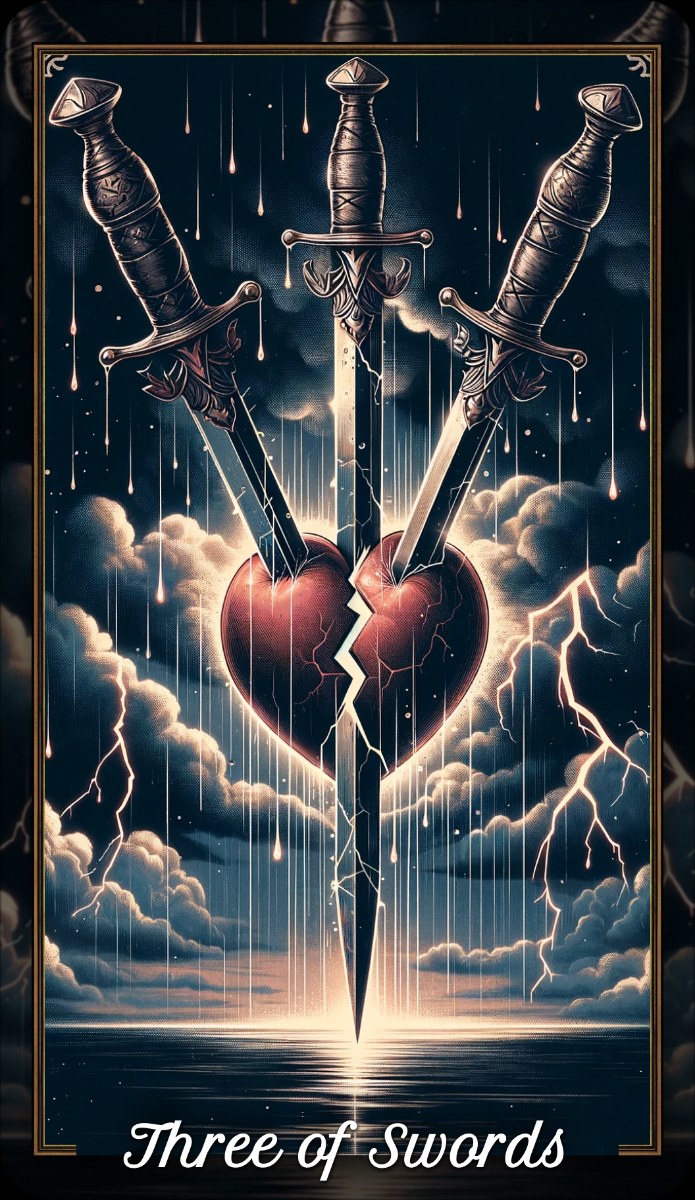
The Three of Swords is the card people dread, the "heartbreak card," read as a sign that something terrible is about to happen. That reading treats the card as a curse when it is really a description. The Three of Swords shows the specific pain of a truth landing in the heart: a betrayal discovered, a feeling not returned, words that cannot be unsaid, a loss you can no longer pretend is not real. Notice that there is no mystery in the image. The heart is plainly pierced, and rain is falling. This is pain that is clear rather than confusing, and grief that has started to move. The card does not say you will always hurt. It says you are allowed to hurt now.
Last updated: October 2026
Key Takeaways
- Upright, the Three of Swords signals heartbreak, grief, painful truths, betrayal, and emotional hurt that cannot be avoided.
- Reversed, it splits two ways: healing and release as the pain begins to ease, or pain held onto, suppressed, or reopened rather than processed.
- It is a card of truth as much as sorrow. The hurt is real, but it is also the beginning of seeing clearly and, eventually, of healing.
Three of Swords At a Glance
| Attribute | Detail |
|---|---|
| Number | 3 |
| Arcana | Minor Arcana |
| Element | Air |
| Ruling Planet | Saturn (Saturn in Libra, in the Golden Dawn system) |
| Zodiac Link | Libra, specifically its second decan (roughly October 3 to October 12). The Golden Dawn calls this card the Lord of Sorrow. Saturn's hard lessons falling on Libra, the sign of relationships and harmony, fits the card closely, and the correspondence is well established. |
| Numerology | 3: growth, expression, and the consequences that emerge when two forces meet |
| Upright Keywords | Heartbreak, grief, sorrow, painful truth, betrayal, separation, emotional pain, rejection |
| Reversed Keywords | Healing, recovery, forgiveness, release, or suppressed grief, lingering pain, reopened wounds, self-inflicted hurt |
Three of Swords Numerology
Three is the number of growth and expression, what emerges when two forces come together. In the suit of Cups, that emergence was celebration. In the suit of Swords, which governs thought, truth, and conflict, it is the moment a mental standoff resolves, and the result is often painful. The Two of Swords held two blades in careful balance; the Three of Swords shows what happens when the truth those blades were holding back finally comes through. The number's growth here is the hard kind, the growth that follows from facing something you could not avoid any longer.
Three of Swords Symbolism
In the Rider-Waite-Smith deck, the Three of Swords is one of the few cards with no human figure at all. Instead, a large red heart hangs suspended in the air, pierced cleanly by three swords. Behind it, heavy grey clouds fill the sky, and rain falls in steady streaks. The image is stark and almost diagrammatic, which gives it unusual directness. There is no story to decode, only the plain fact of the wound.
The absence of people is meaningful. The card focuses on the experience of pain itself rather than on who caused it or how, which is why it can apply equally to romantic heartbreak, family grief, betrayal, or the pain of hearing a hard truth about yourself. The three swords are often read as the mind's role in suffering: words that cut, thoughts that replay the hurt, or truths that pierce through denial. The storm and rain, though, are not only bleak. Rain is release, the sky letting go of what it has been holding, much as tears do. Storms also pass. The card captures the most painful moment, but it implies that the weather will change.
Three of Swords Upright Meaning
Upright, the Three of Swords describes heartbreak and emotional pain. It may arrive through a breakup, a betrayal, a rejection, a bereavement, a cruel word, or the discovery of something you did not want to know. It can also describe grief that is not tied to a single event, such as sorrow over a situation, a disappointment you saw coming, or the slow realisation that something important is over. Whatever its source, the card acknowledges that the pain is real and significant. It is not exaggerated, and it does not need to be hidden or explained away.
Because it belongs to the suit of Swords, the Three is also about truth. The hurt often comes from finally seeing something clearly: what someone really felt, what a situation really was, or what you have been avoiding. That clarity is painful, but it is also what makes healing possible, because you can only grieve what you have admitted is real. The card encourages you to let yourself feel the pain rather than numbing it, to talk about it with people you trust, and to resist the urge to replay it endlessly in your mind. Grief has its own pace. The Three of Swords does not promise it will pass quickly, only that this storm, like all storms, is not permanent.
Three of Swords Reversed Meaning
The reversed Three of Swords splits into two distinct expressions, describing opposite relationships with pain.
The first is healing. The swords are being drawn out. After a period of heartbreak or grief, the pain is beginning to ease, and you are starting to recover. This may involve forgiveness, of someone else or of yourself, a sense of acceptance, or simply finding that the hurt no longer dominates every day. The reversed card in this form is hopeful: the storm is passing, and you are beginning to see light again. It does not mean the loss did not matter, only that you are learning to carry it differently.
The second is pain that has not moved. Instead of healing, the wound is being held onto, pushed down, or reopened. This can look like refusing to grieve, insisting you are fine while the pain shows up as anger, numbness, or exhaustion. It can also look like replaying the hurt over and over, keeping it fresh, or returning to the person or situation that caused it. In some readings, it describes self-inflicted pain: harsh self-criticism, guilt, or negative thinking that keeps cutting. The reversed card in this form gently asks you to stop holding the swords in place and to seek support in letting them go.
Three of Swords in Love
Love is where the Three of Swords is most often drawn and most feared. It is one of tarot's clearest images of heartbreak, but it is not always a prediction of doom. It describes pain that has happened, is happening, or needs to be faced, and it asks how you will move through it rather than whether you will.
Upright in Love
Single: For someone single, the Three of Swords often reflects heartbreak from a past relationship that still hurts, or a recent rejection or disappointment. It can also show unrequited feelings, loving someone who does not love you back. The card validates that this pain is real and worth grieving. It encourages you to let yourself feel it fully, rather than rushing into someone new to escape it, so that when you are ready for love again, you are not carrying unhealed wounds into it.
New relationship: In a new relationship, the Three of Swords can signal an early disappointment: a hurtful word, a discovered lie, a mismatch in feelings, or a painful realisation about the other person. It may also indicate that old heartbreak from previous relationships is affecting this one. The card does not automatically mean the relationship is over, but it does ask for honesty about what has happened and whether trust can be built from here.
Existing partnership: For an established couple, the Three of Swords often points to a painful period: an argument that cut deep, betrayal or infidelity, a separation, or shared grief such as a loss in the family. It may also reflect hurtful truths being spoken, things that needed to be said but were painful to hear. Whether the relationship survives depends on whether both partners can face the hurt honestly and work through it. Sometimes the card marks a crisis that leads to deeper understanding; sometimes it marks an ending.
An ex: Around an ex, the upright Three of Swords most often reflects the grief of the breakup itself, the pain of loss, rejection, or betrayal. It may also indicate learning something painful about the ex or about why the relationship ended. The card rarely points to reconciliation. Instead, it encourages you to allow yourself to grieve, so that the pain can eventually release its grip.
Reversed in Love
Single: Reversed, the Three of Swords for a single person often signals recovery from heartbreak: the pain easing, forgiveness beginning, and openness to love slowly returning. In its other form, it can show someone who has not yet processed an old hurt, keeping the wound open by replaying it, refusing to let go, or closing themselves off from love entirely to avoid being hurt again. Healing may require more time, or more support, than you have been giving yourself.
New relationship: In a new relationship, the reversed Three can indicate moving past an early conflict or misunderstanding, with forgiveness and better communication strengthening the connection. It may also show one partner healing old wounds that once made trust difficult. In its heavier form, it suggests hurt that is being swept under the rug rather than discussed, or old pain repeatedly surfacing in new arguments. Honest conversation is the way through.
Existing partnership: In a committed relationship, the reversed Three of Swords often marks reconciliation and healing after a painful period, with trust slowly rebuilding and forgiveness taking root. In its shadow form, it describes resentment that has not been resolved, a betrayal never fully discussed, or the same hurt reopened in repeated arguments. Both partners may need to address the original wound directly, sometimes with outside support, before healing can be real.
An ex: Reversed around an ex, the Three of Swords frequently indicates healing and acceptance, the point where you can think of the relationship without the same sharp pain. In some readings it may suggest forgiveness or even reconnection after both people have healed. In its other form, it warns of clinging to the hurt or repeatedly reopening contact in ways that keep the wound fresh. Letting go, for your own sake, is the card's encouragement.
Three of Swords for Career & Money
Upright for Career & Money
At work, the Three of Swords can indicate disappointment, rejection, or painful conflict: a lost opportunity, a harsh review, a betrayal by a colleague, redundancy, or the end of a working relationship. It may also reflect stress and hurt feelings in a difficult workplace. The card encourages acknowledging the disappointment honestly, learning what you can from it, and avoiding decisions made in the heat of the hurt. Financially, it can point to a loss or a painful financial reality that needs to be faced directly.
Reversed for Career & Money
Reversed, the Three of Swords can signal recovery from a professional setback, resolving a workplace conflict, or finding a way forward after disappointment. In its heavier form, it may show lingering resentment at work, an unresolved conflict that keeps flaring up, or harsh self-criticism damaging your confidence. Financially, it can indicate recovering from a loss or continuing to avoid a painful money issue. Address it calmly and practically.
Three of Swords for Health & Spirituality
Upright: The Three of Swords can reflect how grief and emotional pain affect the body, through tension, fatigue, disrupted sleep, or a heavy heart. It encourages gentleness with yourself and reaching out for support from people you trust. Spiritually, it speaks to the transformative power of sorrow, the way grief can deepen compassion and reshape what matters to you.
Reversed: Reversed, it may point to recovering after a period of emotional pain, or to suppressed grief continuing to affect your wellbeing. It suggests making space to process feelings rather than pushing them down. Spiritually, it can reflect forgiveness and release, or a need to stop reopening old wounds. Tarot is not a substitute for medical advice, so bring real health concerns to a qualified professional.
Is Three of Swords a Yes or No?
An honest no for now, and a sign that something needs to be grieved before anything new can begin.
Upright, the Three of Swords leans toward no, particularly for questions about relationships and hoped-for outcomes. It suggests disappointment, hurt, or a painful truth stands in the way. Its no is not cruel; it simply reflects reality. Reversed, it leans toward a cautious yes when it signals healing and recovery, and remains a no if the pain is being avoided rather than resolved.
Three of Swords - Card Combinations
| Combination | What It Means |
|---|---|
| Three of Swords + Three of Cups | A love triangle or betrayal involving a third person, or heartbreak that unfolds within a friend group. |
| Three of Swords + The Tower | A sudden, shocking revelation or upheaval that causes deep emotional pain, often clearing away something built on false foundations. |
| Three of Swords + Five of Cups | Prolonged grief and regret. The heartbreak is being relived, with focus fixed on what was lost. |
| Three of Swords + The Star | Healing after heartbreak. Hope, renewal, and recovery follow the pain. |
| Three of Swords + Six of Swords | Moving on from heartbreak. Leaving a painful situation behind and travelling toward calmer emotional waters. |
Something to Sit With
What hurt are you carrying that you have not yet let yourself fully feel, and who could you let in to help you carry it?
Is this pain still asking to be grieved, or have you been keeping the wound open because letting it close would mean letting go?
Frequently Asked Questions
What does the Three of Swords mean?
The Three of Swords represents heartbreak, grief, emotional pain, and painful truths. It shows the moment a hard reality lands in the heart, whether through betrayal, loss, rejection, or hurtful words.
Is the Three of Swords a bad card to draw?
It is a painful card, but not a hopeless one. It acknowledges real hurt while also representing truth and the beginning of healing. Its rain suggests release, and its storm implies change rather than permanence.
What does the Three of Swords reversed mean?
Reversed, the Three of Swords points either to healing, as pain eases and forgiveness begins, or to pain that is suppressed, held onto, or repeatedly reopened. Surrounding cards usually show which applies.
Does the Three of Swords mean cheating?
It can, especially alongside the Three of Cups or the Seven of Swords. The card is associated with betrayal and painful discoveries. However, it more broadly represents heartbreak of any kind and does not by itself confirm infidelity.
Does the Three of Swords always mean a breakup?
No. It can indicate a breakup, but it may also describe a painful argument, a hurtful truth, grief from another source, or heartbreak that a couple works through together. The surrounding cards and your situation shape its meaning.
What is the difference between the Three of Swords and the Ten of Swords?
The Three of Swords describes the sharp pain of heartbreak or a hard truth. The Ten of Swords describes a more complete ending, the feeling of hitting rock bottom, with the sense that the worst is finally over. One is the wound; the other is the end of a painful cycle.
What zodiac sign is the Three of Swords associated with?
In the Golden Dawn system, the Three of Swords corresponds to Saturn in the second decan of Libra, roughly October 3 to October 12. Saturn's hard lessons in Libra, the sign of relationships, reflect the card's themes of sorrow and painful clarity.
What is the numerology of the Three of Swords?
Three represents growth and the results that emerge when forces meet. In the mental suit of Swords, it describes the painful outcome of a truth breaking through, the kind of growth that comes from facing hurt.
What does the Three of Swords mean for travel?
For travel, the Three of Swords can indicate cancelled or disappointing plans, travelling during a time of grief, or a trip affected by conflict. It can also suggest that travel may help you process heartbreak and gain distance from a painful situation.
Explore This Card Further
The Three of Swords can shift in meaning depending on its position in a spread and the question you bring to it. To see how it applies to your own situation, draw a free reading on Limansa. Position-specific guides covering the Three of Swords as feelings, as advice, as an outcome, and as a person explore those angles in more depth.