The Hierophant usually gets flattened into "religion" or "conformity," as though the card were either a sermon or a warning against being boring. What it describes is more specific: the tension between what you were taught and what you actually believe. It is the card of inherited systems, meaning traditions, institutions, mentors, and shared rituals, and it asks whether you are inside those systems by choice or by habit. The Hierophant is also the card of belonging, and belonging has real value when you have chosen it.
Last updated: September 2026
Key Takeaways
- The Hierophant represents tradition, institutions, mentorship, and shared beliefs. It asks you to look at the systems you belong to and whether they still serve you.
- Upright, he signals learning from an established path, formal commitment, and guidance you can trust. Reversed, he points to dogma, pressure to conform, or a healthy break from convention.
- He is a conventional yes. The answer favors the established, recognized route, and it gets more cautious the further you stray from it.
The Hierophant At a Glance
| Attribute | Detail |
|---|---|
| Number | V (5) |
| Arcana | Major Arcana |
| Element | Earth |
| Ruling Planet | Venus (through Taurus; a few modern systems assign Jupiter instead) |
| Zodiac Link | Taurus, in the standard Golden Dawn attribution. This is one of the firmer correspondences in the Major Arcana, and Taurus's love of stability, ritual, and tradition matches the card's themes well. |
| Numerology | 5: change, tension between order and freedom, learning |
| Upright Keywords | Tradition, institutions, guidance, mentorship, shared beliefs, ritual, education, commitment |
| Reversed Keywords | Dogma, conformity, rebellion, hypocrisy, unconventional paths, questioning authority, restriction |
The Hierophant Numerology
Five sits at the midpoint of the numbers one to nine, and it is the number of tension. It comes after the Emperor's four, which established structure, and five tests that structure by introducing questions, change, and competing views. In the Hierophant's case, the tension is between received wisdom and personal experience.
Five also shares its root with Temperance (14) and the four Fives of the minor suits. Those Fives are the difficult, conflict-ridden cards of each suit, and Temperance is about finding balance between opposites. The Hierophant sits between the two ideas, and he represents the effort to hold a community's shared wisdom together while individuals push against it.
The Hierophant Symbolism
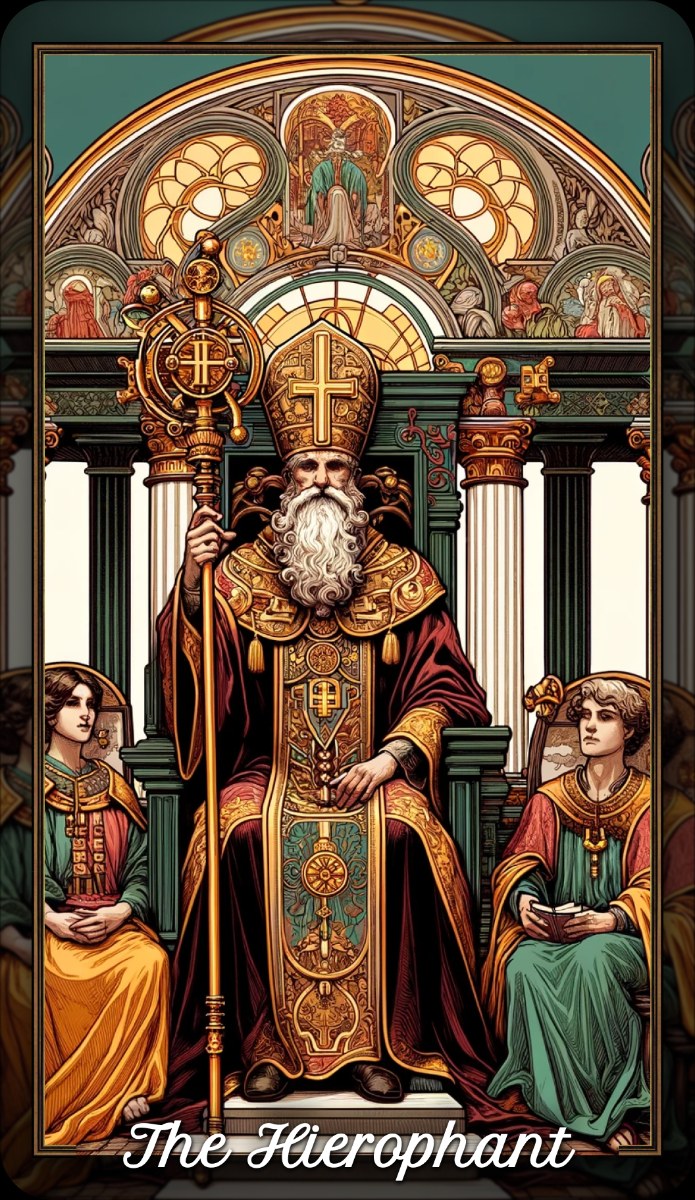
He sits between two grey pillars, the fixed columns of a formal temple, and where the High Priestess's pillars mark a threshold of mystery, his mark the boundary of an established institution. Old decks called this card "The Pope," and the imagery shows why: he wears a triple crown and holds a staff topped with a three-tiered cross, both symbols of authority spanning several levels of the world. One hand is raised in blessing, with two fingers pointing up and two folded down, a gesture that connects the heavens and the earth.
Two crossed keys, one gold and one silver, lie at his feet. They are traditionally read as the conscious and subconscious minds, or as heaven and earth, and they suggest that this figure holds access to knowledge and decides who receives it. Two robed figures kneel in front of him. Their garments carry the same roses and lilies seen elsewhere in the deck, showing them as students receiving instruction.
The scene is orderly, formal, and public. Everything is set up for teaching in the open, and there is no hidden threshold. The Hierophant offers wisdom that has been collected and handed down, and the kneeling figures leave open the question of whether following it is devotion or dependence.
The Hierophant Upright Meaning
Upright, The Hierophant points to the value of an established path. There is a body of knowledge, a group, a process, or a teacher that has already worked out much of what you are trying to figure out, and the card suggests learning from it before you improvise. He appears around education, formal commitments, and mentorship, as well as anything involving shared beliefs or rituals. It can mean joining something, following a recognized process, or seeking guidance from someone with real experience.
The deeper truth is that tradition is compressed experience. Many conventions exist because they solved a problem, and it takes some humility to learn what a system knows before dismissing it. The card also speaks to belonging, since shared rituals, whether religious, cultural, or professional, give people a sense of connection that private effort can't replicate. The question he leaves you with is whether you are following the path because it fits, or only because it is familiar.
The Hierophant Reversed Meaning
Reversed, The Hierophant splits into two distinct expressions. The first is a system failing you. Rules have become dogma, an institution puts its image ahead of its people, or you are pressured to conform to beliefs and expectations you don't share. The card can point to hypocrisy, restrictive traditions, or a mentor whose advice doesn't match their behavior. Here, the discomfort you feel is worth taking seriously.
The second is you leaving the system. This is the break from convention, the decision to build your own approach, question what you were taught, or walk a less recognized route. It can be healthy and necessary, particularly if the old framework no longer fits. It can also be reactive, rejecting a tradition entirely without understanding what it offered. The useful test is whether you are moving toward something or only away from something, and whether you have learned the rules well enough to know which ones to break.
The Hierophant in Love
Upright in Love
Single: You may be looking for something committed and lasting, and the card supports that. It often favors meeting people through shared communities, introductions, or settings that reflect your values, such as a place of worship, a class, or friends' circles. Traditional courtship has its appeal here, with clear intentions and a steady pace. Be honest about what you actually want in a partner, apart from what family or culture may expect.
New relationship: Expect serious intentions and an emphasis on shared values. This card often signals that the relationship is moving toward formal recognition, whether that means meeting family, defining the relationship, or heading toward commitment. Compatibility in beliefs and life direction matters more than chemistry alone. Check that the pace and the plan feel like your own choices.
Existing partnership: This is a strong card for commitment. It can point to marriage, a ceremony, a formal step such as moving in together, or a deepening of shared traditions and values. Rituals matter now: anniversaries, family customs, and the habits that make the partnership feel established. The caution is that routine can stand in for connection, so make sure you are still choosing each other.
An ex: The old relationship followed a script, and the card asks whether that script was ever really yours. If reconciliation is on the table, it would need to be a renewed commitment with clear terms, not a return to old habits. Otherwise, the card supports treating the ending as a proper close, with the story finished and the lessons learned.
Reversed in Love
Single: You may be rejecting conventional dating scripts, and that can be healthy if it reflects what you want. It can also mean you feel bound by expectations from family, culture, or peers that don't fit your life. Ask yourself what you would look for if no one were watching, and whether your rebellion is a preference or a reaction.
New relationship: The connection may not fit the usual mold, and one or both of you might resist labels, timelines, or conventional commitment. That isn't automatically a problem, but talk about what each person wants. The reversal can also point to family or social pressure on the relationship, or to differences in values that haven't been discussed yet.
Existing partnership: Roles, rules, or traditions that once worked may have stopped fitting. One partner may feel constrained by expectations, whether from family, culture, or unspoken relationship rules. This is a chance to renegotiate consciously: decide together which customs you want to keep and which you want to rewrite. Left unspoken, the tension tends to grow.
An ex: You may be stuck on how the relationship "should" have gone, holding on to a version that followed the proper script. The card invites you to drop that story. Sometimes the healthiest step is to stop measuring the relationship against a template and accept it for what it actually was.
The Hierophant for Career & Money
Upright for Career & Money
This card favors established institutions and recognized routes: corporate careers, formal education, professional qualifications, and mentorship. It suggests learning the system, earning credentials, and working within a framework that has a proven track record. It suits teaching, counseling, law, administration, and any role where process and expertise matter. Financially, conventional approaches such as standard savings, established advisors, and proven vehicles are favored over speculation. Seeking guidance from someone experienced is a good move now.
Reversed for Career & Money
Reversed, the card flags bureaucracy, a rigid workplace, or a role that no longer fits your values. It can also encourage an unconventional path, such as going independent or challenging a stale process, provided you have done the groundwork. Financially, be wary of following advice blindly just because it comes from an official source, and equally wary of dismissing established methods out of hand. Question the process, then decide with your own judgment.
The Hierophant for Health & Spirituality
Upright: Structured, guided approaches are favored. That may mean working with a qualified practitioner, following a proven program, or joining a supportive group. Spiritually, he supports established practice, whether religious or otherwise: ritual, community, a teacher, and a tradition with depth. There is real comfort in practicing alongside others who share the path.
Reversed: You may be questioning your inherited beliefs or stepping away from a tradition that no longer speaks to you. That can be a genuine spiritual step, and it can also leave a sense of being unmoored. On the health side, the reversal cautions against following advice without question, and equally against dismissing qualified guidance out of stubbornness. Tarot is not a substitute for medical advice, so bring real health concerns to a qualified professional.
Is The Hierophant a Yes or No?
A conventional yes.
Upright, The Hierophant leans toward yes when you follow the established route, seek guidance, and honor the commitments involved. Reversed, the answer becomes "not the standard way." A yes may still be possible, but it needs an unconventional route, or a hard look at whether the system you are working within deserves your trust.
The Hierophant - Card Combinations
| Combination | What It Means |
|---|---|
| The Hierophant + The Lovers | A commitment made on shared values. A formal, deliberate choice, often pointing toward vows or a lasting partnership. |
| The Hierophant + The High Priestess | Public teaching meets private knowing. A tension between what you were taught and what your intuition says. |
| The Hierophant + Three of Pentacles | Apprenticeship and credentialed skill. Learning a craft through a recognized structure and working alongside others. |
| The Hierophant + Four of Wands | A ceremony or celebration of commitment. A milestone shared with family and community. |
| The Hierophant + The Devil | A belief system or institution that has become a trap. Conformity, guilt, or dogma keeping someone stuck. |
Something to Sit With
Which of my beliefs and habits did I choose, and which did I simply inherit?
Am I breaking from this tradition because it no longer serves me, or because I never took the time to understand what it offered?
Frequently Asked Questions
What does The Hierophant mean in tarot?
The Hierophant represents tradition, institutions, mentorship, and shared beliefs. He appears when you are dealing with an established system, a teacher, or a formal commitment. His themes include learning from accumulated wisdom, belonging to a community, and the tension between conformity and personal conviction.
Is The Hierophant a good card to draw?
Generally yes, especially when you need guidance, structure, or a commitment that has real backing. It is a stabilizing card. The caution is that it can point to conformity or restriction, and reversed it invites you to question the system you are inside.
What does The Hierophant reversed mean?
Reversed, it points to one of two things. Either a system or authority is failing you, through dogma, hypocrisy, or pressure to conform, or you are stepping away from convention to find your own path. The second can be healthy, as long as you are moving toward something and not only away from something.
What is the opposite of The Hierophant?
The High Priestess is the closest counterpart. She holds private, intuitive knowledge that isn't formally taught, while he holds public knowledge that has been passed down through institutions. Some readers also contrast him with The Fool, who follows no rules, or The Hermit, who seeks truth alone.
What zodiac sign is The Hierophant?
The Hierophant is linked to Taurus in the standard Golden Dawn attribution, and this is a well-established correspondence. Taurus's steadiness, love of ritual, and respect for tradition fit the card. Taurus is ruled by Venus, which is why the card is also connected to that planet.
What is The Hierophant's number and what does it mean in numerology?
The Hierophant is number five, the number of tension, change, and learning. In numerology, five sits between stability and freedom, and it asks how much to keep and how much to question. It follows the Emperor's four by testing the structures he built.
Does The Hierophant mean marriage?
It often can, particularly alongside cards such as the Four of Wands, the Ten of Cups, or The Lovers. Marriage is one of the most recognizable formal commitments, and this card governs recognized ceremonies and vows. On its own, it points to commitment and shared values in general, so it is a supportive sign and not a guarantee.
Does The Hierophant mean travel?
Only in a limited way. His travel is tied to a purpose such as a pilgrimage, a religious or cultural ceremony, a formal course of study, or a visit to an institution. Adventure travel is not his territory, so look to the surrounding cards for any leisure element.
What do the crossed keys in The Hierophant mean?
The two keys, one gold and one silver, are commonly read as the conscious and subconscious minds, or as heaven and earth. They show that the Hierophant holds access to knowledge and to the way it is shared. Placed at his feet, they suggest that the tools of understanding are available to those willing to learn.
Explore This Card Further
Ready to see what The Hierophant says about your own situation? Draw a free reading on Limansa. Limansa also publishes position-specific guides that cover how this card reads in different spreads and questions. Look for them under the tarot card meanings section as they are added.