
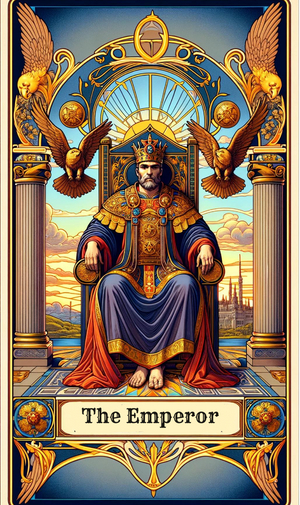
The Emperor usually gets flattened into the domineering patriarch, the boss who barks orders, or "male energy" in some vague sense. The card describes something more precise and, once you see it, more useful: authority that is earned through self-command, and structure that exists to protect what matters. Where The Empress grows things, The Emperor builds the walls, boundaries, and systems that let growth last. He is what order looks like when it is an act of care.
Last updated: September 2026
Key Takeaways
- The Emperor represents structure, authority, discipline, and stability. It is a card of building something solid and taking responsibility for it.
- Upright, he signals leadership, clear boundaries, and a dependable foundation. Reversed, he points to rigidity, control, or a lack of discipline where structure is needed.
- He is a firm yes on structured terms. The answer favors plans with rules, commitment, and follow-through, and it does not favor improvisation.
The Emperor At a Glance
| Attribute | Detail |
|---|---|
| Number | IV (4) |
| Arcana | Major Arcana |
| Element | Fire |
| Ruling Planet | Mars |
| Zodiac Link | Aries in the standard Golden Dawn and Rider-Waite-Smith attribution. This is one of the firmer correspondences in the Major Arcana, though the Thoth tradition swaps it and gives Aries to The Star, so treat it as a strong convention and not a universal rule. |
| Numerology | 4: structure, stability, foundation, order |
| Upright Keywords | Authority, structure, stability, discipline, leadership, protection, responsibility |
| Reversed Keywords | Rigidity, control, domination, inflexibility, lack of discipline, misuse of power |
The Emperor Numerology
Four is the number of foundations: four corners, four walls, four legs of a table. It is stable because it is built from balanced parts. After the creative burst of three, four brings form to what has been created, so the card is what happens when energy needs to be organized and made durable.
Four also shares its root with Death (13) and the four Fours of the minor suits. Both involve a structure being established or a structure reaching its limit. The Emperor is the constructive version of that idea, setting the boundaries and rules that hold a life or a project in place.
The Emperor Symbolism
He sits on a heavy stone throne, and rams' heads are carved into it. The ram is the animal of Aries, which fits the card's association with Mars, fire, and decisive action. His posture is upright and rigid, and his long white beard signals age, experience, and the authority of time. He wears a red robe, the color of will and vitality, over what looks like a suit of armor. The armor is visible at his feet, a reminder that his power comes with the readiness to defend it.
In one hand he holds an ankh, an ancient symbol of life, and in the other a globe representing dominion over the material world. Behind him stand bare, rocky mountains beneath an orange sky, and only a thin stream runs through the scene. This is a deliberate contrast with The Empress's lush forest and wheat field. His landscape is austere and unadorned, a place where things are built and held, and not somewhere they grow easily.
Everything in the image is solid, stone, and fixed. The Emperor does not move or improvise. He is presented as the one who stays and holds the line, and the price of that steadiness is a certain hardness.
The Emperor Upright Meaning
Upright, The Emperor says it is time to bring order to something. There is a project, a household, a finance, or a team that needs clear structure, and you are the one who can provide it. He appears when improvisation has run its course and what the situation needs is a plan, a set of rules, and the discipline to stick to them. This is the card of people who take responsibility, set boundaries without apology, and follow through on commitments.
The deeper truth is that real authority is quiet. It comes from self-command, and the loud version is usually insecurity in costume. The Emperor asks whether you can direct your own impulses, keep your word, and hold a standard consistently, because everything else he builds depends on that. He is also a protector. Structure, at its best, is a way of making a space safe enough for other people, and for yourself, to rely on.
The Emperor Reversed Meaning
Reversed, The Emperor splits into two distinct problems. The first is structure that has hardened into control. It looks like micromanagement, inflexibility, insistence on being right, or authority used to dominate. The rules have become the point, and the people they were meant to protect are being squeezed by them. This can describe someone else in your life or a habit in yourself, and the card is asking who benefits from the rigidity.
The second is the absence of structure. This version feels like drift: missed deadlines, vague commitments, boundaries that don't hold, and a life that runs on mood. You may be avoiding responsibility, refusing to take charge, or handing your authority to someone else. In both cases the fix is the same balance point. Keep enough structure to be dependable, and keep it flexible enough that it serves people instead of ruling them.
The Emperor in Love
Upright in Love
Single: You know what you want, or you are ready to decide. This card favors clear standards, and it asks you to stop tolerating ambiguity from people who won't commit. You may be drawn to someone steady, established, and decisive, and the card also encourages you to become that kind of partner yourself. Set your boundaries early and keep them. Attraction built on clarity tends to last.
New relationship: Expect a serious, stable connection with clear intentions. The pace may be measured, and the other person may be a little reserved emotionally at first, since The Emperor shows care through reliability more than words. Look for consistency between what they say and what they do. If both of you are looking for commitment, this is a strong foundation.
Existing partnership: This is a card of commitment, security, and shared long-term planning. It can point toward marriage, moving in together, or formalizing the partnership. It supports a relationship where each person knows their role and their responsibilities. The caution is emotional openness, because reliability can slide into distance, and a stable relationship still needs tenderness.
An ex: Whatever happened, it ended on terms that are now fairly clear. The Emperor rarely favors sentimental improvisation here. If contact returns, it is likely to be practical and deliberate, and any reconciliation would need real structure: clear agreements, changed behavior, and defined boundaries. Without those, the card says the decision to stay apart is a sound one.
Reversed in Love
Single: Look at where control is showing up. You may be holding potential partners to a rigid checklist, or keeping everyone at a distance to stay in charge. It can also mean the opposite, a pattern of drifting into relationships without ever deciding what you want. Either way, the card asks you to name your standards and be honest about which are real and which are armor.
New relationship: Watch for early signs of control, such as a partner who sets all the terms, dismisses your input, or treats dominance as strength. It can also point to someone who is emotionally unavailable, present in body and absent in feeling. Notice how they handle disagreement, because that shows more than any first-date charm.
Existing partnership: A power imbalance may be at work, where one person makes the decisions and the other adapts. Rigid roles, unspoken rules, and resentment over who gets to lead can wear the relationship down. It can equally describe a partnership with no structure at all, where no one takes responsibility and nothing gets decided. Talk openly about how decisions are made.
An ex: An old power struggle may still be running. You might be replaying the argument, needing to be proven right, or still reacting to their control. The card asks whether you are seeking closure or a win. Letting go of the need to have the last word is often what actually ends it.
The Emperor for Career & Money
Upright for Career & Money
This is one of the strongest cards for professional life. It supports leadership, promotion, running a business, and anything that requires structure and accountability. You are being asked to take charge, build a system, or step into a role with real responsibility. Financially, he favors budgeting, long-term planning, and disciplined investment over speculation. A clear plan and consistent execution are the path, and this is a good moment to formalize agreements, set goals, and put your finances in order.
Reversed for Career & Money
Reversed, the card flags an overbearing boss, a rigid workplace, or your own tendency to micromanage. It can also point to poor discipline, such as missed obligations, disorganized finances, or an unwillingness to take responsibility. Check whether you need more structure or less. Sometimes the fix is a real budget and schedule, and sometimes it is loosening your grip on a process that should not depend on you alone.
The Emperor for Health & Spirituality
Upright: Discipline and routine are the themes. He supports consistent habits, structured training, regular sleep, and a plan you actually follow. Spiritually, he favors practices that rely on commitment and repetition, such as a set daily discipline, a tradition with clear forms, or work with a teacher who holds you to a standard.
Reversed: Rigid routines, perfectionism, and treating the body as something to command can create stress and burnout. The reverse problem is also possible, with no routine at all and health habits drifting. Spiritually, the reversal can mean rebelling against every form of structure or, on the other side, mistaking rule-following for depth. Aim for a routine that supports you without becoming another form of control. Tarot is not a substitute for medical advice, so bring real health concerns to a qualified professional.
Is The Emperor a Yes or No?
A firm yes, on structured terms.
Upright, The Emperor leans clearly toward yes when the plan has a solid foundation, clear rules, and someone willing to take responsibility for it. Reversed, the answer becomes "not on these terms." Look at whether the structure is too rigid, too loose, or serving the wrong person.
The Emperor - Card Combinations
| Combination | What It Means |
|---|---|
| The Emperor + The Empress | Structure paired with nurture. A stable framework in which real growth can take place. |
| The Emperor + Justice | Fair, consistent authority. Rules applied evenly, with accountability on all sides. |
| The Emperor + The Tower | A rigid structure under pressure. What was built on control or false stability is being tested. |
| The Emperor + Four of Pentacles | Holding on too tightly. Security tipping into hoarding, or control over money and resources. |
| The Emperor + Ace of Swords | A clear decision backed by authority. A firm choice made with logic and conviction. |
Something to Sit With
What in my life needs a firmer structure, and what am I avoiding taking responsibility for?
Where has my need for control started to protect me more than it protects the people or things I care about?
Frequently Asked Questions
What does The Emperor mean in tarot?
The Emperor represents structure, authority, discipline, and stability. He appears when something needs order and someone needs to take responsibility for it. His themes include leadership, boundaries, protection, and building something that lasts.
Is The Emperor a good card to draw?
Generally yes, especially for work, finances, and any situation that needs stability. It is a card of solid foundations and steady progress. The caution is rigidity, and in the reversed position it warns about control, inflexibility, or a lack of discipline.
What does The Emperor reversed mean?
Reversed, he points to one of two problems. Either structure has hardened into control, with micromanagement, domination, or inflexible rules, or structure is missing, leaving drift, avoided responsibility, and boundaries that don't hold. The surrounding cards usually show which one applies.
What is the opposite of The Emperor?
The Empress is his natural counterpart. He provides structure, order, and protection, and she provides nurture, growth, and receptivity. The two are complementary, because growth needs both a framework to grow inside and warmth to grow toward.
What zodiac sign is The Emperor?
In the standard Golden Dawn and Rider-Waite-Smith attribution, The Emperor is linked to Aries, the fire sign ruled by Mars. The link is fairly well established, though the Thoth tradition swaps the assignments and gives Aries to The Star. Aries's initiative and directness do echo the card, though the Emperor channels that fire into structure and discipline.
What is The Emperor's number and what does it mean in numerology?
The Emperor is number four, the number of stability, foundations, and order. In numerology, four is about building something solid and dependable through effort and discipline. It follows the creativity of the Empress's three by giving that energy form.
Does The Emperor mean commitment or marriage?
It can, particularly alongside cards such as the Four of Wands, the Ten of Cups, or the Hierophant. On its own, it points to commitment, security, and long-term seriousness, though not necessarily a wedding. It signals that the relationship or plan is being placed on a stable, clearly defined footing.
Does The Emperor mean travel?
Not typically. His travel is purposeful and structured, such as a business trip, a relocation to establish a base, or a carefully planned journey. Spontaneous wandering is not his style, so look to the surrounding cards for any leisure or adventure element.
Why is The Emperor's throne decorated with rams' heads?
The ram is the symbol of Aries, the zodiac sign linked to this card, and it stands for drive, courage, and leadership. Carved into stone, the ram's energy has been turned into something permanent and fixed. It represents fire that has been disciplined into authority.
Explore This Card Further
Ready to see what The Emperor says about your own situation? Draw a free reading on Limansa. Limansa also publishes position-specific guides that cover how this card reads in different spreads and questions. Look for them under the tarot card meanings section as they are added.