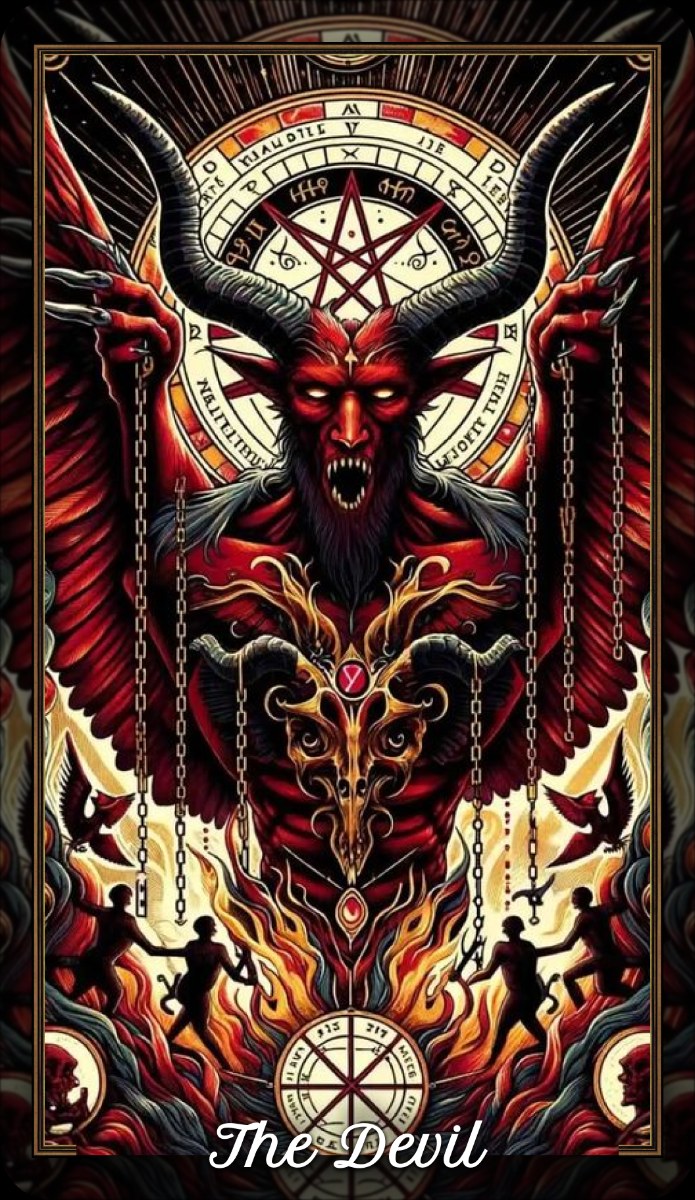
The Devil usually gets flattened into "something bad is happening," a warning label with no real content. What the card actually names is more specific and, in a way, more useful: the exact mechanics of a self-made trap. The chains in this card's image are loose enough to slip off, and the figures wearing them don't. That gap between what's actually possible and what feels possible is the entire subject. This is the card of attachments you could leave and haven't, because some part of the arrangement still feels safer than the alternative.
Last updated: September 2026
Key Takeaways
- The Devil represents bondage, unhealthy attachment, and the specific trap of restrictions that feel permanent but aren't. It points to what you're choosing not to see.
- Upright, it signals real entanglement, whether that's compulsion, a toxic dynamic, or material or physical desire pulling harder than judgment. Reversed, it points to breaking free, or to a chain being noticed for the first time.
- It is a cautionary no, or a yes only once the chain is seen clearly. The card rarely favors moving forward while still bound to what's holding you back.
The Devil At a Glance
| Attribute | Detail |
|---|---|
| Number | XV (15) |
| Arcana | Major Arcana |
| Element | Earth |
| Ruling Planet | Saturn (in the standard Golden Dawn attribution, through the sign it corresponds to) |
| Zodiac Link | Capricorn, a well-established correspondence in the standard attribution. The horned, goat-like figure in the card's central image is a fairly direct visual echo of Capricorn's own symbol. |
| Numerology | 15: bondage, material entrapment, a number that intensifies the Lovers' choice into compulsion |
| Upright Keywords | Bondage, attachment, temptation, materialism, addiction, restriction, shadow self |
| Reversed Keywords | Breaking free, awareness of a trap, releasing an unhealthy attachment, reclaiming control |
The Devil Numerology
Fifteen follows Temperance's fourteen, where opposing forces were blended patiently into balance, and fifteen shows what happens when that same intensity curdles into imbalance instead: one force overtaking the other completely. Fifteen also reduces to six (1+5=6), the number of the Lovers, and the connection is deliberate. Both cards involve two figures and a choice, but where the Lovers choose freely, the figures in the Devil have stopped choosing at all.
That shared root number is one of the clearer intentional pairings in the deck. The Lovers is connection built on free will; the Devil is the same basic scene with the will removed, replaced by habit, fear, or compulsion. Fifteen asks what happened between the choosing and the staying.
The Devil Symbolism
A large horned, goat-like figure sits on a pedestal above two smaller human figures, a man and a woman, who stand chained loosely by the neck. The Devil figure holds one hand raised in a mocking inversion of the Hierophant's blessing gesture, and an inverted pentagram sits on his forehead, a symbol traditionally read as spiritual truth turned upside down and subordinated to material or base concerns.
The two human figures closely resemble the Lovers in pose and setting, right down to small horns and tails that have begun to grow on them, a detail suggesting a slow, almost unnoticed transformation that comes from prolonged proximity to whatever the Devil represents. The critical detail is the chains around their necks: they're loose enough to be lifted off with minimal effort. Nothing in the image physically prevents either figure from simply walking away.
The background is dark and enclosed, a sharp departure from the open skies of earlier cards, suggesting a world that has narrowed around this dynamic. Torches burn on either side of the pedestal, small points of light in an otherwise oppressive scene, hinting that awareness, and eventually escape, are still possible even here. The whole image is a study in a trap that only holds because its captives haven't tested it.
The Devil Upright Meaning
Upright, The Devil names something you're attached to that isn't actually serving you, whether that's a habit, a relationship dynamic, a fear, or a desire that's gained more control over your decisions than you'd like to admit. It often appears when denial is doing a lot of work, when it's easier to call something "just how things are" than to look honestly at whether you're choosing it or simply stuck in it. The card doesn't moralize about the specific attachment. It asks whether you can see the chain at all.
The deeper truth is that most of what this card describes is more voluntary than it feels. Genuine restriction, real material desire, real compulsion, real unhealthy loyalty to a person or a pattern, these things exert a pull, but the pull isn't the same as an actual lock. The card's honest, uncomfortable message is that the first step out of a trap like this is simply admitting it's a trap, since most people in this position have spent real effort convincing themselves otherwise.
The Devil Reversed Meaning
Reversed, The Devil splits into two distinct expressions. The first, and more hopeful one, is the moment of actually recognizing the chain and starting to loosen it. This can look like breaking a habit that's had a real grip, leaving a relationship or dynamic that had stopped serving you, or simply seeing clearly, for the first time, that something you thought was permanent was actually a choice you kept making. This version of the reversal is genuinely encouraging.
The second is a chain that's just come into view without any movement toward release yet. You may be newly aware of a compulsion, an unhealthy dependency, or a pattern you've been minimizing, but awareness alone hasn't translated into action. This can also describe someone else's attachment becoming visible to you, a person whose control over a situation, or over you, is finally being named. Either way, this reversal marks a threshold rather than a resolution: the trap is visible now, and what happens next depends on what you do with that visibility.
The Devil in Love
Upright in Love
Single: You may be drawn to a familiar, intense kind of connection that has more to do with old patterns or unresolved wounds than genuine compatibility. This card asks whether you're chasing chemistry that reliably leads somewhere painful because it's familiar rather than because it's good for you. It can also point to using dating, or avoiding it entirely, as a distraction from something else you don't want to face.
New relationship: Watch for intense, almost obsessive attraction that feels less like genuine connection and more like a pull you can't fully explain or control. This can be exciting, and it's also worth examining closely, since the Devil rarely describes something entirely healthy in its early upright form. It can also point to a real power imbalance forming, where one person is gaining more control over the other's decisions or self-worth than is healthy.
Existing partnership: This card often points to unhealthy patterns that have become entrenched, such as codependency, jealousy, control, or a cycle of conflict and reconciliation that keeps repeating without real change. It can also describe two people staying together out of fear, financial entanglement, or habit rather than genuine desire to be with each other. The card asks whether the relationship is a choice you'd make again, or a chain you've stopped questioning.
An ex: There may be a real pull back toward this person that has more to do with unfinished attachment, unresolved desire, or old dynamics than anything actually healthy. The Devil rarely recommends acting on this pull, especially if the original relationship involved control, dependency, or a cycle you've already named as harmful. Notice the chain before you pick it back up.
Reversed in Love
Single: You may be recognizing, finally, that a pattern you've repeated in dating has actually been a choice you kept making rather than something inevitable. This reversal often marks real progress: seeing the trap clearly enough to stop walking back into it. It can also mean you're newly aware of it but haven't yet changed your behavior, and the card asks what would actually help you follow through.
New relationship: You may be noticing early warning signs of an unhealthy dynamic, control, intensity that outpaces trust, or a pull that doesn't feel entirely like your own choice, and the reversal is a genuinely useful moment to pay attention rather than dismiss it. It can also describe successfully avoiding a pattern that would once have pulled you in. Trust the early read.
Existing partnership: This can be one of the more hopeful reversals in the deck, marking real movement away from codependency, control, or a stuck dynamic toward something healthier. It can also mean the unhealthy pattern has just become visible to one or both partners, without a resolution yet in place. Naming the pattern honestly is the necessary first step either way.
An ex: You may be genuinely breaking free of an attachment that had a real hold on you, whether that's finally losing interest in reconciliation or releasing a pattern the relationship reinforced. It can also mean you're just now seeing how much control this relationship, or your attachment to it, actually had over you. Give yourself credit for the clarity, even if the full release hasn't happened yet.
The Devil for Career & Money
Upright for Career & Money
This card often points to feeling trapped in a job, contract, or financial situation that's become genuinely unhealthy, whether that's a toxic workplace, golden handcuffs keeping you in a role for the money alone, or a pattern of overwork you can't seem to stop. Financially, it warns about compulsive spending, debt that's spiraled past comfortable, or material desire driving decisions more than actual need. The card's uncomfortable question is whether the constraint is truly external, or whether fear, comfort, or habit is doing more of the holding than the actual circumstances.
Reversed for Career & Money
Reversed, the card can point to genuinely breaking free of a job, financial pattern, or professional dynamic that had real hold over you, such as finally leaving a toxic workplace or breaking a compulsive spending habit. It can also mean the trap has just become visible, such as recognizing golden handcuffs for what they are, without having acted on that recognition yet. Either way, this reversal favors honest reckoning with what's actually keeping you stuck.
The Devil for Health & Spirituality
Upright: This card often points to a compulsive pattern around food, substances, screens, or any habit that's gained more control over your choices than feels comfortable to admit. It favors honest acknowledgment of the pattern over continued minimizing. Spiritually, it points to the shadow self, the parts of yourself that feel uncomfortable to look at directly, and the specific work of facing them rather than pretending they aren't there.
Reversed: This can mark genuine progress in breaking a compulsive pattern or unhealthy attachment, or it can mean the pattern has just become visible without change following yet. Spiritually, the reversal favors continued shadow work rather than either denial or self-punishment. Tarot is not a substitute for medical advice, so bring real health concerns to a qualified professional.
Is The Devil a Yes or No?
A cautionary no, until the chain is seen clearly.
Upright, The Devil rarely favors moving forward, since it usually signals an attachment or pattern that needs honest examination first. Reversed, the answer softens toward yes, but only once real awareness of the trap has actually translated into a different choice.
The Devil - Card Combinations
| Combination | What It Means |
|---|---|
| The Devil + The Lovers | The same bond seen two ways. The question is whether it's freely chosen or held together by compulsion. |
| The Devil + The Tower | A trap breaking apart by force. Sudden upheaval that finally shatters an attachment willpower alone couldn't. |
| The Devil + Nine of Cups | Indulgence tipping past satisfaction. A desire that's stopped being a pleasure and become a habit running the show. |
| The Devil + Strength | A struggle with instinct or compulsion. The question is whether it's being tamed with patience or fought with force. |
| The Devil + Ten of Swords | A cycle finally hitting bottom. The pattern has to break because there's nowhere further for it to go. |
Something to Sit With
What am I calling permanent that's actually a choice I keep making?
If I stopped minimizing this attachment for a moment, what would I actually see?
Frequently Asked Questions
What does The Devil mean in tarot?
The Devil represents bondage, unhealthy attachment, and the specific trap of a restriction that feels permanent but isn't. It appears when denial is doing significant work, making a chosen pattern feel like an unavoidable fact. Its core theme is that most of what it describes is more voluntary than it feels from inside it.
Is The Devil a good card to draw?
It's one of the more uncomfortable cards to see, and it's genuinely useful precisely because of that discomfort. It names something worth looking at honestly rather than continuing to avoid. Reversed, it can be a hopeful sign of breaking free, though it sometimes only marks the moment a trap becomes visible, without the escape having happened yet.
What does The Devil reversed mean?
Reversed, it points to one of two things. Either you're genuinely breaking free of an unhealthy attachment or pattern, or a chain has simply come into clear view for the first time without action following yet. Both are progress, since seeing the trap honestly is the necessary first step either way.
What is the opposite of The Devil?
The Lovers is its direct counterpart, sharing the same root number and a nearly identical central image. The Lovers is connection built on free, conscious choice, while The Devil is the same basic bond with the will removed, replaced by compulsion, fear, or habit.
What zodiac sign is The Devil?
The Devil is linked to Capricorn, a well-established correspondence in the standard attribution. The horned, goat-like central figure is a fairly direct visual reference to Capricorn's own symbol, making this one of the more visually obvious zodiac links in the deck.
What is The Devil's number and what does it mean in numerology?
The Devil is number fifteen, which reduces to six, the same root number as the Lovers. In numerology, this shared number frames the two cards as a deliberate pair, one showing connection through free choice and the other showing the same bond curdled into compulsion. Fifteen itself marks a point of intensified attachment or restriction.
Does The Devil mean addiction?
It can point to compulsive patterns, including addiction, though it's a broader card than that single meaning. It describes any attachment that has more control over your choices than you'd like to admit, which can include relationships, habits, fears, or material desires as much as substances. If addiction is a genuine concern in your own life, that deserves support from a qualified professional rather than a card reading alone.
Does The Devil mean travel?
Rarely, and this isn't a card associated with movement or journeys in any traditional sense. Its imagery is enclosed and stationary, a scene defined by staying rather than going. If it appears near travel-related cards, it's more likely to point to something holding you back from a trip than the trip itself.
Why are the chains in The Devil card loose?
The loose chains are widely read as the card's central argument: the two human figures could remove them with minimal effort, but they haven't. It suggests the restriction is maintained more by habit, fear, or denial than by any actual external force. The detail turns the whole card from a simple warning into a specific, pointed observation about self-imposed limitation.
Explore This Card Further
Ready to see what The Devil says about your own situation? Draw a free reading on Limansa. Limansa also publishes position-specific guides that cover how this card reads in different spreads and questions. Look for them under the tarot card meanings section as they are added.