The Chariot usually gets flattened into "victory ahead," a card that just promises a win if you stay the course. That reading skips the actual mechanism. The Chariot is not about a smooth ride toward triumph. It is about holding two opposing forces in the same hand and driving them forward anyway, without either one taking over. Willpower here isn't hype or hustle. It is the specific skill of staying in control of something that would otherwise pull you apart.
Last updated: September 2026
Key Takeaways
- The Chariot represents willpower, focused determination, and forward motion achieved by controlling opposing forces rather than avoiding them.
- Upright, it signals drive, discipline, and a hard-won victory. Reversed, it points to a loss of direction, internal conflict, or force used without control.
- It is a yes, provided you actually take the reins. The card gives nothing to passive hoping and everything to deliberate, sustained effort.
The Chariot At a Glance
| Attribute | Detail |
|---|---|
| Number | VII (7) |
| Arcana | Major Arcana |
| Element | Water |
| Ruling Planet | The Moon (in the standard Golden Dawn attribution; a few systems assign it to Mars for its drive and momentum) |
| Zodiac Link | Cancer, in the standard Golden Dawn attribution. This one surprises people, since the card looks like Mars energy, but Cancer's link comes through the Moon and speaks to the emotional discipline the card actually requires. |
| Numerology | 7: mastery, inner conflict resolved, momentum through effort |
| Upright Keywords | Willpower, determination, control, victory, focus, momentum, discipline |
| Reversed Keywords | Lack of direction, loss of control, aggression, burnout, self-doubt, being pulled apart |
The Chariot Numerology
Seven is the number of mastery achieved through effort, not luck. It follows the Lovers' six, where a choice was made, and now that choice has to be carried out against resistance. Seven often marks a stage where something has been tested and is proving itself, whether that is a skill, a relationship, or a plan finally in motion.
Seven also shares its root with The Tower (16) and the four Sevens of the minor suits, which tend to involve challenge, assessment, or a moment of reckoning. The Chariot is the version of seven where the reckoning is met head-on and driven through, rather than avoided or endured.
The Chariot Symbolism
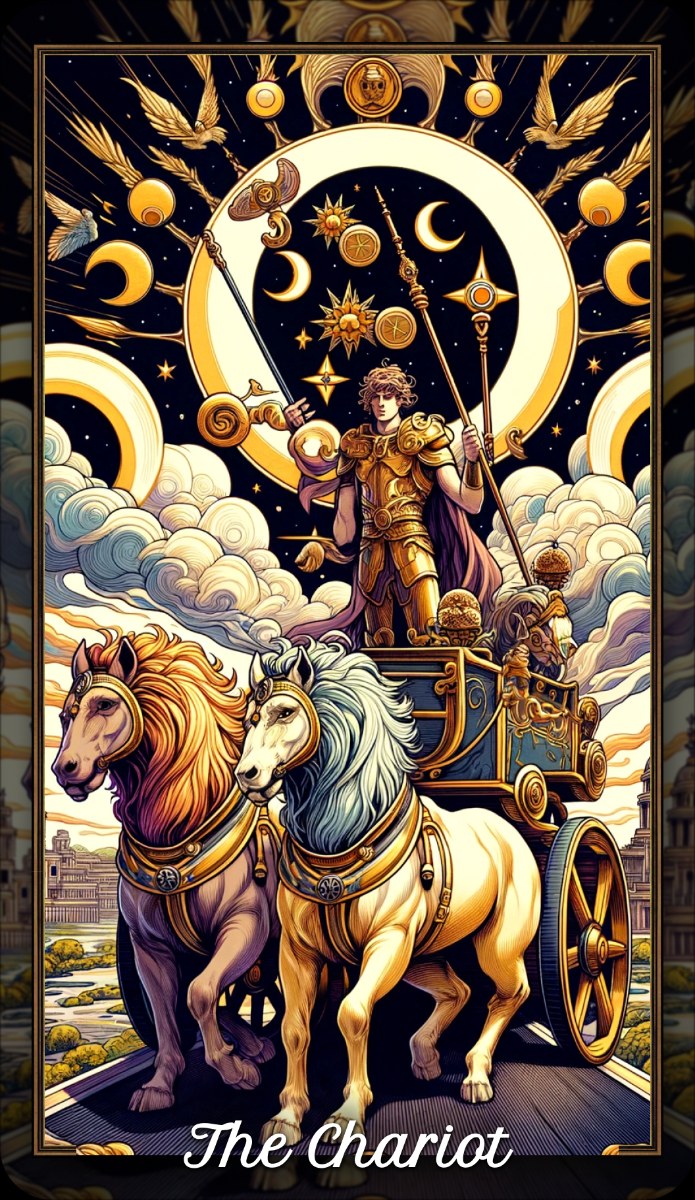
A armored figure stands in an open chariot, holding no reins. Two sphinxes, one black and one white, are harnessed in front of him, facing in slightly different directions. They represent opposing forces, such as fear and desire, order and chaos, or the conscious will and the unconscious pull, and the figure's task is to hold them together through will alone rather than physical control.
Above him stretches a canopy dotted with stars, suggesting the chariot is guided by something larger than personal effort. On his shoulders are carved crescent moons, tying him to the card's lunar rulership, and a square symbol appears on his chest, a sign of grounded, practical thought balancing the celestial imagery above. He wears a laurel-and-star crown, marking anticipated victory rather than one already achieved.
Behind him stands a walled city, the settled place he is leaving or has already left, and the chariot itself has no visible wheels touching the ground in most renderings, giving the whole image a sense of being propelled by intention rather than terrain. The absence of reins is the detail that matters most. Control here is internal, held through focus and will, not through gripping the world tightly.
The Chariot Upright Meaning
Upright, The Chariot describes a moment where you are being asked to take deliberate control and push forward, even while pulled by conflicting impulses. It often appears when a goal is within reach but requires sustained willpower, not a single burst of effort. Something in you wants to go one way, and something else wants to go another, and the card's message is that the win comes from holding both in check and directing them at the same target.
The deeper truth is that this isn't about eliminating opposition. The sphinxes are never tamed into identical creatures. They stay black and white, pulling in their own directions, and mastery means keeping them harnessed to the same chariot anyway. This can describe competing priorities, a divided mind, or genuinely opposing people in your life who all have to move in the same direction for something to succeed. The card rewards focus, self-discipline, and the willingness to keep steering even when it's hard.
The Chariot Reversed Meaning
Reversed, The Chariot splits into two distinct problems. The first is loss of direction. The forces that were meant to be held together have broken loose, and you feel scattered, indecisive, or unable to commit to a single path. Plans stall, momentum disappears, and what looked like progress starts sliding backward. This version often shows up as burnout, where the willpower ran out before the goal did.
The second is force without control. Here the will is fully present, but it's being applied recklessly, aggressively, or without regard for who or what gets run over. This can look like bulldozing people, forcing an outcome that isn't ready, or channeling frustration into aggression instead of direction. Both versions trace back to the same imbalance between the two sphinxes: either nobody is holding the reins, or one side has been allowed to dominate the other completely. The fix, in either case, is to reassert deliberate, internal control rather than either giving up or gripping harder.
The Chariot in Love
Upright in Love
Single: You are likely pursuing what you want with real intention rather than waiting for it to arrive. This card favors clarity about your goals in dating, whether that's a specific kind of relationship or a firm decision to stop settling. It can also mean you're juggling competing desires, such as wanting independence and wanting connection, and the card asks you to hold both without letting either one win by default.
New relationship: There may be real momentum here, with both people moving the connection forward with intention rather than drifting. It can also describe a relationship that requires navigating two different personalities or paces, similar to the two sphinxes, and success depends on both of you steering toward the same destination rather than pulling apart. Keep communicating about direction as things speed up.
Existing partnership: This card often shows up when a couple is actively working through something together, whether that's a challenge, a big goal, or simply competing schedules and priorities. It favors partners who function as a team pointed at the same outcome, even when their individual approaches differ. Willpower and follow-through, from both people, keep the relationship moving rather than stalling.
An ex: There may have been a real struggle for control in that relationship, whether that was about direction, decisions, or who was steering. The Chariot asks you to look honestly at whether you were both pulling toward the same place or working against each other the whole time. Moving on from this one requires the same deliberate will the card is known for: a conscious decision to drive forward rather than stay parked.
Reversed in Love
Single: You may feel torn between two people, two types of relationships you want, or conflicting instincts about what to pursue. Indecision can be stalling your dating life more than any external circumstance. It's also worth checking whether frustration or impatience about being single is pushing you toward choices that don't actually fit.
New relationship: Watch for a power struggle, whether that's about pace, control, or whose preferences take priority. One person pushing too hard, or both of you pulling in different directions without acknowledging it, can derail early momentum. This reversal can also point to a relationship losing steam because neither person is actively steering it anymore.
Existing partnership: A tug-of-war may be underway, over decisions, direction, or control of the relationship's pace and priorities. Burnout is common here too, particularly if one or both partners have been forcing things to work through sheer effort. The remedy is to stop pulling against each other and have an honest conversation about where you're actually trying to go.
An ex: You may still feel like you're fighting a battle that's already over, replaying who was right or trying to force a resolution that isn't coming. The card suggests you've lost your grip on the direction you actually want to move in. Redirect that energy toward your own forward motion instead of a rematch with the past.
The Chariot for Career & Money
Upright for Career & Money
This card favors ambitious pursuit of a specific goal: a promotion, a competitive opportunity, launching something, or pushing a stalled project across the finish line. It rewards focus and the willingness to manage competing demands, such as multiple projects or stakeholders with different priorities, without losing sight of the target. Financially, it supports disciplined pursuit of a specific goal, such as paying down debt aggressively or saving toward something concrete, rather than diffuse effort. Victory here is earned through sustained will, not a single lucky break.
Reversed for Career & Money
Reversed, the card flags scattered effort, competing priorities with no clear resolution, or burnout from pushing too hard for too long. It can also point to aggressive tactics at work, such as forcing decisions or steamrolling colleagues, that damage more than they build. Financially, it warns against forcing an investment or purchase before you're actually ready, and against letting frustration drive impulsive money decisions. Regroup, choose one direction, and conserve your energy for it.
The Chariot for Health & Spirituality
Upright: Discipline and focused effort serve you well now, whether that's training toward a specific goal, sticking with a program, or channeling restless energy into structured movement. Spiritually, the card favors practices that build willpower and inner control, such as focused meditation or any discipline that trains you to hold steady under pressure rather than react.
Reversed: Pushing your body too hard, ignoring signs of exhaustion, or scattering your energy across too many pursuits can catch up with you. Spiritually, the reversal can mean forcing a practice rather than genuinely engaging with it, or feeling pulled between competing paths. Slow down enough to figure out which direction actually deserves your energy. Tarot is not a substitute for medical advice, so bring real health concerns to a qualified professional.
Is The Chariot a Yes or No?
A yes, but only if you take the reins.
Upright, The Chariot leans strongly toward yes, provided you bring focused, sustained will to it. Nothing here arrives passively. Reversed, the answer becomes "not while you're this divided." Resolve the internal or external tug-of-war first, then push forward.
The Chariot - Card Combinations
| Combination | What It Means |
|---|---|
| The Chariot + Eight of Wands | Fast, unstoppable momentum. Things move quickly once you commit to a direction. |
| The Chariot + Two of Swords | Tension between an avoided decision and the drive to move. The stalemate has to break before real progress starts. |
| The Chariot + The Tower | Forced momentum meeting a hard correction. Pushing through something that needed to be rebuilt instead. |
| The Chariot + Strength | Willpower paired with patience. Control achieved through steady resolve rather than force. |
| The Chariot + Ten of Wands | Determination running on fumes. A goal in sight, but the weight of getting there is starting to show. |
Something to Sit With
What two opposing forces am I currently trying to drive forward together, and am I actually steering them or just hoping they cooperate?
Where has my drive tipped into force, running over something or someone that needed a lighter hand?
Frequently Asked Questions
What does The Chariot mean in tarot?
The Chariot represents willpower, focused determination, and victory earned through disciplined effort. It appears when opposing forces, whether internal impulses or external circumstances, need to be held together and driven toward a single goal. Its core theme is control achieved through will, not by removing the opposition but by mastering it.
Is The Chariot a good card to draw?
Yes, especially when you're pursuing a specific goal that requires sustained effort. It signals forward motion and a real chance at success. Reversed, it becomes a caution about losing direction, burning out, or applying force without control.
What does The Chariot reversed mean?
Reversed, it points to one of two problems. Either you've lost direction, with competing priorities pulling you apart and momentum stalling, or willpower has turned into recklessness and force applied without control. The surrounding cards usually clarify which one applies.
What is the opposite of The Chariot?
The Hanged Man is often read as its counterpart. The Chariot is forward motion achieved through willpower and control, while the Hanged Man is progress achieved through surrender and stillness. Strength is also frequently contrasted with it, since both involve mastery, but Strength gets there through patience and gentleness rather than driven force.
What zodiac sign is The Chariot?
The Chariot is linked to Cancer in the standard Golden Dawn attribution, through its lunar rulership. This surprises people because the card's imagery reads as more Mars-like, but the Cancer connection actually points to the emotional discipline and inner control the card requires, rather than raw aggression.
What is The Chariot's number and what does it mean in numerology?
The Chariot is number seven, the number of mastery achieved through effort and inner conflict resolved. In numerology, seven often marks a stage where something is being tested and proven. It follows the Lovers' six by taking a choice already made and carrying it forward against resistance.
Does The Chariot mean travel?
It can, more than most Major Arcana cards, since the image itself is a vehicle in motion. It often suggests a purposeful journey, a relocation, or travel tied to achieving a goal, rather than a leisurely trip. The direction matters more than the destination in this card's version of travel.
Why does the Chariot figure have no reins?
The absence of reins is deliberate. It shows that the sphinxes are controlled through will and focus rather than physical restraint, which is the whole point of the card. Mastery here is internal: the figure directs the chariot by holding his intention steady, not by gripping the world tightly.
Why are the two sphinxes different colors?
The black and white sphinxes represent opposing forces, such as fear and desire, or the conscious and unconscious mind. They are never merged into one, and they never fully agree on direction. The card's lesson is that mastery means keeping both harnessed to the same purpose, not eliminating the tension between them.
Explore This Card Further
Ready to see what The Chariot says about your own situation? Draw a free reading on Limansa. Limansa also publishes position-specific guides that cover how this card reads in different spreads and questions. Look for them under the tarot card meanings section as they are added.