
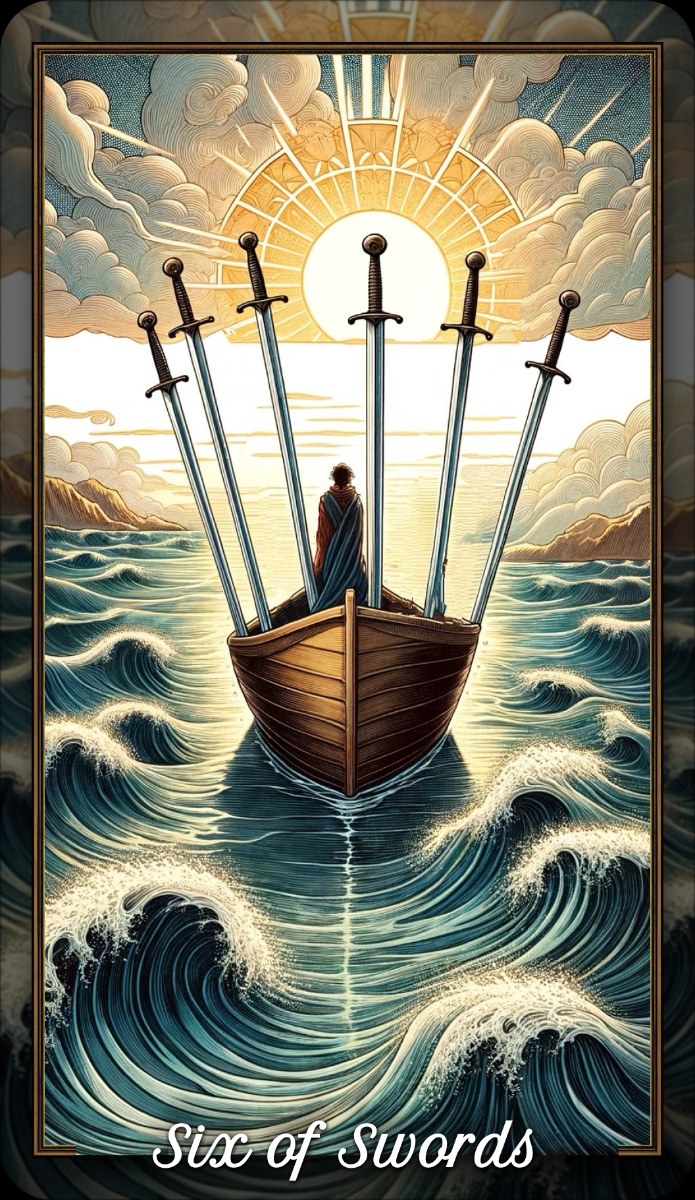
The Six of Swords is usually summed up as "moving on to better things," a hopeful card about leaving trouble behind. That is true, but it skips how the card actually feels. The figures in the boat are not celebrating. They are quiet, huddled, heads bowed, and they have brought the swords with them. The Six of Swords describes the real texture of moving on: you leave a painful situation without leaving the pain behind all at once, and you let someone or something else carry you for a while because you are too tired to row. It is a passage, not an escape. The water ahead is calmer, but you will still be carrying what happened when you reach the other side.
Last updated: October 2026
Key Takeaways
- Upright, the Six of Swords signals transition, moving on, recovery, and a gradual passage from turbulence toward calmer circumstances.
- Reversed, it splits two ways: resisting the transition, by staying stuck or turning back, or a rough passage, where you move on while carrying more baggage than the boat can hold.
- Healing here is movement, not erasure. The swords come with you, but they no longer have to wound you.
Six of Swords At a Glance
| Attribute | Detail |
|---|---|
| Number | 6 |
| Arcana | Minor Arcana |
| Element | Air |
| Ruling Planet | Mercury (Mercury in Aquarius, in the Golden Dawn system) |
| Zodiac Link | Aquarius, specifically its second decan (roughly January 30 to February 8). The Golden Dawn calls this card the Lord of Earned Success, sometimes also titled Science, reflecting clear thinking that helps you navigate out of difficulty. The correspondence is well established. |
| Numerology | 6: harmony, restored balance, and movement back toward equilibrium after disruption |
| Upright Keywords | Transition, moving on, recovery, travel, leaving difficulty behind, calmer waters, rite of passage, accepting help |
| Reversed Keywords | Resisting change, feeling stuck, unfinished business, turning back, or turbulent transition, emotional baggage, repeating patterns |
Six of Swords Numerology
Six is the number of harmony and restored balance. Across the tarot, the sixes tend to bring relief after the difficulties of the fives. In the suit of Swords, that relief arrives as movement. After the bitter conflict of the Five, the Six shows someone leaving the battlefield and heading somewhere calmer. The balance is not fully restored yet, which is why the passage feels quiet and subdued, but the direction has changed. The six in this suit is the turn from struggle toward recovery.
Six of Swords Symbolism
In the Rider-Waite-Smith deck, a ferryman stands at the back of a small wooden boat, pushing it across the water with a long pole. In front of him sit two passengers: a woman wrapped in a cloak, her head bowed, and a small child pressed close beside her. Neither looks back, and neither looks particularly joyful. Their posture suggests tiredness, sorrow, or quiet endurance, people who have been through something and are now being carried away from it.
Six swords stand upright in the front of the boat, their points driven into the wood. They represent the thoughts, memories, and hurts the travellers bring with them. Importantly, the swords are not piercing the passengers; they are simply present, part of the cargo. On one side of the boat, the water is choppy and disturbed, while the water ahead appears smoother, suggesting the move from turbulent circumstances toward calmer ones. A distant shore lies ahead, still some way off. The ferryman is a meaningful figure: someone else is doing the work of moving the boat. The card acknowledges that, during hard transitions, accepting help is part of how we get through.
Six of Swords Upright Meaning
Upright, the Six of Swords describes a transition away from difficulty. It may be leaving a relationship, a job, a home, or a painful situation, or simply moving mentally and emotionally out of a hard period into something steadier. The card does not suggest that everything is suddenly fine. It suggests that the worst is behind you and that you are heading in the right direction, even if you are still tired and sad. Progress here is gradual and quiet rather than dramatic.
The card also speaks to accepting support. The passengers are not rowing; they are being carried. This may point to leaning on friends, family, a therapist, or a community while you recover, or simply allowing time to do some of the work. It also recognises that you will bring your experiences with you. The swords in the boat are memories and lessons that will not disappear, but they no longer have to wound you. With distance and time, they become part of your story rather than an open injury. Literally, the Six of Swords is also one of the tarot's clearest cards of travel and relocation, especially journeys over water or moves made to start fresh.
Six of Swords Reversed Meaning
The reversed Six of Swords splits into two distinct expressions, describing different ways a transition can stall or go wrong.
The first is resisting the passage. You know you need to move on but cannot bring yourself to leave. You may be clinging to a relationship, job, or situation that is no longer right, staying because the unknown feels frightening or because there is unfinished business you cannot let go of. It can also describe starting to move on and then turning back, returning to an old pattern or person because it feels familiar. The reversed card in this form asks what is keeping you on the shore, and whether staying is really safer than going.
The second is a rough crossing. You are moving on, but the passage is turbulent. You may be carrying so much emotional baggage that the new situation starts to look like the old one, repeating the same patterns somewhere new. The transition itself may be delayed, disrupted, or more difficult than expected. This expression suggests that physical distance alone does not resolve everything; some of the swords need to be examined and set down, not just carried. Support, patience, and honest reflection help make the crossing smoother.
Six of Swords in Love
In love, the Six of Swords is a card of moving on, either away from a painful relationship or toward a calmer phase within one. It rarely describes dramatic change. It describes the quiet, gradual work of leaving difficulty behind, and it acknowledges that you will carry some of what happened with you for a while.
Upright in Love
Single: For someone single, the Six of Swords often signals recovery after heartbreak. You may be slowly moving on from a past relationship, gaining distance and perspective, and beginning to feel more like yourself again. The process may not feel triumphant; it may feel tired and bittersweet. That is normal. The card suggests you are heading toward a healthier emotional place, and that when love comes again, you will meet it with more clarity. It can also point to meeting someone after relocating or travelling.
New relationship: In a new relationship, the Six of Swords can describe a connection that helps you move past old pain, a calmer, steadier relationship after a difficult history. It may also indicate that one or both of you are still carrying baggage from previous relationships, which needs gentle acknowledgement rather than denial. In some readings, it points to moving in together, relocating for the relationship, or a long-distance connection that involves travel.
Existing partnership: For an established couple, the Six of Swords often marks a transition from a difficult period into a calmer one: recovering together after conflict, illness, financial stress, or loss. It can also indicate a literal move, such as relocating to a new home or city to start fresh. The card suggests that the relationship is moving in a better direction, though the effects of what you went through may still need time to heal. Supporting each other through the passage is the key.
An ex: Around an ex, the upright Six of Swords strongly suggests moving on. The relationship is behind you, and the card encourages you to keep going rather than looking back. You may still feel sadness or carry painful memories, but distance is helping. It rarely points to reconciliation; instead, it points to a gradual release and the calmer life waiting on the other side.
Reversed in Love
Single: Reversed, the Six of Swords for a single person can indicate being stuck on a past relationship, unable to move forward, or returning to an ex out of familiarity. It may also show bringing old baggage into new connections, repeating the same patterns with different people. The card encourages you to examine what you are still carrying and to seek support in setting it down, so that the next relationship can truly be new.
New relationship: In a new relationship, the reversed Six can point to past hurts interfering with the present, such as trust issues, comparisons, or unresolved feelings for someone else. It may also indicate a transition, such as moving in together or relocating, that is proving harder than expected. Honest conversation about what each of you is bringing into the relationship can make the crossing smoother.
Existing partnership: In a committed relationship, the reversed Six of Swords can describe a couple unable to move past a difficult period, revisiting old conflicts or stuck in a situation that needs to change. It may also indicate resistance to a necessary move or transition, or one partner wanting change while the other holds back. In some cases, it suggests a relationship that has tried to move on but keeps running into the same problems. Addressing the underlying issues, rather than just changing circumstances, is essential.
An ex: Reversed around an ex, the Six of Swords often warns of turning back toward a relationship you had begun to leave, or struggling to let go because of unfinished business. It can also show the breakup dragging on through repeated contact or unresolved practical ties. The card encourages you to complete the crossing, even if it feels hard, rather than returning to waters you already know are rough.
Six of Swords for Career & Money
Upright for Career & Money
At work, the Six of Swords often indicates a transition: leaving a difficult job, moving to a new role or company, relocating for work, or moving out of a stressful period into a more stable one. Business travel is also favoured. The card suggests things are improving, even if gradually. Financially, it points to moving out of difficulty toward stability, such as recovering from a setback or making practical changes that ease pressure over time.
Reversed for Career & Money
Reversed, the Six of Swords can indicate feeling stuck in a job you need to leave, a delayed career transition, or bringing the same problems into a new role. Work-related travel or relocation may face complications. Financially, it can point to difficulty moving out of a hard situation, or repeating old money patterns. The card asks you to address underlying issues rather than hoping a change of scene will solve them.
Six of Swords for Health & Spirituality
Upright: The Six of Swords often indicates gradual recovery: moving out of illness, stress, or emotional difficulty toward better health. It encourages accepting support and allowing the healing process its time. Spiritually, it is a card of passage, moving from one stage of life or understanding to another, often guided by help from others.
Reversed: Reversed, it may reflect slow or interrupted recovery, or difficulty letting go of patterns that affect your wellbeing. It suggests seeking additional support and being patient with setbacks. Spiritually, it may point to resisting a necessary inner transition. Tarot is not a substitute for medical advice, so bring real health concerns to a qualified professional.
Is Six of Swords a Yes or No?
A gradual yes: things are moving in the right direction, slowly.
Upright, the Six of Swords leans toward yes, especially for questions about moving on, travel, relocation, and recovery. Its yes is quiet and steady rather than dramatic, pointing to improvement over time. Reversed, it leans toward not yet, because resistance, unfinished business, or emotional baggage is slowing the transition.
Six of Swords - Card Combinations
| Combination | What It Means |
|---|---|
| Six of Swords + Eight of Cups | Leaving something behind for good. A decision to walk away becomes a real journey toward a new life. |
| Six of Swords + The Chariot | A determined move or relocation. Travel or transition undertaken with focus and purpose. |
| Six of Swords + The Star | Healing and hope ahead. The difficult passage leads toward renewal, peace, and optimism. |
| Six of Swords + Death | A complete transition. One chapter ends fully, and the crossing leads into a genuinely new phase of life. |
| Six of Swords + Five of Cups | Grieving while moving on. Leaving is the right choice, but sadness about what was lost travels with you. |
Something to Sit With
What are you carrying across with you, and who could you let row for a while so you can rest?
If you keep ending up on the same rough waters, what are you bringing into every new place that needs to be set down?
Frequently Asked Questions
What does the Six of Swords mean?
The Six of Swords represents transition, moving on, and recovery. It shows a gradual passage away from difficulty toward calmer circumstances, often with support from others and with past experiences carried along.
Is the Six of Swords a good card to draw?
Yes, it is generally a positive card, indicating that the worst is behind you and things are improving. Its tone is quiet rather than joyful, reflecting the tiredness and sadness that often accompany real healing.
What does the Six of Swords reversed mean?
Reversed, the Six of Swords points either to resisting transition, such as staying stuck or turning back, or to a rough passage where emotional baggage makes moving on difficult. Surrounding cards usually show which applies.
Does the Six of Swords mean travel or moving house?
Often, yes. It is one of the tarot's strongest travel cards, particularly for journeys over water, relocations, and moves made to start fresh. It can also describe an emotional or mental journey rather than a physical one.
What do the swords in the boat mean?
The six upright swords represent the memories, thoughts, and hurts the travellers bring with them. They are not wounding the passengers, which suggests that past pain can be carried without continuing to cause harm.
Who is the ferryman in the Six of Swords?
The ferryman represents help during transition: a person, a support system, or simply time doing the work of moving you forward. His presence suggests that accepting help is part of moving through difficulty.
What is the difference between the Six of Swords and the Eight of Cups?
The Eight of Cups is the decision to walk away from something unfulfilling, often alone and on foot. The Six of Swords is the passage after leaving difficulty, often supported by others and moving toward calmer circumstances. One is the choice to leave; the other is the journey that follows.
What zodiac sign is the Six of Swords associated with?
In the Golden Dawn system, the Six of Swords corresponds to Mercury in the second decan of Aquarius, roughly January 30 to February 8. Mercury's clear thinking and movement within forward-looking Aquarius reflect the card's themes of navigation and transition.
What is the numerology of the Six of Swords?
Six represents harmony and restored balance. In the mental suit of Swords, it describes the movement away from conflict toward peace, the gradual return to equilibrium after a difficult period.
Explore This Card Further
The Six of Swords can shift in meaning depending on its position in a spread and the question you bring to it. To see how it applies to your own situation, draw a free reading on Limansa. Position-specific guides covering the Six of Swords as feelings, as advice, as an outcome, and as a person explore those angles in more depth.