
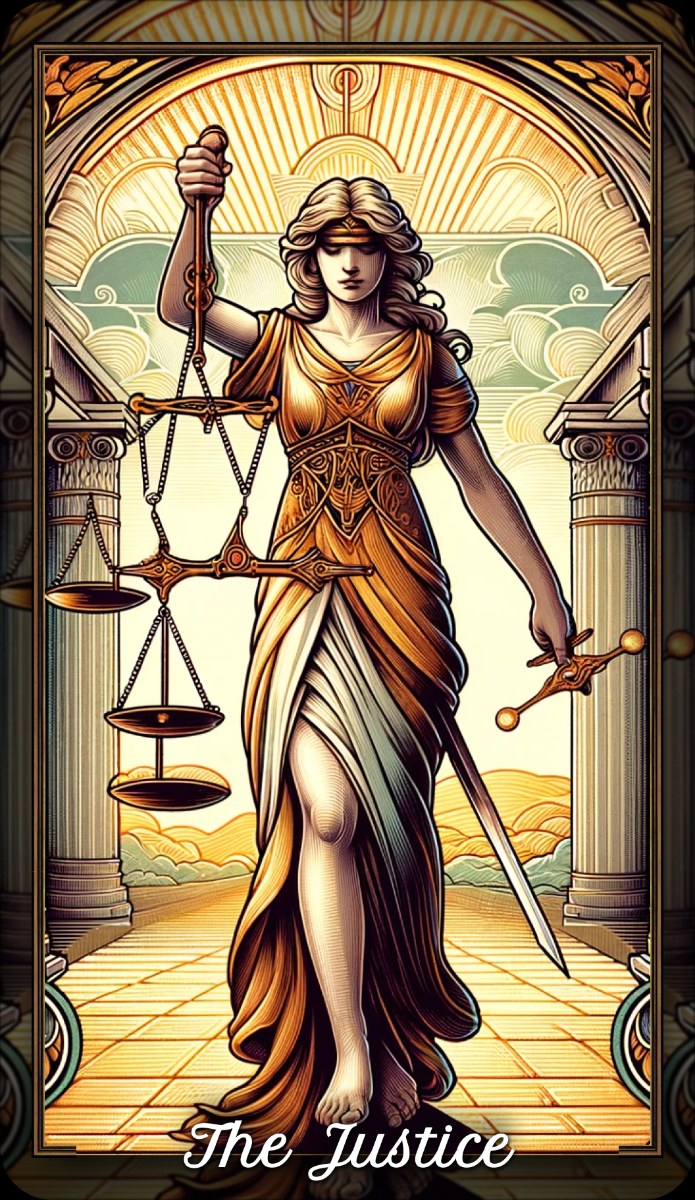
Justice usually gets flattened into "karma is coming," as if the universe were about to deliver a verdict on your behalf. The card is more exacting than that. It isn't about cosmic payback, it's about cause and effect made visible: the honest accounting of what your choices actually set in motion, and the discipline of weighing a situation clearly instead of through the story you'd prefer to tell about it. Justice doesn't punish. It measures.
Last updated: September 2026
Key Takeaways
- Justice represents fairness, cause and effect, and clear-eyed decision-making. It asks you to see a situation as it actually is, not as you wish it were.
- Upright, it signals a fair outcome, accountability, and a decision made with clarity. Reversed, it points to bias, avoided consequences, or a situation that hasn't been dealt with honestly.
- It is an honest, conditional yes. The answer favors whichever side of the situation is actually true, not whichever side you're rooting for.
Justice At a Glance
| Attribute | Detail |
|---|---|
| Number | XI (11) in Rider-Waite-Smith; VIII (8) in Marseille-based decks, where it is swapped with Strength |
| Arcana | Major Arcana |
| Element | Air |
| Ruling Planet | Venus (in the standard attribution, through the sign it corresponds to) |
| Zodiac Link | Libra, a well-established correspondence in the standard attribution. Libra's own symbol is a set of scales, making this one of the clearest and least contested zodiac links in the entire deck. |
| Numerology | 11: balance, truth, accountability, a higher form of judgment |
| Upright Keywords | Fairness, truth, accountability, cause and effect, clarity, balance, legal matters |
| Reversed Keywords | Unfairness, bias, avoided consequences, dishonesty, an unresolved situation, imbalance |
Justice Numerology
Eleven is a master number in many numerological systems, carrying the weight of one plus one, a doubled will pointed toward higher awareness rather than personal gain. It follows the Wheel of Fortune's ten, where cycles turn regardless of intent, and Justice answers that with a demand for accountability: whatever the wheel brought you, what did your own choices contribute, and what do you owe as a result?
Eleven shares its root with Strength (8, through digit reduction) and the four elevens implied across the minor arcana's court and pip structure. The connection to Strength is not incidental. In Marseille decks, the two cards are numbered eight and eleven in reverse of the Rider-Waite-Smith order, and both cards, regardless of number, deal with a form of internal or external reckoning that requires clear, steady judgment.
Justice Symbolism
A robed figure sits on a stone throne between two grey pillars, echoing the High Priestess's seat but with a very different purpose. In one hand the figure holds an upright sword, pointed straight up, representing clear-cut, decisive thought unclouded by sentiment. In the other hand rests a set of scales, held level, representing the careful weighing of evidence, consequence, and fairness before any conclusion is reached.
The figure's face is calm and direct, without a blindfold in this deck's version, a deliberate choice that suggests judgment here is made with eyes open, seeing the situation clearly rather than pretending not to know the people or context involved. A square-shaped clasp sits at the figure's throat, a symbol of grounded, structured thought, and a purple cloth drapes behind the throne, a color long associated with authority and higher judgment.
Everything about the composition emphasizes balance: two pillars, two scale pans, the upright sword bisecting the frame symmetrically. Nothing tips one way without reason. The card is a portrait of judgment exercised with full awareness, not blind faith that fairness will simply sort itself out.
The Justice Upright Meaning
Upright, Justice says a fair reckoning is underway, or needs to be. This can mean an actual legal or formal matter, a decision that needs to be made with real objectivity, or simply a moment where the consequences of past choices are becoming clear and need to be faced honestly. The card asks you to look at the situation without the spin, whether that spin is self-flattering or self-punishing, and to weigh what's actually there.
The deeper truth is that Justice isn't concerned with intentions, only with what actually happened and what it produced. This can be uncomfortable, since it means owning outcomes you might prefer to explain away. It can also be a relief, since a fair accounting often resolves ambiguity that's been dragging on. This card frequently marks a moment where truth becomes unavoidable, where fairness, however delayed, finally catches up with a situation.
The Justice Reversed Meaning
Reversed, Justice splits into two distinct problems. The first is unfairness, meaning a situation where bias, dishonesty, or an uneven process is distorting a fair outcome. This can describe an unjust system, someone else's dishonest account of events, or your own tendency to judge a situation through a distorted lens, whether that's self-interest, grudge, or wishful thinking.
The second is avoided accountability. Here the reckoning is being dodged rather than faced, whether that's a consequence you're trying to outrun, a decision you're refusing to make clearly, or a debt, literal or figurative, left unpaid. This version often shows up as a situation that stays unresolved precisely because someone, possibly you, won't look at it honestly. In both cases, the remedy is the same discipline the upright card asks for: set the story aside and look at what's actually true, even when that's the harder read.
Justice in Love
Upright in Love
Single: This card favors clear-eyed honesty about your own patterns, including where past relationships genuinely went wrong versus where you've been telling yourself a more flattering version. It supports making dating decisions based on evidence, such as how someone actually treats you, rather than potential you're hoping they'll grow into. Fair, balanced give-and-take is what you should be looking for and offering.
New relationship: This suggests a connection built on honesty and fairness from the start, where both people are being upfront about intentions and treating each other as equals. It's a good sign if both sides are contributing evenly, whether that's effort, communication, or vulnerability. Watch for a lopsided dynamic forming early, since this card asks you to notice imbalance before it calcifies.
Existing partnership: This card often points to a relationship working through something that requires real fairness, whether that's dividing responsibilities more evenly, resolving a disagreement honestly, or facing a consequence from past choices together. It favors clear, direct conversation over avoidance. A relationship that's been out of balance has a genuine chance to correct itself now, provided both people are willing to look honestly at their part.
An ex: This card suggests a clear-eyed, honest accounting of what actually happened, without the more flattering or more damning version either of you may have told yourself since. It can indicate closure arriving through genuine clarity rather than lingering ambiguity. If there's a consequence still outstanding, such as an apology owed or a truth left unspoken, this is a card that favors settling it rather than carrying it forward.
Reversed in Love
Single: You may be judging your own dating patterns unfairly, either too harshly or with too much self-serving excuse-making. It can also point to consistently ending up with partners who treat you unevenly, which is worth examining honestly rather than attributing to bad luck. Look at where the imbalance actually starts.
New relationship: Watch for dishonesty, whether that's someone misrepresenting their intentions, availability, or history, or an imbalance where one person is investing far more than the other. It can also mean you're not seeing the situation clearly yet, letting hope distort what the evidence actually shows. Be willing to look at the facts rather than the story you'd prefer.
Existing partnership: An imbalance may have taken root, whether that's unequal effort, unresolved resentment, or a pattern where consequences keep getting avoided rather than addressed. Dishonesty, even small omissions, can also be eroding trust. This reversal often calls for an honest, uncomfortable conversation that's been put off for too long.
An ex: You may be holding onto a version of events that isn't entirely accurate, whether that casts you as more wronged or more at fault than the full picture actually supports. Unresolved resentment or an avoided accountability, on either side, can keep this chapter from properly closing. A more honest look at what actually happened tends to be the only real way through.
Justice for Career & Money
Upright for Career & Money
This card favors situations involving contracts, negotiations, legal matters, or any decision that benefits from objective, careful evaluation rather than instinct alone. It can point to a fair outcome in a dispute, a promotion or recognition that's genuinely earned, or accountability finally catching up with past effort in a good way. Financially, it favors careful, honest bookkeeping, fair agreements, and decisions based on clear evidence rather than optimism. This is a strong card for anything requiring balanced, well-documented judgment.
Reversed for Career & Money
Reversed, the card flags unfair treatment at work, a biased process, or a legal or contractual matter that isn't being handled honestly. It can also point to your own avoided responsibility, such as a mistake not owned or a debt not addressed. Financially, it warns against dishonest dealings, whether that's someone misrepresenting terms to you or your own bookkeeping being less than fully honest. Face the actual numbers and the actual facts before deciding anything.
Justice for Health & Spirituality
Upright: This card favors an honest, clear-eyed look at your actual health habits and their real consequences, rather than a more comfortable story about them. It supports balanced approaches, such as fair expectations of your body and consistency rather than extremes. Spiritually, it points to karma in its more precise sense, cause and effect, and to ethical living as a genuine spiritual practice rather than an abstract idea.
Reversed: Denial about a health pattern, or an unfair standard you're holding yourself to, can distort your actual wellbeing. Spiritually, the reversal can mean avoiding accountability for choices that have real consequences, or judging yourself unfairly harshly for things outside your control. Aim for an honest, balanced accounting rather than either extreme. Tarot is not a substitute for medical advice, so bring real health concerns to a qualified professional.
Is Justice a Yes or No?
An honest yes, if the facts support it.
Upright, Justice leans toward yes when the situation is examined fairly and the evidence genuinely supports it. Reversed, the answer becomes "not without an honest look first." Check for bias, avoided accountability, or a story that's more flattering than accurate.
Justice - Card Combinations
| Combination | What It Means |
|---|---|
| Justice + The Emperor | Fair, consistent authority. Rules applied evenly, with accountability that holds for everyone. |
| Justice + The Hanged Man | A necessary pause before judgment. Seeing the full picture from a different angle before deciding. |
| Justice + Ten of Swords | An ending brought on by an unavoidable reckoning. Consequences finally catching up in full. |
| Justice + The Wheel of Fortune | An outcome that feels earned. Circumstances turning in a way that genuinely reflects past choices. |
| Justice + Seven of Swords | A dishonesty about to be uncovered. Something hidden or unfair is being brought into full view. |
Something to Sit With
If I set aside the version of this story that makes me look best, what would an honest account actually say?
What consequence have I been avoiding, and what would it cost me to finally face it?
Frequently Asked Questions
What does Justice mean in tarot?
Justice represents fairness, cause and effect, and clear-eyed decision-making. It appears when a situation needs to be weighed honestly, without the more flattering or more self-punishing story getting in the way. Its core theme is accountability: seeing what your choices actually produced and responding to that reality.
Is Justice a good card to draw?
Generally yes, especially if you've been waiting for clarity or a fair resolution. It signals that truth and balance are coming into view. Its caution is that fairness applies to you too, and reversed, it warns about bias, dishonesty, or avoided accountability.
What does Justice reversed mean?
Reversed, it points to one of two problems. Either an unfair or biased situation is distorting a fair outcome, or accountability is being avoided, whether that's a consequence you're dodging or a truth you're not facing. Look honestly at which one applies before deciding what to do.
What is the opposite of Justice?
The Hanged Man is sometimes read as its counterpart, since Justice moves toward a decisive, clear judgment while the Hanged Man asks you to pause and see things from an entirely different angle before judging at all. Some readers also contrast it with The Moon, since Justice favors clarity and the Moon favors ambiguity and illusion.
What zodiac sign is Justice?
Justice is linked to Libra, a well-established correspondence in the standard attribution. Libra's own symbol is a set of scales, which makes this one of the clearest and least contested zodiac links anywhere in the tarot deck.
What is Justice's number and what does it mean in numerology?
In the Rider-Waite-Smith deck, Justice is number eleven, a master number tied to balance, truth, and a higher form of judgment. In Marseille-based decks it is numbered eight and swapped with Strength, a difference tied to differing esoteric traditions about the card sequence.
Why is Justice numbered differently in some decks?
The Rider-Waite-Smith deck, following the Golden Dawn tradition, places Justice at eleven and Strength at eight. Older Marseille-style decks reverse this, placing Strength at eleven and Justice at eight. Both orderings reflect genuine differences in esoteric reasoning about the cards' sequence, and neither is considered more correct than the other.
Does Justice mean legal matters?
Often, yes, and this is one of the more literal cards in the deck when it comes to formal legal situations, such as contracts, court proceedings, or negotiations. It doesn't guarantee a particular outcome, only that a fair, evidence-based process is at play. The surrounding cards usually clarify how a specific legal matter is likely to unfold.
Why doesn't the figure in Justice wear a blindfold?
Unlike many classical statues of justice, the Rider-Waite-Smith figure is shown with eyes open. This is a deliberate choice suggesting that fair judgment here comes from seeing a situation clearly and completely, not from pretending not to know the people or context involved. It frames fairness as full awareness rather than deliberate ignorance.
Explore This Card Further
Ready to see what Justice says about your own situation? Draw a free reading on Limansa. Limansa also publishes position-specific guides that cover how this card reads in different spreads and questions. Look for them under the tarot card meanings section as they are added.