
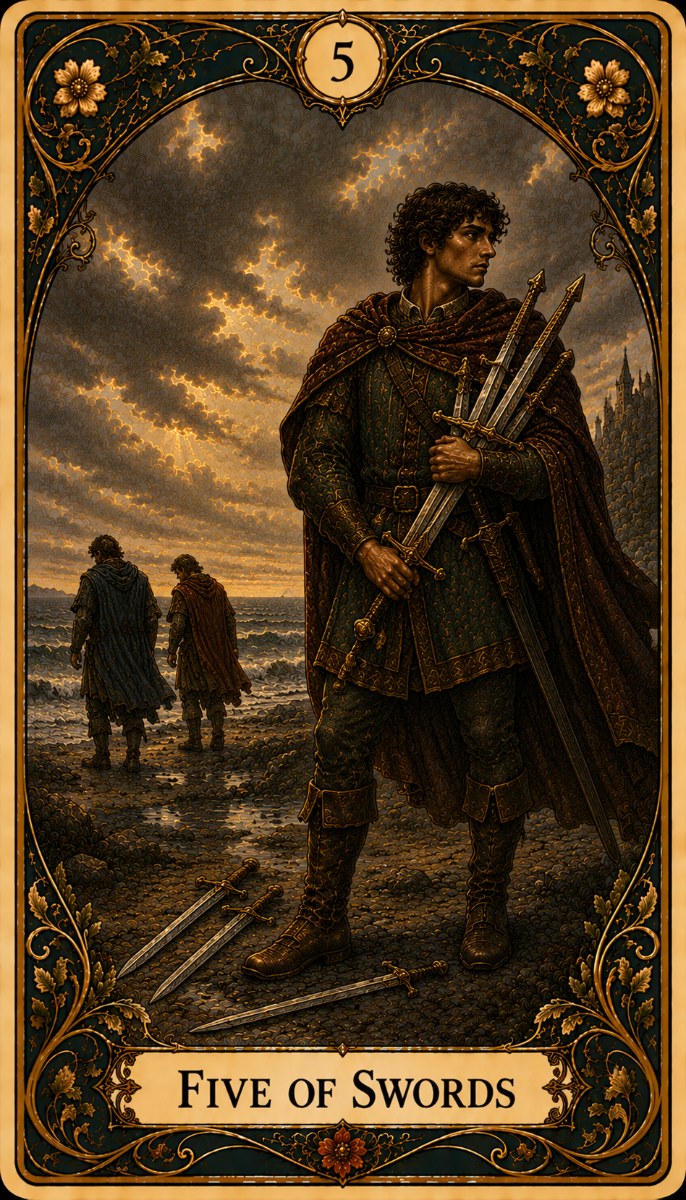
The Five of Swords is usually read as "you will be beaten" or "someone will cheat you." Look at the whole scene, though: one person collecting swords with a smirk, and two others walking away, defeated. The card shows every side of a fight that should not have been fought this way. Somebody won, but the win cost them everyone around them. Somebody lost, and is carrying that home. The real question of the Five of Swords is not "who wins?" It is whether being right, getting your way, or having the last word is worth what it is about to cost you, and whether walking away might be the stronger move.
Last updated: October 2026
Key Takeaways
- Upright, the Five of Swords signals conflict, hollow victories, winning at any cost, humiliation, and tension that damages relationships.
- Reversed, it splits two ways: making peace, with apology, reconciliation, and choosing to walk away from the fight, or escalation, with grudges, resentment, and conflict that keeps festering.
- You may be any figure in the card. It asks honestly whether you are the one gathering the swords, the one walking away, or the one deciding which to be.
Five of Swords At a Glance
| Attribute | Detail |
|---|---|
| Number | 5 |
| Arcana | Minor Arcana |
| Element | Air |
| Ruling Planet | Venus (Venus in Aquarius, in the Golden Dawn system) |
| Zodiac Link | Aquarius, specifically its first decan (roughly January 20 to January 29). The Golden Dawn calls this card the Lord of Defeat. Venus, the planet of harmony, sits uneasily in detached Aquarius, which suits a card about relationships damaged by conflict. |
| Numerology | 5: disruption, conflict, instability, and the breaking of an established balance |
| Upright Keywords | Conflict, hollow victory, winning at all costs, defeat, humiliation, tension, self-interest, betrayal |
| Reversed Keywords | Reconciliation, making amends, letting go, ending conflict, or lingering resentment, grudges, escalation, revenge |
Five of Swords Numerology
Five is the number of disruption. It breaks the stability of the four and introduces conflict, competition, and change. Across the tarot, the fives are the difficult cards of their suits. In the suit of Swords, which governs thought and communication, the five shows mental and verbal conflict turning ugly: arguments, power struggles, and words used as weapons. After the rest of the Four of Swords, the Five shows what happens when the swords are picked up again and the fight resumes, often with more damage than anyone intended.
Five of Swords Symbolism
In the Rider-Waite-Smith deck, a man stands in the foreground with a satisfied, almost smug expression. He holds three swords, two resting on his shoulder and one pointed toward the ground, while two more lie at his feet, abandoned. He has collected the weapons of the defeated, and he seems pleased with himself. But his victory looks lonely. No one is celebrating with him.
In the background, two figures walk away toward the water. One has his head bowed, perhaps with his face in his hands, suggesting shame, grief, or humiliation. The other turns away entirely. They have given up the fight, either because they lost or because they decided it was not worth continuing. Above them, the sky is filled with ragged, wind-torn clouds, a sign of turbulence and unease that the conflict has left behind. The water ahead of the departing figures hints at the emotional fallout that will follow them home. The card's composition captures the central truth of the Five of Swords: winning a conflict does not necessarily mean coming out ahead.
Five of Swords Upright Meaning
Upright, the Five of Swords describes conflict and its aftermath. It may point to an argument, a power struggle, a competition, or a situation where someone prioritises winning over fairness or relationships. It often describes hollow victories: you get what you wanted, but at the cost of trust, goodwill, or your own integrity. It can also describe being on the losing side, feeling humiliated, outmanoeuvred, or treated unfairly, and walking away hurt.
The card's deeper message concerns the price of conflict. The Five of Swords asks you to look honestly at your role. If you are the one gathering swords, consider whether winning this argument is worth damaging the relationship, and whether your methods are something you are proud of. If you are the one walking away, the card acknowledges the hurt, while also suggesting that leaving a fight you cannot win fairly is not weakness but self-respect. Sometimes the card advises choosing your battles carefully: not every disagreement needs to be won, and some cannot be won without becoming someone you do not want to be.
Five of Swords Reversed Meaning
The reversed Five of Swords splits into two distinct expressions, pointing to very different outcomes.
The first is making peace. The conflict is ending. People may be apologising, making amends, or deciding that continuing the fight is not worth it. You may realise you were wrong, or choose to let go of a grudge for your own peace of mind. It can also describe walking away from a toxic situation or relationship rather than continuing to fight within it. The reversed card in this form brings relief and the possibility of rebuilding, even if trust takes time to return.
The second is escalation. Here the conflict does not end; it festers. Resentment lingers, grudges harden, and old arguments keep resurfacing. There may be a desire for revenge, or a refusal to let go of being wronged. It can also show conflict going underground, with passive aggression, gossip, or quiet sabotage replacing open disagreement. In some readings, it describes ongoing humiliation or feeling unable to escape a situation where you keep losing. The card in this form asks what it would take to stop, and whether holding on is protecting you or keeping you hurt.
Five of Swords in Love
In love, the Five of Swords describes conflict that damages connection. It often points to arguments where winning matters more than understanding, power struggles, and hurtful words. Its central question is one many couples face: would you rather be right, or be close?
Upright in Love
Single: For someone single, the Five of Swords can reflect the aftermath of a bitter breakup, feeling hurt, betrayed, or defeated by how a past relationship ended. It may also describe dating experiences marked by games, manipulation, or people who seem more interested in winning than connecting. The card encourages you to walk away from anyone who treats love as a competition, and to notice whether you are carrying defensive habits from past hurts that make every new connection feel like a battle.
New relationship: In a new relationship, the Five of Swords can indicate early conflict, mind games, or a power imbalance. One person may be trying to control the dynamic, or arguments may already feel unexpectedly sharp. It can also point to dishonesty or someone acting in self-interest. The card asks you to pay attention to how disagreements are handled now, because how a couple fights early on often predicts how they will treat each other later.
Existing partnership: For an established couple, the Five of Swords often describes arguments where both people are trying to win, repeated fights over the same issues, or cruel words said in anger. There may be a power struggle, with one partner dominating or both keeping score. Even if one of you wins the argument, the relationship loses. The card encourages stepping back from the fight, listening rather than defending, and asking what you both actually need instead of who is right.
An ex: Around an ex, the upright Five of Swords frequently points to a bitter or contentious breakup: disputes over possessions, custody, or friends, hurtful accusations, or one person feeling they "lost" the relationship. It may also show ongoing conflict with an ex. The card advises choosing peace over victory where you can, and walking away from fights that only reopen wounds.
Reversed in Love
Single: Reversed, the Five of Swords for a single person often marks letting go of old resentment from a past relationship, finally moving past bitterness so you can love again. It may also show you recognising and leaving a pattern of toxic connections. In its other form, it can reflect lingering grudges or a defensive stance that keeps potential partners at a distance. Letting go of the need to be vindicated may be the step toward something new.
New relationship: In a new relationship, the reversed Five can indicate resolving an early conflict and learning to communicate more respectfully. It can also show one partner apologising and making amends. In its heavier form, it suggests unresolved tension, passive aggression, or a power struggle that continues beneath the surface. Address the dynamic directly before it becomes the foundation of the relationship.
Existing partnership: In a committed relationship, the reversed Five of Swords often signals reconciliation after conflict, with both partners deciding the relationship matters more than winning. Apologies, compromise, and renewed respect are possible. In its shadow form, it describes resentment that keeps resurfacing, unresolved arguments, or partners holding grudges. It may also indicate a decision to end a relationship that has become a constant battle. Either way, the card favours peace over endless conflict.
An ex: Reversed around an ex, the Five of Swords frequently shows conflict easing: a civil relationship forming, apologies being made, or both people deciding to stop fighting. In its other form, it warns against continuing to engage in old battles, seeking revenge, or holding onto bitterness. Letting go, even without an apology, can free you to move on.
Five of Swords for Career & Money
Upright for Career & Money
At work, the Five of Swords often points to workplace conflict, competition, office politics, or someone taking credit for your work. It may describe a colleague acting purely in self-interest, or a win that damages team relationships. The card advises choosing your battles carefully, protecting yourself from unfair tactics, and considering whether winning a particular dispute is worth the cost. Financially, it can warn of unfair dealings, disputes over money, or being taken advantage of in a negotiation.
Reversed for Career & Money
Reversed, the Five of Swords can indicate a workplace conflict being resolved, a fair compromise reached, or deciding to leave a toxic work environment. In its other form, it suggests lingering tension, resentment among colleagues, or a dispute that keeps escalating. Financially, it can point to resolving a money dispute or continuing conflict over finances. Seek fair solutions rather than total victory.
Five of Swords for Health & Spirituality
Upright: The Five of Swords can reflect how conflict and tension affect wellbeing, through stress, anger, or the exhaustion of constant disagreement. It encourages stepping away from draining battles to protect your energy. Spiritually, it asks you to examine your ego: where are you fighting to be right rather than to understand?
Reversed: Reversed, it may indicate stress easing as conflicts resolve, or lingering resentment continuing to affect your peace of mind. It suggests that forgiveness, even if only for your own sake, can be healing. Spiritually, it may call for humility and letting go of grudges. Tarot is not a substitute for medical advice, so bring real health concerns to a qualified professional.
Is Five of Swords a Yes or No?
A no, or at best a hollow yes that costs more than it gives.
Upright, the Five of Swords leans toward no, especially for questions about relationships and fair outcomes. If the answer is yes, it may come at the expense of trust, goodwill, or integrity. Reversed, it leans toward a cautious yes when it signals reconciliation and peace, and toward no when it points to continuing conflict or resentment.
Five of Swords - Card Combinations
| Combination | What It Means |
|---|---|
| Five of Swords + Seven of Swords | Deception, manipulation, and unfair tactics. Someone may be acting dishonestly to gain an advantage. |
| Five of Swords + Justice | A legal dispute or conflict where fairness needs to be restored. The outcome may depend on truth and accountability. |
| Five of Swords + Five of Wands | Intense competition and ongoing disputes. Many voices are fighting for control. |
| Five of Swords + Two of Cups | Reconciliation after conflict. Partners or friends choosing connection over being right. |
| Five of Swords + Ten of Swords | A painful defeat or ending. A conflict that has gone as far as it can, leaving the need to start over. |
Something to Sit With
If you won this argument completely, what would you have, and who would still be standing next to you?
What grudge are you still carrying, and is holding it protecting you or just keeping the fight alive?
Frequently Asked Questions
What does the Five of Swords mean?
The Five of Swords represents conflict, hollow victories, and winning at any cost. It shows the damage that arguments and power struggles can cause, and asks whether being right is worth what it costs.
Is the Five of Swords a bad card to draw?
It is a challenging card, pointing to conflict and tension. It is also a useful warning, helping you see where a fight may be causing more harm than good and when walking away might be wiser.
What does the Five of Swords reversed mean?
Reversed, the Five of Swords points either to making peace, through apologies, reconciliation, and letting go, or to escalation, with grudges, resentment, and conflict that continues to fester. Surrounding cards usually show which applies.
Am I the winner or the loser in the Five of Swords?
It depends on your situation. The card shows both the victor collecting swords and the defeated walking away. Readers often ask which figure you identify with, or whether you are being asked to choose between continuing a fight and leaving it behind.
What is the difference between the Five of Swords and the Seven of Swords?
The Five of Swords focuses on open conflict and its costs, winning at others' expense. The Seven of Swords focuses on deception and stealth, getting away with something quietly. One is a visible battle; the other is hidden strategy.
Does the Five of Swords mean betrayal?
It can. The card is associated with self-interest, unfair tactics, and people acting against others for their own gain. Alongside cards like the Seven of Swords or the Three of Swords, betrayal becomes a stronger theme.
What zodiac sign is the Five of Swords associated with?
In the Golden Dawn system, the Five of Swords corresponds to Venus in the first decan of Aquarius, roughly January 20 to January 29. Venus's longing for harmony sits uneasily in detached Aquarius, reflecting relationships strained by conflict.
What is the numerology of the Five of Swords?
Five represents disruption, conflict, and instability. In the mental suit of Swords, it describes arguments, power struggles, and verbal conflict that disturbs peace and damages relationships.
What does the Five of Swords mean for travel?
For travel, the Five of Swords can indicate disputes, such as disagreements with travel companions, problems with bookings or refunds, or being taken advantage of. It advises staying alert, keeping documentation, and choosing calm over confrontation.
Explore This Card Further
The Five of Swords can shift in meaning depending on its position in a spread and the question you bring to it. To see how it applies to your own situation, draw a free reading on Limansa. Position-specific guides covering the Five of Swords as feelings, as advice, as an outcome, and as a person explore those angles in more depth.