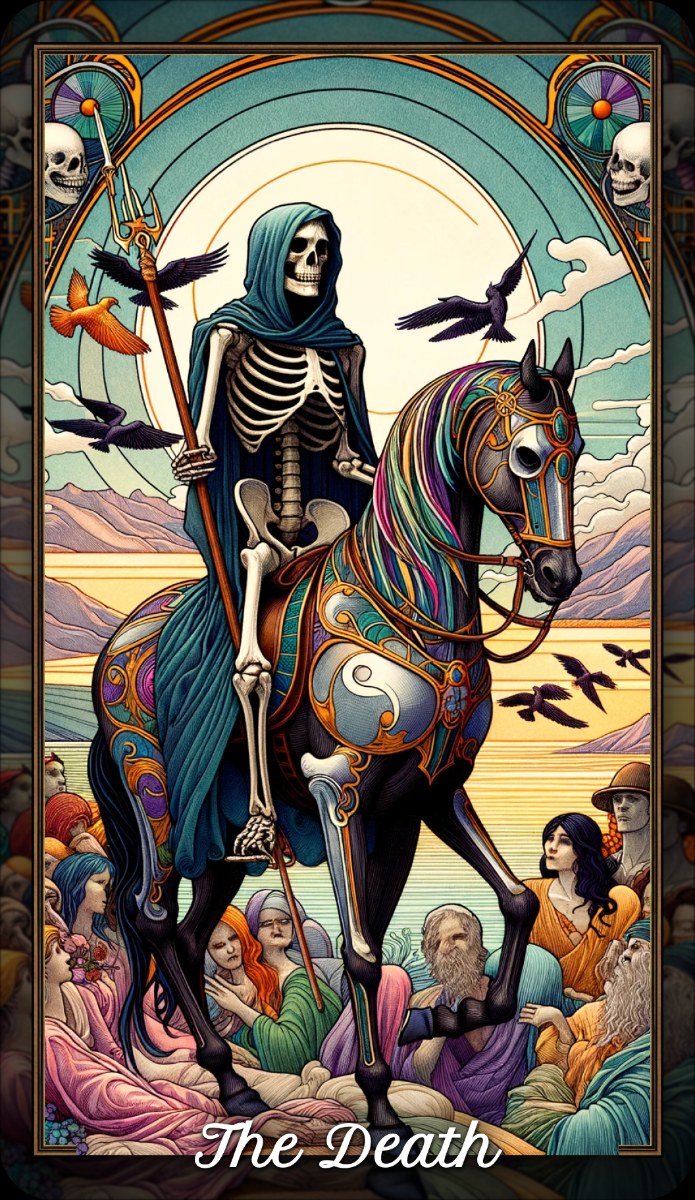
Death is the card everyone flinches at and almost nobody in tarot actually means literally, which is true but also a little too easy to say. The reassurance "it's not about dying, it's about change" gets repeated so often it stops meaning anything. What the card actually demands is more specific: the end of a chapter that has genuinely finished, whether or not you're ready to admit it has, and the refusal to keep something alive past its natural close just because letting it go is frightening.
Last updated: September 2026
Key Takeaways
- Death represents a genuine ending, transformation, and the clearing away of what has run its course. It is almost never a card about literal death.
- Upright, it signals a necessary and often clarifying ending that makes room for something new. Reversed, it points to resisting a change that needs to happen, or a slow, dragged-out ending instead of a clean one.
- It is a yes, but only to the ending itself. The card doesn't promise what comes next, only that this chapter is over.
Death At a Glance
| Attribute | Detail |
|---|---|
| Number | XIII (13) |
| Arcana | Major Arcana |
| Element | Water |
| Ruling Planet | Pluto (a modern attribution; the card predates the discovery of Pluto, so classical systems assign it to Scorpio directly rather than through a planet) |
| Zodiac Link | Scorpio, a well-established correspondence in the standard attribution. Scorpio's association with endings, transformation, and rebirth lines up directly with the card's themes. |
| Numerology | 13: transformation, an ending that clears the way, a threshold number long tied to upheaval |
| Upright Keywords | Endings, transformation, release, transition, closure, renewal, letting go |
| Reversed Keywords | Resistance to change, a stalled ending, fear of letting go, decay, stagnation |
Death Numerology
Thirteen has carried a reputation for upheaval across many cultures for centuries, and the tarot doesn't soften that. It follows the Hanged Man's twelve, where a deliberate pause opened up a new way of seeing, and thirteen delivers the consequence of that new sight: something that no longer fits has to go. The number sits just past twelve's sense of completion, forcing the cycle to break open rather than simply close.
Thirteen doesn't share a clean numerological kinship with another Major Arcana card through digit reduction in the way some neighboring numbers do (1+3=4, echoing the Emperor's structure), and some readers do link Death to the Emperor's four this way, framing Death as the harder, forced version of building something new from a cleared foundation. Whether or not that reduction feels meaningful to you, the card's own number has never needed rehabilitating. It's supposed to feel heavy.
Death Symbolism
A skeletal figure in black armor rides a white horse across a field, carrying a black flag marked with a white five-petaled rose, a symbol of transformation and new life growing directly out of what has ended. The armor suggests that this figure is unstoppable and impartial, not cruel but simply beyond negotiation. The white horse, traditionally associated with purity and a kind of grim clarity, moves forward without hesitation.
Around the rider, different figures respond differently to the same approaching force. A fallen king lies on the ground, his crown having offered no protection, a reminder that endings don't respect status or achievement. A child reaches toward the figure without fear, too young to have built the defenses adults rely on. A young woman turns away, unable to look, and a bishop or clergyman stands with hands folded, seemingly resigned or in prayer, perhaps the only one meeting the moment with something like acceptance.
In the distance, the sun rises between two towers, a detail many readers point to as proof the card is fundamentally about renewal rather than annihilation. Endings, the image insists, happen regardless of how anyone in the scene feels about them, and the sunrise waits patiently just past the immediate loss, visible to anyone willing to look up.
The Death Upright Meaning
Upright, Death says something in your life has genuinely ended, or needs to, and the healthiest response is to let it go cleanly rather than try to resuscitate it. This isn't usually about tragedy. More often it's about a relationship, a job, an identity, or a way of living that has quietly stopped serving you, and the card is naming what you may have already sensed: this particular chapter is over. Trying to keep it going past its natural close tends to cost more than the loss of ending it.
The deeper truth is that endings are what make room for anything new to actually take root. Nothing grows in soil that's already fully occupied. This card often shows up alongside real grief, even when the ending is objectively for the best, and it doesn't ask you to skip that grief or pretend the loss doesn't matter. It asks you to let the ending be complete, rather than dragging out a slow, half-finished version of it that leaves you stuck between two chapters instead of fully in either.
The Death Reversed Meaning
Reversed, Death splits into two distinct problems. The first is resistance to a change that clearly needs to happen. You may be clinging to a relationship, job, identity, or routine well past the point it was serving you, out of fear of what comes after or a refusal to accept that this particular thing is genuinely finished. This resistance rarely prevents the ending. It usually just makes it slower and more painful than it needed to be.
The second is a stalled or incomplete ending, something that has technically ended but hasn't been allowed to actually finish. This can look like an ex you haven't truly let go of, a job you've quit but still check in on, or a version of yourself you keep returning to even after outgrowing it. Decay belongs in this reversal too, a situation left to rot slowly instead of being cleanly closed. In both versions, the fix is the same difficult honesty the upright card asks for: acknowledge what has actually ended, and stop treating it as unfinished business.
Death in Love
Upright in Love
Single: This card often marks the genuine end of a pattern, such as a type of person you keep choosing or a version of dating that's run its course, rather than the end of a specific relationship. Letting that pattern die fully, instead of half-heartedly retiring it, tends to be what actually opens space for something different. It can feel like loss even when nothing concrete has changed yet.
New relationship: A significant, transformative shift may be underway, either in how you approach relationships generally or in what this specific connection is pushing you to release, such as an old fear, a defense mechanism, or an outdated expectation. The relationship itself may be catalyzing real change in you. This isn't usually a card of endings within a brand-new connection, more often it signals the death of an old pattern making room for this one.
Existing partnership: Something within the relationship, a dynamic, a role, a way you've been relating to each other, has genuinely run its course and needs to end so the relationship itself can evolve. This can be difficult but constructive, provided both people are willing to let the old version go rather than trying to preserve it. Occasionally this card does point to the relationship itself ending, and if that's what the surrounding cards support, it usually reflects something that had already been over for a while.
An ex: This relationship is genuinely over, and the card asks you to treat it as fully closed rather than a chapter you keep half-reopening. Any lingering hope for reconciliation likely needs to be released along with everything else. This can be a difficult message, but it also tends to bring real relief once the ending is actually allowed to be complete.
Reversed in Love
Single: You may be holding onto a pattern, a person, or a version of dating that's clearly finished, refusing to let it fully die because the alternative feels scarier than staying stuck. It can also point to going through the motions of dating without any real transformation happening underneath. Notice what you're protecting by not letting go.
New relationship: Old patterns or defenses may be resisting the change this connection is trying to bring about, keeping you half-guarded even as things develop. It can also describe a relationship that started before an old one was actually finished, leaving unresolved business bleeding into something new. Let the old chapter close fully before building on top of it.
Existing partnership: A relationship that has genuinely run its course may be being kept alive out of fear, obligation, or simple habit rather than anything that's actually working. This can also describe a slow, painful decline instead of a clean break, both people aware something is over but neither willing to say so. The card asks for honesty about whether this chapter has already ended in every way but the official one.
An ex: You may not have let this relationship fully die yet, whether that's checking their social media, keeping the door open, or holding onto hope for a return. The reversal suggests the lingering attachment is what's actually causing pain now, more than the original ending. A cleaner, more complete goodbye is likely overdue.
Death for Career & Money
Upright for Career & Money
This card often signals a genuine end to a job, project, or professional chapter that has run its course, and it favors a clean exit over trying to stretch out something that's clearly finished. It can point to a layoff, a resignation, or the natural conclusion of a role, and while the transition can be unsettling, the card frames it as necessary rather than punitive. Financially, it can mean the end of a particular income stream, budget, or financial habit, and it favors letting that version go fully rather than clinging to an approach that no longer fits your circumstances.
Reversed for Career & Money
Reversed, the card flags a job, business, or financial situation that's clearly over but being artificially kept alive, whether that's a role you should have left already or a financial habit you know isn't working. It can also point to a slow professional decline instead of a decisive change, dragging out a bad situation rather than ending it cleanly. Financially, it warns against propping up something that's fundamentally not viable anymore. Let it close so you can actually move past it.
Death for Health & Spirituality
Upright: This card often points to the end of an old habit, routine, or approach to your wellbeing that's no longer serving you, and it favors letting that version go fully rather than a partial reform. It can also mark a significant physical or lifestyle transition, such as recovering from an illness or finishing a demanding phase. Spiritually, it's one of the deck's clearest cards for genuine transformation, the kind that requires an old identity or belief to fully dissolve before something new can take its place.
Reversed: Clinging to unhealthy habits or an old version of yourself out of fear of change can keep you stuck in a pattern that isn't serving you. Spiritually, the reversal can mean resisting a transformation your own growth is clearly asking for, or staying attached to an old identity that no longer fits. Tarot is not a substitute for medical advice, so bring real health concerns to a qualified professional.
Is Death a Yes or No?
A yes to the ending, not necessarily to what comes after.
Upright, Death confirms that a chapter has genuinely closed, and the honest response is to let it. Reversed, the answer becomes "you're prolonging something already over." Whatever question you asked, the card is really answering a different one: this needs to end.
Death - Card Combinations
| Combination | What It Means |
|---|---|
| Death + The Tower | A double ending. One that was coming gradually, meeting one that arrives all at once. |
| Death + The Sun | An ending that clears the way for real joy. What follows the loss is genuinely brighter. |
| Death + Ten of Swords | A rock-bottom ending that has nowhere left to fall. The worst of it is finally, fully over. |
| Death + Four of Wands | An ending that opens into celebration. A closed chapter making room for a genuine milestone. |
| Death + Eight of Cups | A conscious, chosen departure. Walking away deliberately from something that's already over. |
Something to Sit With
What have I already sensed is over, that I'm still treating as unfinished?
What would I have to admit is true if I stopped trying to keep this particular chapter alive?
Frequently Asked Questions
What does Death mean in tarot?
Death represents a genuine ending, transformation, and the release of something that has run its course. It's almost never a card about literal death, and instead it points to relationships, identities, habits, or chapters of life that need to close so something new can take root. Its core theme is that clean endings, however painful, create real room for renewal.
Is Death a good card to draw?
It's one of the most misunderstood cards in the deck, but it's generally constructive rather than ominous. It signals necessary change and the relief that comes from finally letting go of something already finished. Reversed, it warns about resisting a change that needs to happen or dragging out an ending instead of allowing it to close cleanly.
What does Death reversed mean?
Reversed, it points to one of two problems. Either you're resisting a change that's clearly necessary, clinging to something out of fear rather than genuine attachment, or an ending has stalled halfway, technically over but not fully released. Look at what you're still holding onto that has already run its course.
What is the opposite of Death?
Temperance is often read as its counterpart, since Death is abrupt transformation through ending while Temperance is gradual transformation through blending and balance. Some readers also contrast it with The Sun, since Death clears something away while The Sun represents open, unguarded joy on the other side of difficulty.
What zodiac sign is Death?
Death is linked to Scorpio, a well-established correspondence in the standard attribution. Scorpio's deep association with endings, transformation, and rebirth lines up directly with the card's themes, making this one of the more confidently assigned zodiac links in the Major Arcana.
What is Death's number and what does it mean in numerology?
Death is number thirteen, a number long associated with upheaval and transformation across many cultures. In this deck, thirteen represents a forced ending, something that breaks a cycle open rather than gently completing it. It follows the Hanged Man's twelve, turning a new perspective into an actual, necessary change.
Does Death mean literal death?
Almost never. In the overwhelming majority of readings, this card refers to a symbolic ending, such as a relationship, job, identity, or habit that has run its course, not physical death. If a reading touches on serious health concerns or loss, that deserves care from a qualified professional rather than a card interpretation either way.
Does Death mean travel?
Rarely, and if it appears alongside travel-related cards, it's more likely to point to relocating away from a chapter that's ended, such as moving after a breakup or a job change, than travel for its own sake. The card's real focus is on what's being left behind rather than the destination.
Why is the sun rising between two towers in the Death card?
The distant sunrise is widely read as the card's clearest argument that this is fundamentally about renewal rather than destruction. It sits just past the immediate scene of loss, visible to anyone willing to look beyond the ending itself. The detail suggests that what comes after tends to be brighter, even when it isn't visible yet from inside the loss.
Explore This Card Further
Ready to see what Death says about your own situation? Draw a free reading on Limansa. Limansa also publishes position-specific guides that cover how this card reads in different spreads and questions. Look for them under the tarot card meanings section as they are added.