
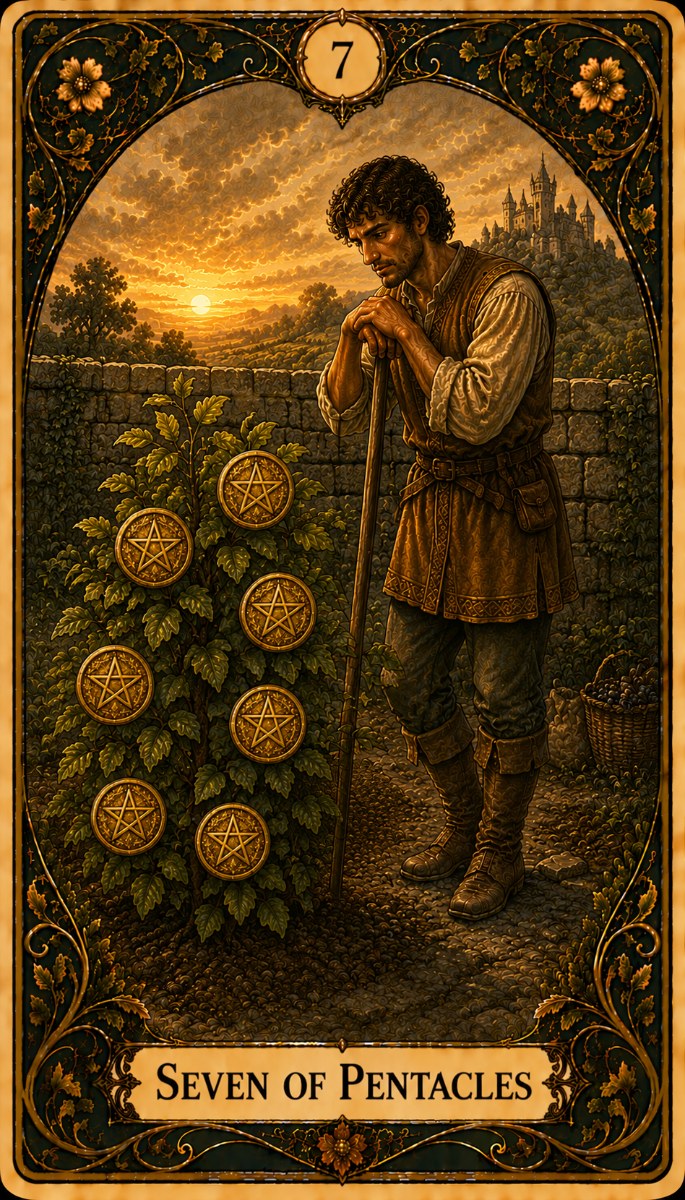
Seven of Pentacles yes or no is a maybe — but a specific, actionable maybe that's different from every other maybe in the deck. The card shows a figure leaning on his hoe, pausing mid-work to look at a vine heavy with pentacles: he has invested, growth has occurred, and now he's assessing whether the growth matches the investment before deciding whether to continue. The card hands you the same pause. It isn't withholding a yes or no out of vagueness — the answer lives inside the assessment, and the assessment is yours to make. What honest evaluation reveals about your specific question is where the yes or no actually lives, and that plays out differently for love, reconciliation, career, and money. all 78 cards yes or no guide
Does Seven of Pentacles Mean Yes or No?
For a general question, the Seven of Pentacles is a maybe that leans toward yes if the work has been consistent and the growth is real — and toward no if the investment has been high and the return hasn't matched it. In practical terms the card says: the situation is mid-development, not finished, and results are forming but not yet harvestable. If you asked "will this pay off," the card doesn't answer yes or no — it puts the vine in front of you and asks what you see. If the growth on the vine corresponds to what you've invested, yes is coming. If what you're looking at is sparse growth on heavy investment, the card is asking whether continued patience is wisdom or whether this particular vine isn't going to produce what was hoped.
The reasoning comes from the card's position in the Pentacles sequence. After the Three's collaborative building, the Four's security, the Five's hardship, and the Six's generous exchange, the Seven is the mid-story pause: the point where enough has been invested and enough time has passed that an honest assessment is possible. Sevens in tarot are cards of reflection and recalibration — the situation examined at the halfway point — and the Pentacles bring the material, practical dimension to that examination: what was the effort, what has grown, and what would continued investment actually produce? The card positions itself precisely at that calculation, and its maybe is the honest acknowledgment that the calculation gives different results in different situations. What it refuses to do is answer before the asker has looked at the vine.
On the yes-no-maybe spectrum, this sits at a genuine, active maybe — not the passive uncertainty of the Two of Swords or the forced suspension of the Hanged Man, but the live evaluation of a farmer who has the information to decide and is deciding. The card's yes is available: it's the yes that comes after honest assessment reveals that the growth matches the investment and continued patience is warranted. The card's no is also available: it's the no that comes after honest assessment reveals that the vine isn't producing in proportion to what's been put into it, and the energy is better redirected. Both are real answers. The card is asking you to do the looking first.
Six of Pentacles Yes or No: Yes — But Which Figure Are You?, Five of Pentacles Yes or No: A Hard No — For Now, Four of Pentacles Yes or No: Holding On Too Tight and Seven of Pentacles as How Someone Sees You: Weighing It
Seven of Pentacles Reversed — Yes or No?
Reversed, the Seven of Pentacles shifts to a warning that can land as either a no or a specific caution depending on which direction the reversal runs — and it runs in two distinct directions that matter differently. The first and more common: impatience that harvests too early. The fruit isn't ready but the waiting has become intolerable, so the decision gets made or the move gets executed before the conditions are right — and what's harvested is unripe, incomplete, not what the investment was building toward. If you asked "should I act now," reversed often answers: not yet, even though the waiting feels impossible.
The second reversal is harder to hear: futile investment. The vine has been tended carefully and honestly, the assessment has been done, and the growth isn't there — not because the timing is wrong but because this particular vine isn't going to produce. The effort has been real; the return isn't coming. The reversed card in this reading says stop putting energy here and redirect it somewhere it can actually grow. The practical distinction between the two: if you've been consistently investing for a reasonable period and honestly can't point to proportional growth, the reversal is probably the second reading, and the no it gives is the no of redirecting rather than waiting. If you've been investing and growth is visible but incomplete, the reversal is probably the first reading, and what's needed is to stay the course rather than force the harvest.
Seven of Pentacles Yes or No for Love and Relationships
For love, the Seven of Pentacles is a maybe with an honest and sometimes uncomfortable mechanism: it asks you to assess whether your emotional investment is producing proportional growth in the connection. This is the card that appears when someone has been putting consistent care, effort, and vulnerability into a relationship and is pausing — consciously or not — to ask whether it's growing. The card doesn't answer the question; it confirms the pause is the right move and puts the vine in front of you. What honest assessment of the relationship's growth reveals is the actual answer: if the connection has deepened in proportion to what you've given, the yes is real and patience continues to be warranted. If you've been investing heavily and the vine looks much the same as it did six months ago — same depth, same availability, same dynamic — the card is asking whether more patience is wisdom or whether the energy is better grown elsewhere.
Seven of Pentacles Yes or No: Reconciliation / Getting Back Together
For reconciliation, the Seven of Pentacles is a maybe built around an assessment of a specific and difficult question: was what was invested in this relationship before actually growing into something, or was it being consumed without producing? The card on a reconciliation question isn't asking whether the love was real — it's asking whether the relationship as a structure was generating growth from the investment both parties put in. That's a different and more useful question, because people can love each other genuinely while being in a relationship that isn't growing either of them.
The honest reading: a reconciliation this card supports is one entered after real assessment rather than after the pain of absence has made the past look better than it was. The figure in the image knows exactly what he invested and is looking at exactly what grew — not at what he hoped would grow, not at the best moments, but at the current state of the vine after honest tending. That's the evaluation a reconciliation question deserves. If the relationship was genuinely growing both people before it ended, and the conditions that stunted it have changed, the seven leans toward a considered yes. If the honest look at the vine shows that the investment was consistently higher on one side, or that the relationship was cycling rather than developing, the card is pointing at that pattern rather than endorsing the return to it.
Have this exact question? Will he want me back?
Seven of Pentacles Yes or No: Marriage or Commitment
For marriage, the Seven of Pentacles is a yes — specifically, a yes to commitment made after honest evaluation rather than from hope or momentum. This is the card that blesses the decision to commit when the assessment has been done: the relationship has been invested in, growth has been observed, and the choice to formalize the partnership comes from having looked at the vine and seen that it's genuinely producing. A Seven of Pentacles yes to marriage is one of the most grounded the deck offers, because it doesn't come from feeling swept along — it comes from a person who looked at what they've built and chose to keep building it.
The condition that defines the yes also points at its limit: commitment entered before the assessment is done — before enough time and investment have produced visible, verifiable growth — is what the card's maybe is about. The relationship may be wonderful and the person may be right; the Seven of Pentacles asks for the evidence to support that, not as a test of love but as a confirmation that the vine being formalized into a lifelong structure is actually the kind that produces. If you're trying to determine whether you've done that assessment honestly or are still in the hoping phase, a full love tarot reading can help separate the two.
Seven of Pentacles Yes or No for Career or Big Decisions
For career questions, the Seven of Pentacles is a yes to long-term investment and a no to shortcuts — and the distinction between them is the card's primary career contribution. Asked "will this pay off eventually," the card leans yes, provided the investment has been consistent and the growth, while slow, is real. It particularly favors careers and projects with long development curves: skills being built over years, businesses in their early stages, academic or professional credentials being earned rather than demonstrated. The figure in the image doesn't expect the vine to be full immediately; he tends it and waits, and the pentacles on it confirm the waiting is producing something.
The career assessment the card asks for is the same one it asks everywhere: look at the vine honestly. Is the skill you've been developing actually growing? Is the project showing the markers of progress you'd expect at this stage? Is the effort being invested producing proportional development, or has a lot of time and energy gone in without visible return? If the growth is real but slow, continue and trust the timeline. If the growth isn't there despite consistent effort, the card is raising the question of whether this particular path is the one that produces — and the seven's position in the suit means there's still time to redirect before the harvest question becomes urgent.
Seven of Pentacles Yes or No for Money
For money questions, the Seven of Pentacles is a yes to patient investment strategy and a specific answer to the timing question most financial draws involve: not yet, but building. Asked "will this investment pay off," "should I hold or sell," or "will my savings grow into what I need," the card answers yes to the long-term picture and asks for patience with the near-term one. This is the compound-growth card — the investment that requires time to mature, the savings plan that looks small in the short term and significant in the long one, the financial seed that needs another season before it becomes a harvest. The pentacles on the vine are already there; the question is whether to wait for them to ripen or to pick them now at less than their full value.
The card's specific financial instruction is also its most practical: don't make permanent decisions from the middle of a growth cycle. The figure isn't deciding whether to uproot the vine — he's assessing whether to continue tending it. Applied to money: don't liquidate a long-term investment because the short-term value isn't dramatic enough, don't abandon a savings plan because the balance feels small, don't redirect financial energy away from something growing because it isn't growing fast enough to be satisfying right now. The Seven of Pentacles is the card of investments that reward patience and punish impatience, and its yes to the financial question carries that timing as its primary condition.
Signs to Trust This Answer
- You're at a genuine crossroads about whether to continue — not at the beginning of something or at its end, but in the middle, wondering whether the investment so far warrants continued effort — because the Seven of Pentacles describes exactly this mid-point position, and drawing it there confirms the card is reading the actual moment.
- You can honestly assess the growth — you have enough information to compare what was invested to what has grown, even if the comparison is uncomfortable — because the card's assessment is only useful when there's real information to assess, and having that information confirms the card is arriving at the right time.
- The growth is visible but slow — something is happening, just not at the pace that feels satisfying — because this card specifically describes the phase where real development is occurring at a rate that tests patience, and recognizing that pattern confirms the continued-investment reading rather than the redirect reading.
- If you pulled more than one card, let the neighbors indicate the harvest's direction: a completion card (Ten of Pentacles, The World) says the investment matures into exactly what was hoped, a depletion card (Five of Pentacles, Eight of Swords) says the conditions around the investment are undermining its growth, while a decision card (The Lovers, Two of Swords) says the assessment moment has arrived and a choice is genuinely due.
- You've been avoiding the assessment — if part of you has been not-looking at the vine because the honest look might produce an uncomfortable result, that avoidance is the card's most accurate signal: it's appearing precisely to point at the assessment that hasn't been done yet.
Seven of Pentacles Yes or No — Card Combinations
If you drew more than one card, the card beside the Seven of Pentacles changes the strength or direction of the answer. Here are the most common combinations and what they indicate:
| Combination | What It Means for Your Yes or No Answer |
|---|---|
| Seven of Pentacles + Ten of Pentacles | Confirms the long-term yes in full. The patient investment matures into exactly the lasting abundance that the work was building toward — this pairing says stay the course, because the harvest is the kind that compounds rather than depletes, and the waiting period is the last one before it arrives. |
| Seven of Pentacles + Eight of Cups | Softens the yes into a considered maybe about walking away. The honest assessment of the vine has produced a difficult conclusion: the investment isn't growing the way that makes continued effort worthwhile, and the cards together say the next right move may be redirecting energy rather than continuing to tend what isn't producing. |
| Seven of Pentacles + Five of Pentacles | Flips the answer toward a no. The investment is happening in conditions of scarcity that are preventing the growth rather than nurturing it — this pairing says the vine can't produce in the current environment, and continued investment under these conditions compounds the depletion rather than building toward harvest. |
| Seven of Pentacles + The Wheel of Fortune | Yes, and the timing is about to shift — a turning-point condition. The patient investment meets an external change that accelerates the growth; what has been developing slowly is about to be catalyzed by circumstances outside anyone's control, and the harvest is closer than the current pace would suggest. |
| Seven of Pentacles + Three of Pentacles | A strong double-confirmation for career and project questions. Patient individual investment meets skilled collaborative effort — the work being done is both growing and being done correctly, and this pairing says the harvest isn't just coming but will reflect the quality of the work that produced it. |
This Does NOT Mean
The specific over-interpretation readers make with the Seven of Pentacles is treating "be patient" as the whole message — hearing the card's pause as an instruction to wait indefinitely without doing the assessment the pause is for. She draws the card on "will he come back" or "will this relationship work out," reads "patience, things are growing," and settles in for an undefined period of continued investment without checking whether the vine is actually producing. This is the most common misreading, and it's generated by the advice that tarot commentary defaults to for this card — "good things take time" — which is true and useless in equal measure, because good things take time and bad investments also take time, and the card's entire point is that the figure is looking at the vine to determine which one he has. The patience is not the message. The assessment is the message, and patience is warranted only after the assessment confirms there's something growing worth waiting for.
The second misreading goes the other direction: using the card's assessment quality as permission to give up whenever something isn't growing at the preferred pace. "I assessed it and it's not growing fast enough" can be an accurate reading of a genuinely unproductive situation, or it can be impatience performing as discernment. The card's reversed reading distinguishes the two: if real growth is visible but slow, the upright card asks for patience; if honest assessment finds no proportional growth despite consistent investment, the reversed card is the redirect. The correction for both misreadings is the same discipline the figure in the image is practicing — look at the actual vine, not at what was hoped for and not at what would justify the decision already made. The card's maybe is as reliable as the honesty of the assessment it's asking for, and no more so.
FAQ
What does Seven of Pentacles mean as a yes or no card?
The Seven of Pentacles means maybe — the most active and assessment-driven maybe in the deck. It signals a mid-development pause where real investment has been made and real growth is visible, but the harvest hasn't arrived and the question of whether to continue is live. The card's yes or no lives inside an honest evaluation of whether what's been invested is producing proportional growth — and it hands that evaluation to the asker rather than deciding for her.
Seven of Pentacles reversed yes or no?
Reversed, the answer shifts to a warning in one of two directions. The more common: impatience harvesting too early — acting before conditions are ready and getting an incomplete result. The harder: futile investment, where honest assessment reveals the vine isn't producing despite consistent effort and the energy is better redirected. The distinction between them is whether visible growth exists but feels slow, or whether visible growth is genuinely absent after a real investment period.
Seven of Pentacles yes or no for love?
Maybe — built around whether the emotional investment in the relationship is producing proportional growth. The card doesn't answer the love question; it confirms the assessment pause is right and puts the vine in front of you. Honest evaluation of whether the connection has deepened in proportion to what's been given is the real answer — and the card's yes or no follows from that honestly rather than from hope or from the fear of what the honest look might show.
Seven of Pentacles yes or no relationship / reconciliation?
Maybe — built around whether the relationship before the breakup was actually growing both people, or cycling. The card asks for honest assessment of the vine rather than nostalgic assessment of the best moments: what was the structure of the relationship producing, in proportion to what was invested? A reconciliation entered after that honest look is a different proposition from one entered because the absence has made the past look better than it was.
Does the Seven of Pentacles mean I should keep waiting or move on?
It means look at the vine before deciding either. "Keep waiting" and "move on" are both available answers — the card is the pause before the choice, not the choice itself. The practical instruction: assess honestly whether the growth you can currently see is proportional to what you've invested, and whether continued patience has a realistic basis in observable evidence. If the honest answer is yes, stay. If the honest answer is no, the card is giving you permission to redirect rather than requiring you to keep waiting for a harvest that isn't forming.
Related Readings
Draw your own card with the Yes or No Tarot tool, or if your question is really about the whole arc of what you're building rather than one assessment moment, start wider with a Free Tarot Reading.