
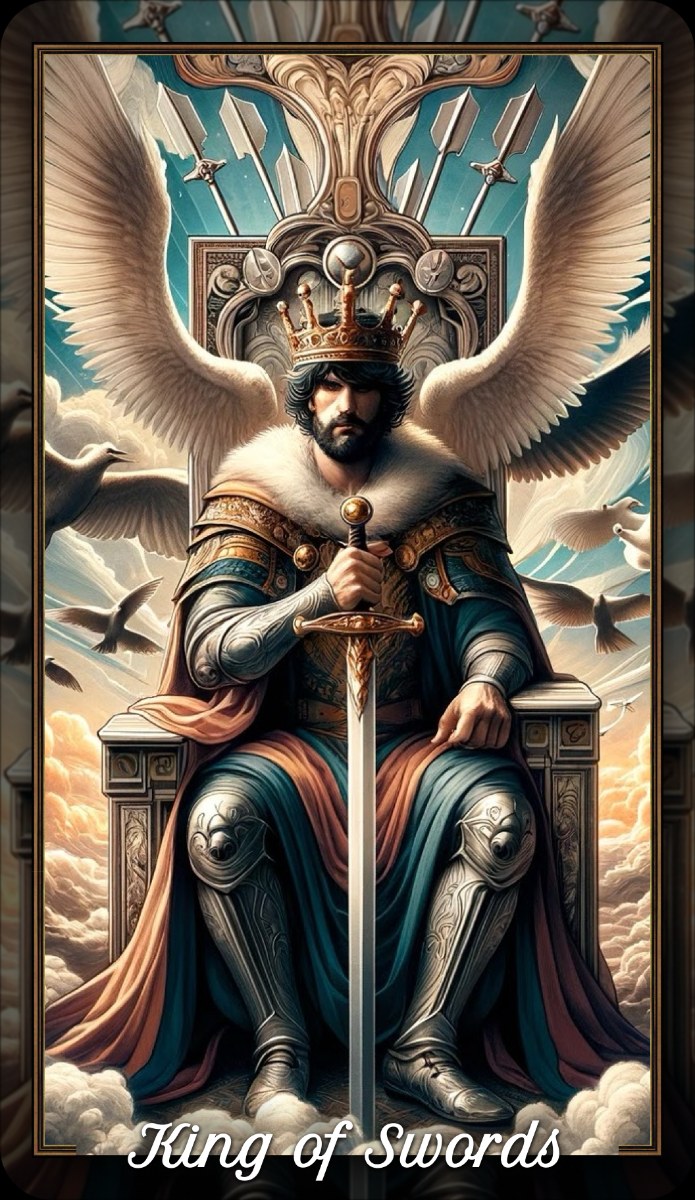
King of Swords yes or no is a yes — but a specific kind: a verdict, not a feeling. This is the deck's authority card, the figure who sits at the top of the Swords court having examined the situation in full and rendered a clear, considered judgment. The image shows it plainly: a king enthroned, sword pointed straight up, gaze direct and level — nothing wavering, nothing under review. That "decided and standing" quality is what makes this card's answer depend so much on context: for general and career questions it's a strong, reliable yes, and for love and reconciliation it describes a mind that has already concluded, which can cut in either direction. The sections below sort out which one applies to your question. browse yes or no tarot answers
Does King of Swords Mean Yes or No?
For a general question, the King of Swords is a yes — a verdict yes rather than a hopeful one. In practical terms the card says the situation has a correct answer, the correct answer is knowable, and the conditions to act on it are in place. If you asked "will this be resolved," yes — this card operates in the domain of resolution; things brought before the King of Swords get decided, not deferred. If you asked "is my judgment right," yes — the card confirms the sound call made from full information, the conclusion reached without sentiment clouding the process.
The reasoning sits in what kings represent and what Swords adds to the throne. Kings in tarot are the outward, established expression of their suit's mastery — where the Queen knows inwardly, the King acts publicly; where the Queen perceives, the King rules. Swords govern truth, the mind, and communication, so the King of Swords is truth wielded with authority: the expert, the judge, the person in the room who has earned the right to the final word through depth of understanding rather than rank alone. His yes carries that authority — it isn't optimistic, it isn't warm, and it doesn't require emotional buy-in from the person receiving it. It is simply the assessed and declared correct answer, delivered by someone who has been right enough times that the sword stays pointed up.
On the yes-no-maybe spectrum, this sits as a strong yes for questions about decisions, authority, expertise, legal or contractual matters, and clear calls being made — and a more context-dependent answer on love questions, where the card's authority can represent either a clear-eyed "yes, this is right" or an already-reached "no, I've concluded otherwise" — because the King of Swords doesn't leave questions open. Whatever he's decided about your situation, he's decided, and the yes-or-no of it depends on which way his verdict fell.
Queen of Swords Yes or No: A Yes That Sees Clearly, Knight of Swords Yes or No: Fast Yes, Check the Speed, Page of Swords Yes or No: Watching, Not Moving Yet and King of Swords as How Someone Sees You: Authoritative
King of Swords Reversed — Yes or No?
Reversed, the King of Swords flips to a no — and the reversal is the card's most serious, because it inverts the one thing that made the upright yes trustworthy: the integrity of the judgment. Where the upright King uses his authority in service of truth, reversed that authority serves itself — or serves something darker. Cold, rigid, and unmovable where the upright King is firm; manipulative where the upright King is direct; corrupt where the upright King is principled. The reversed King of Swords is the judge who has already decided before the evidence came in, the authority that punishes honesty and rewards compliance, the brilliant mind turned to control rather than clarity.
For a yes/no question, reversed answers no — and the no comes with a warning about whose judgment you're relying on. If the card describes a person in your situation, do not take their assessment at face value; the authority they're projecting isn't grounded in fair analysis. If the card describes your own thinking, check whether your conclusions are being reached from clear reasoning or from a position you've already decided to defend. Reversed also covers the specific failure mode of the King's character: cruelty performed as honesty — "I'm just being direct" as a cover for delivering hurt. The cut of truth and the cut of contempt feel identical in the moment and leave different marks afterward; the reversed card is the second kind.
King of Swords Yes or No for Love and Relationships
For love, the King of Swords is a maybe — and the maybe is generated by the card's primary characteristic in a romantic context: this person has already concluded. Unlike the Knight who is mid-charge, the Page who is still watching, and the Queen who perceives without announcing — the King of Swords has rendered his verdict on the relationship and filed it. That means the card's love answer depends entirely on which way the verdict went, and the honest truth is that the King of Swords' love verdicts tend to be demanding ones: he is a yes to connection that is intellectually honest, equally matched in intelligence, and capable of direct communication without performance — and a quiet, decided no to connections maintained by avoidance, pretense, or the hope that things will feel different eventually. Drawn on "does he feel something real," the card says yes, if the feeling has survived his own scrutiny — and this king's scrutiny is the thing most feelings don't survive intact, which is the honest note the love section has to carry.
King of Swords Yes or No: Reconciliation / Getting Back Together
For reconciliation, the King of Swords leans no — and the lean needs the same plain handling it got in the Queen's article, because the mechanism is different and more final. The Queen of Swords sees clearly but remains in a perceptive, open posture; the King has moved from perception to verdict. Drawn on "will he come back," this card most often describes someone who examined the relationship with his characteristic thoroughness, reached a conclusion, and proceeded to the next chapter — not with drama, not with a door slammed, but with the quiet finality of a file closed. The King of Swords doesn't leave cases open. If his conclusion was that the relationship had run its course, that conclusion tends to stand.
The honest exception, stated once and not inflated: the King of Swords can revise a verdict when presented with genuinely new information — evidence, not appeals to feeling. What won't move him is an emotional argument for why he should feel differently; what can, in principle, move him is a demonstrable change in the conditions he assessed. That's a narrow exception in practice, because genuine new information in relationship terms means changed behavior over meaningful time, not a changed conversation. And the secondary reading worth checking: this card sometimes represents not the ex but an authority figure in the situation — a parent who has weighed in, a mutual friend who has rendered judgment, a mediating influence. Identify which figure the King is in your actual situation before applying the verdict reading.
Have this exact question? Will we get back together?
King of Swords Yes or No: Marriage or Commitment
For marriage, the King of Swords is a yes — and a significant one, for the right question. This card is one of the deck's strongest commitment answers when commitment is being considered correctly: with full information, clear eyes, complete honesty about what's being chosen and what it will require. The King of Swords does not make promises lightly, and when he does, they hold — because his commitments are decisions rather than feelings, and decisions made from full understanding don't require the same maintenance that commitments made from hope do. If you asked "is this the right choice, truly" while genuinely able to hear the answer either way — the King says yes, and his yes on a marriage question is among the most durable verdicts in the deck.
The condition that defines the yes also defines its requirement: committed with full information means committed after the difficult conversations have happened, the non-negotiable things have been named, and the terms of the partnership have been made explicit rather than assumed. A King of Swords marriage built on clarity is built to last; a King of Swords marriage attempted before the honest accounting is done will eventually force that accounting at a higher cost. If what you're trying to assess is whether that honest accounting has actually happened yet in the relationship — whether you're seeing it clearly or still seeing it hopefully — a full love tarot reading can map the difference.
King of Swords Yes or No for Career or Big Decisions
For career questions, the King of Swords is the clearest yes in the Swords court — this is his native domain, the context in which everything the card embodies produces its best result. Asked "will the decision go in my favor," "is my professional read correct," "should I make the call I've been considering," the card answers yes with the weight of someone who has been right in this territory many times. He particularly favors questions involving expertise, authority, legal or contractual matters, high-stakes communication, and any situation where the correct answer exists and needs to be stated clearly over the comfortable one. He is also, frequently, the authority figure in your professional situation — the decision-maker above you, the person whose judgment will be applied — and in that reading the card says the decision gets made correctly and in good faith, which on a favorable question leans yes.
The calibration for decisions: the King's yes is to the correct call, and the correct call is the one that holds up to full scrutiny — not the one that feels safest, not the one that avoids conflict, not the one that keeps everyone comfortable. If the decision you're weighing would look sound on paper and in a year's time, this card backs it. If it looks sound only through the lens of what you'd like to be true, the King of Swords is not the card endorsing it — he's the one who would ask you to look again.
Signs to Trust This Answer
- The question you asked has a correct answer — not a preferred one, a correct one — because the King of Swords operates in the domain of decisions that can be assessed against reality, and his yes is most reliable when the question was about judgment rather than desire.
- An authority figure, expert, or decision-maker is involved in the situation — a boss, lawyer, mediator, or person whose professional assessment matters — because this card frequently marks their presence and their verdict, rather than the asker's own position.
- You've already done the analysis — reviewed the facts, considered the angles, checked the reasoning — and the card is confirming a conclusion you've earned rather than delivering one you haven't yet worked for; the King of Swords blesses prepared judgment, not wishful thinking.
- If you pulled more than one card, let the neighbors set the stakes and direction: a legal or formal card beside it (Justice, The Emperor) confirms an institutional or official resolution in your favor, while a conflict card (Five of Swords, Seven of Swords) says the verdict is correct but contested — someone isn't accepting it cleanly.
- The situation calls for directness rather than diplomacy — if the honest answer is the necessary one and you've been searching for a gentler framing, the King of Swords is the card telling you the honest answer is the framing, and the gentler version would be less kind in the long run.
King of Swords Yes or No — Card Combinations
If you drew more than one card, the card beside the King of Swords changes the strength or direction of the answer. Here are the most common combinations and what they indicate:
| Combination | What It Means for Your Yes or No Answer |
|---|---|
| King of Swords + Justice | Confirms and amplifies the yes to its maximum in formal or legal contexts. Both cards deal in correct verdicts and both cards hold — this pairing says the right outcome is delivered by the right authority, and appeals against it go nowhere. |
| King of Swords + Six of Cups | Softens the answer to a genuine maybe. The King's concluded judgment is being visited by genuine nostalgia and old warmth — the verdict isn't as final as it appeared, because something from the past is still capable of reaching it; this pairing keeps the door fractionally open where the King alone would have closed it. |
| King of Swords + The Tower | Flips the authority reading dramatically. The structure the King represents — the judgment, the institution, the decided arrangement — is about to be disrupted by something neither party controlled; the verdict gets overturned not by argument but by event. |
| King of Swords + The Hermit | Yes, but the verdict is still being formed — a timing condition. The King is in deliberation rather than declaration; the judgment is coming and it will be thorough, but it hasn't been rendered yet, and nothing moves until it has. Patience here isn't passive waiting — it's respecting a process that cannot be rushed. |
| King of Swords + Queen of Cups | A strong complementary pairing for love and relationship questions. Intellectual authority meets emotional depth — the two most different kinds of knowing in dialogue; this combination says the situation contains both a correct answer and genuine feeling, and navigating it well requires respecting both rather than letting one override the other. |
This Does NOT Mean
The specific over-interpretation readers make with the King of Swords is assuming the verdict is still open for appeal — that the right argument, the right emotional moment, the right set of words will change a King of Swords mind that has already concluded. The error is especially common on reconciliation questions: she draws the card, reads that it represents someone who decides from full information, and reasons that if she could just present new information — make him understand her better, show him what he's missing, reach him at the right moment — the verdict would change. The card's answer to that plan is the image itself: a king on a throne with a sword held straight and a gaze that isn't scanning the room for incoming appeals. King of Swords minds are changed by facts, rarely by feelings, and almost never by being told the conclusion was wrong.
The second misreading is conflating authority with correctness — hearing the King's yes as a guarantee that whatever authority is in your situation has gotten it right. Upright, the card warrants that faith; reversed, it explicitly withdraws it. The King of Swords only certifies sound judgment in his upright position, and the check before relying on any authority figure's verdict in your actual situation is whether the reversed reading applies: is this person deciding from clear analysis and good faith, or from a position already chosen? The card that represents fair judgment and the card that represents its corruption are the same figure at different orientations, and only one of them earns the trust the archetype is often given by default.
FAQ
What does King of Swords mean as a yes or no card?
The King of Swords means yes — a verdict yes, authoritative and already decided. As a yes/no card he confirms that the situation has a correct answer, the correct answer is knowable, and sound judgment applied to full information produces it. His yes is most reliable on questions about decisions, authority, and expertise — and most context-dependent on love questions, where the verdict he's rendered may have already gone either way.
King of Swords reversed yes or no?
Reversed, the answer flips to a no — the authority becomes corrupt or cruel. Sound judgment inverted into rigid control, a decision made from power rather than truth, or brilliance turned to manipulation rather than clarity. Don't take the reversed King's assessment at face value — whether he represents a person in your situation or your own current reasoning, the judgment isn't grounded in fair analysis and shouldn't be acted on as though it were.
King of Swords yes or no for love?
Maybe — the King has already concluded on the relationship, and the maybe is which way. He's a yes to connections that are intellectually honest, equally matched, and capable of direct communication without pretense — and a decided, quiet no to connections maintained by avoidance or hope. His love verdict tends to be the one most feelings don't survive intact, which is the honest thing to know before drawing him on a question about whether someone's feeling is real.
King of Swords yes or no relationship / reconciliation?
Leans no — this card most often describes someone who examined the relationship thoroughly, reached a conclusion, and proceeded to the next chapter. King of Swords verdicts don't typically stay open for appeal, and what can revise them is demonstrable changed circumstances over time — not an emotional argument for why the conclusion was wrong. Check also whether the King represents the ex or an authority figure in the situation; the answer shifts depending on which figure he actually is.
Does the King of Swords represent a specific person or my own thinking?
Both are live readings, and the fastest check is context. As a person: someone with authority, expertise, or a sharp, analytic mind who plays a significant role in your situation — a boss, lawyer, or partner who leads with intellect and holds to high standards. As your own thinking: your judgment is in King of Swords mode — thorough, decided, not easily moved — and the card is either endorsing that clarity or, reversed, flagging that the certainty has outrun its evidence. Notice which reading produces recognition on contact; that one is usually the accurate one.
Related Readings
Draw your own card with the Yes or No Tarot tool, or if you're working through a bigger decision than one card can hold, start wider with a Free Tarot Reading.